ObituaryMay 13, 2016
Marisol Escobar
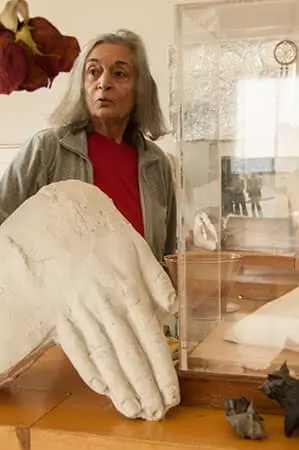
With Marisol Escobar ("Marisol"), who died on April 30th, we have lost one of the most singular and iconic sculptors of the Twentieth Century. A Venezuelan born in Paris, she had ties to the South American nation not only thanks to her father's heritage, but also for her having lived in Caracas as a child, after the death of her mother in 1941. At the same time, her work was the object of warm and sustained acclaim in the Venezuelan cultural scene, which proudly incorporated her as one of the country's most important artists. Escobar's education was vast and richly varied. She studied at such prestigious institutions as the École nationale superiéure des Beaux-Arts and the Académie Julian, both in Paris and the Art Student League and the New School for Social Research, in New York City. In the 1950s, Escobar began to develop her unique personal style by creating small terracotta figures arranged in boxes. Her long career as an exhibited artist began in those years at the Leo Castelli Gallery. Settling in New York in the 1960s, she was linked to the artists of the Pop Art movement due to the direct style of her works, which addressed the human figure via carved and painted wood blocks with various objects attached. Escobar's inclusion in Art of Assemblage, a 1961 exhibition at MoMA, inducted her into the New York scene and the international art circuit. Later, figures in Escobar's work became more abstract and geometric, and her compositions found inspiration in totems. Escobar's independent, ironic disposition drove her to combine diverse materials, techniques, and objects, and to turn assemblage into a language perfectly adjusted to her expressive intent. Her works began to be characterized not only by such complex multiplicity, but also by their unique spatial arrangements and the satirical tone with which they engaged their subject matter. In 1968, Escobar represented Venezuela at the 34th Venice Biennale, and during the early 1970s she was featured in important group shows in the UK, Japan, France, Germany, Italy, and the United States. Escobar's first solo exhibition in Venezuela was presented at Estudio Actual gallery in 1973. Over the course of that decade, she created important public-art works in Caracas, as well as her La reina Isabel ("Queen Elizabeth") for the city's Museo de Arte Contemporáneo. In the 1980s she continued to engage her recurrent themes of portraits—a vast series that included significant figures of international politics, art, and culture—and family groups. In 1984 she received Venezuela's National Fine Arts Award, and the following year the New York City Art Commission's Excellence in Drawing award. Several exhibitions of her work were presented in subsequent years; some highlights among them are her shows at the Contemporary Arts Museum in Houston (1977), the Smithsonian Institute (Washington, D.C., 1991), a traveling exhibition organized by New York's Marlborough Gallery (which went to several museums in Japan in 1995), and the Museo de Arte Contemporáneo in Caracas (1996). Marisol Escobar was able to express classical subjects from a novel perspective that capture and communicated the multifarious, complex visuality of the contemporary world. This is why her images have such a deep impact on our sensibility. Escobar possessed an exceptional sense of synthesis for figurative volumes and for the arrangement of masses in space, and, at the same time, of details as powerful containers of meaning. Those were the bases of her mastery in the creation of a deeply personal, unique body or work where the enigmatic, the ironic, and the imaginative combine in order to imbue that which is contingent with the enduring power of the eternal.&n...