ExhibitionDecember 13, 2022
Margarita Azurdia. Margarita Rita Rica Dinamita
The exhibition Margarita Azurdia. Margarita Rita Rica Dinamita is the first monographic exhibition in Europe dedicated to Azurdia (Antigua Guatemala, 1931 - Guatemala City, 1998). This exhibition, curated by Rossina Cazali, delves into her extensive oeuvre that includes painting, sculpture, and non-object art, as well as artist's books made of drawings, collages, and poems.
From a retrospective viewpoint, the exhibition provides an insight into Guatemala's panorama of modern and contemporary art. Inviting visitors to explore the creative metamorphosis undergone by the artist between the 1960 and the mid-1990s, something that is also reflected in the multiple changes of name under which she signs her works. Margarita Azurdia was Margot Fanjul when she was married; Anastasia Margarita when she was going through her most poetic and spiritual times, or she called herself Margarita Rita Rica Dinamita when she was already an artist of recognized trajectory in modern and contemporary art in Guatemala.
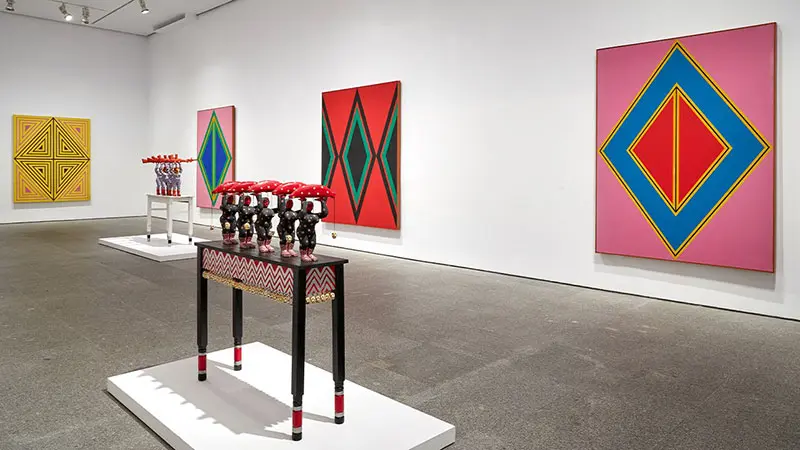
From the mid-1960s and the beginning of the following decade, Azurdia ventured into geometric forms inspired by the indigenous textile designs of Guatemala, which she applied mainly to painting. Her Geométricas series was exhibited at the Galería DS in Guatemala City in 1968. Two years later, the artist received an honorable mention at the X Biennial of São Paulo for her series Asta 104 (1969) – large sculptural paintings – as a question of the discipline.
Like other Latin American artists active at that time, and in line with formal and conceptual concerns at the international level, Azurdia was interested in actively integrating the public in her works. At the III Bienal de Arte Coltejer (1972), her mobile marble sculptures stood out for being subject to the pulsions of the spectators.
In 1974 Margarita Azurdia moved to Paris, where she began to attend circles of women artists who encouraged her to trace a before and after in her feminine and artistic conceptions. In addition to being absorbed by contemporary dance, she concentrated on writing and illustrating several of her artist's books. Upon her return to Guatemala in 1982, she met artists Benjamín Herrarte and Fernando Iturbide, with whom she formed an experimental dance group called Laboratorio de Creatividad. After its dissolution in 1985, Azurdia continued to explore the paradigm between art and spirit, giving workshops and deepening the ideas of care and healing linked to nature and the environment, reflected in the painting of the last years of her career.
If you want to learn more about Margarita Azurdia, find the article published in 2018 by Rosina Cazali
https://www.artnexus.com/en/magazines/article-magazine-artnexus/6042bb38d7dac6104e1b9ab2/110/margarita-azurdia
From a retrospective viewpoint, the exhibition provides an insight into Guatemala's panorama of modern and contemporary art. Inviting visitors to explore the creative metamorphosis undergone by the artist between the 1960 and the mid-1990s, something that is also reflected in the multiple changes of name under which she signs her works. Margarita Azurdia was Margot Fanjul when she was married; Anastasia Margarita when she was going through her most poetic and spiritual times, or she called herself Margarita Rita Rica Dinamita when she was already an artist of recognized trajectory in modern and contemporary art in Guatemala.
From the mid-1960s and the beginning of the following decade, Azurdia ventured into geometric forms inspired by the indigenous textile designs of Guatemala, which she applied mainly to painting. Her Geométricas series was exhibited at the Galería DS in Guatemala City in 1968. Two years later, the artist received an honorable mention at the X Biennial of São Paulo for her series Asta 104 (1969) – large sculptural paintings – as a question of the discipline.
Like other Latin American artists active at that time, and in line with formal and conceptual concerns at the international level, Azurdia was interested in actively integrating the public in her works. At the III Bienal de Arte Coltejer (1972), her mobile marble sculptures stood out for being subject to the pulsions of the spectators.
In 1974 Margarita Azurdia moved to Paris, where she began to attend circles of women artists who encouraged her to trace a before and after in her feminine and artistic conceptions. In addition to being absorbed by contemporary dance, she concentrated on writing and illustrating several of her artist's books. Upon her return to Guatemala in 1982, she met artists Benjamín Herrarte and Fernando Iturbide, with whom she formed an experimental dance group called Laboratorio de Creatividad. After its dissolution in 1985, Azurdia continued to explore the paradigm between art and spirit, giving workshops and deepening the ideas of care and healing linked to nature and the environment, reflected in the painting of the last years of her career.
If you want to learn more about Margarita Azurdia, find the article published in 2018 by Rosina Cazali
https://www.artnexus.com/en/magazines/article-magazine-artnexus/6042bb38d7dac6104e1b9ab2/110/margarita-azurdia
Gallery