ExhibitionNovember 7, 2022
Political/ Subjective Maps
The Institute for Studies on Latin American Art (ISLAA) announced the exhibition “Political/Subjective Maps: Anna Bella Geiger, Magali Lara, Lea Lublin, and Margarita Paksa,” on view from October 13, 2022, through February 24, 2023. Curated by Cecilia Fajardo-Hill, the show will bring together key works by Anna Bella Geiger (Brazilian, b. 1933), Magali Lara (Mexican, b. 1956), Lea Lublin (French Argentine, 1929– 1999), and Margarita Paksa (Argentine, 1933–2020). It will explore how these four visionary conceptual artists have appropriated the visual language of maps to highlight entrenched power structures; mine social, political, emotional, and personal subjects; and imagine new ways of apprehending the world.
Maps have an extensive legacy in Latin American art history—from Joaquín Torres-García’s América Invertida (1943) to Juan Downey’s Map of America (1975)—and have offered productive terrain for confronting the colonialist systems underpinning international dynamics. Whereas maps are often accepted as neutral, depoliticized, and scientific, artists have emphasized their origins as constructed and symbolic representations informed by their creators’ biased viewpoints and covert objectives.
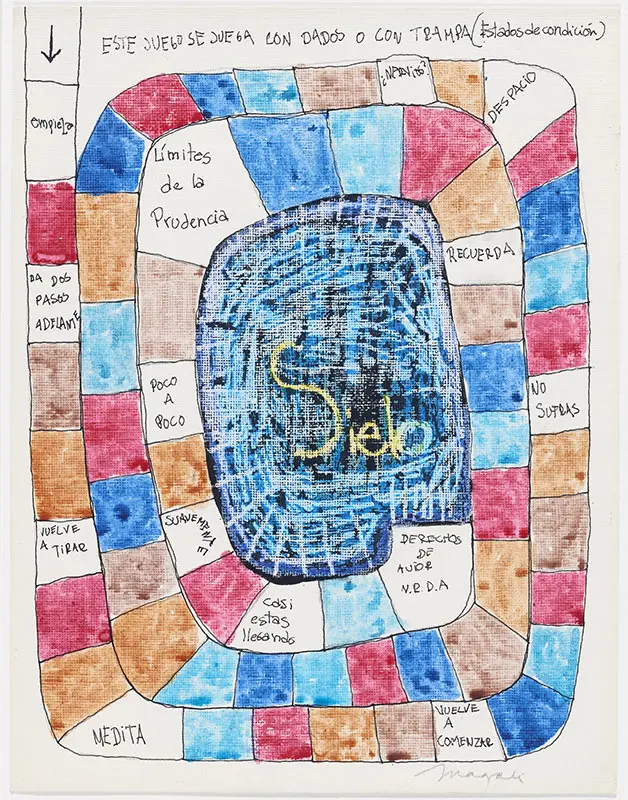
Geiger defies neocolonial categories in her reconceived maps, while Paksa examines histories of state violence in Uruguay and Argentina in series such as “Diagramas de batallas” (1975). In opposition to the scientific rationality of ordering systems such as charts and atlases, Lara addresses intimacy, emotion, and desire in her drawings and watercolors, whereas Lublin constructed interactive environments such as “Fluvio Subtunal” (1969) that sought to generate new, liberatory ways of experiencing art.
Thematically and spatially, the exhibition is divided into two broad topics and the body to the exterior domains of the public and the political. The first section explores the use of mapping as a means for producing a collective experience in Lublin’s work and concludes with Lara’s application of cartography to depict personal subjectivity and feminine identity. The second section considers representations of geopolitical dynamics in Geiger’s work and the politics of resistance and denunciation in Paksa’s practice.
“Political/Subjective Maps” is accompanied by a booklet featuring an essay by Cecilia Fajardo-Hill and designed by Ramón Tejada. Physical copies will be distributed free of charge at ISLAA, and a digital version is available to download at islaa.org
Maps have an extensive legacy in Latin American art history—from Joaquín Torres-García’s América Invertida (1943) to Juan Downey’s Map of America (1975)—and have offered productive terrain for confronting the colonialist systems underpinning international dynamics. Whereas maps are often accepted as neutral, depoliticized, and scientific, artists have emphasized their origins as constructed and symbolic representations informed by their creators’ biased viewpoints and covert objectives.
Geiger defies neocolonial categories in her reconceived maps, while Paksa examines histories of state violence in Uruguay and Argentina in series such as “Diagramas de batallas” (1975). In opposition to the scientific rationality of ordering systems such as charts and atlases, Lara addresses intimacy, emotion, and desire in her drawings and watercolors, whereas Lublin constructed interactive environments such as “Fluvio Subtunal” (1969) that sought to generate new, liberatory ways of experiencing art.
Thematically and spatially, the exhibition is divided into two broad topics and the body to the exterior domains of the public and the political. The first section explores the use of mapping as a means for producing a collective experience in Lublin’s work and concludes with Lara’s application of cartography to depict personal subjectivity and feminine identity. The second section considers representations of geopolitical dynamics in Geiger’s work and the politics of resistance and denunciation in Paksa’s practice.
“Political/Subjective Maps” is accompanied by a booklet featuring an essay by Cecilia Fajardo-Hill and designed by Ramón Tejada. Physical copies will be distributed free of charge at ISLAA, and a digital version is available to download at islaa.org