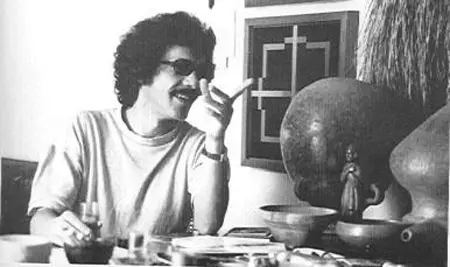
Manolo Vellojín
It is with great sadness that it was announced in recent days the death of Manolo Vellojín, a referent of geometric and abstract art in Colombia who approached religious themes with great passion, respect and innovation.
Vellojín was born in the city of Barranquilla and from an early age demonstrated a commitment to art. In 1968 he presented his first exhibition and became part of a generation of Colombian artists who manifested a tendency towards abstract and geometric art. Back then, Vellojín presented bicolor paintings on irregular canvases.
It is unquestionable that his Jesuit education influenced his life and by the 1970s his work began to demonstrate a preference for religious themes, as he would rely on the crusades, on rites and religious objects—scapulars and reliquaries—as source of inspiration. Thus, his paintings stand out for their highly symbolic and religious content, for a marked symmetry and a constant reflection centered on philosophical inquiries associated with life and death.
Besides his endeavor as a painter, Vellojín also created collages and assemblies in which he would use fabric or paper stripes linearly arranged on his canvases in order to divide symmetric horizontal or vertical spaces as he saturated the space and arrived to a cross-shaped composition where the colors gold, silver, black and red were frequently used to render liturgical atmospheres.
Manolo Vellojín knew how to successfully convey a singular vision in works that attempted to transcend the mere representation of religious rites. About this, he once said "I rescue the religious part since the theme has apparently been too much for philosophers, psychoanalysts, researchers and historians like Jung and Freud." Entitled Beatos (Blessed), the last exhibition by Vellojín was presented at the Galería Garcés Velásquez in Bogota, the city in which the artist lived most of his life and where he died on June 1.