ReviewNovember 13, 2020· By Carlos Jimenez
Lygia Clark, or Painting as Experimentation
It's the 100th anniversary of the birth of Brazilian artist Lygia Clark, and the Guggenheim Museum Bilbao organized a large tribute exhibition, focused on works from a little-known period in her career: the decade between 1948 and 1958. Her work from those years is overshadowed by the brilliance of her Neo-Concretist period, in the 1960s, when Clark, Hélio Oiticica, and others exploded the formalism tour court of Brazilian modern art of the prior decade with the powerful immersive experiences of their performances and installations. That formalism had also been theirs, as proven by the light this exhibition sheds on the years when Clark's painting took a turn away from figuration and towards geometric abstraction and constructivism. The São Paulo Biennial, first held in 1951, was a formidable echo chamber for these trends, and its 1953, 1955, and 1957 editions became a point of reference for them at the international level. Lygia Clark participated in those three editions.
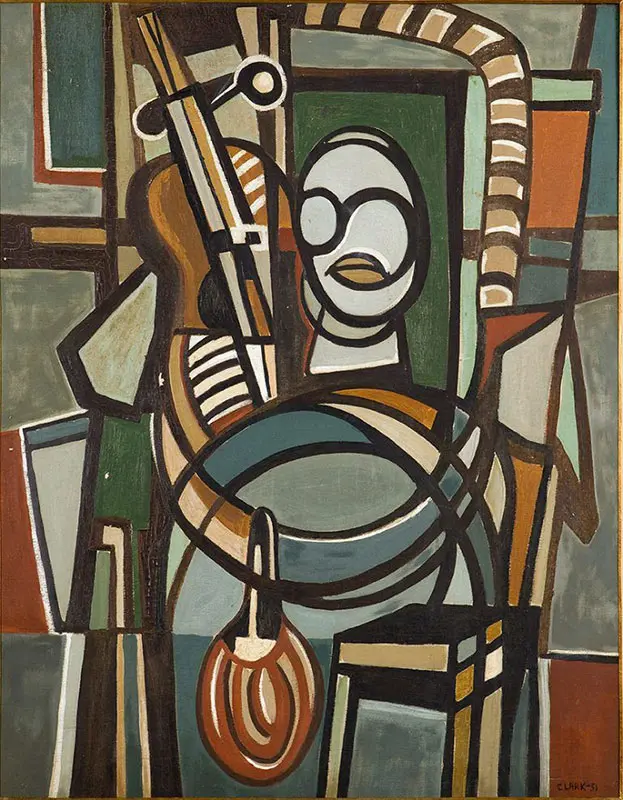
Geaninne Gutierrez–Guimaraes, adjunct curator at the Guggenheim NYC and the curator of this exhibition, organized the material in three sections: “The Early Years, 1948–1952;” “Geometric Abstraction, 1953–1956;” and “Variation of Form: Modulating Space, 1957–1958.” Presiding over the first section was Retrato da pianista Angélica de Rezende (Portrait of Pianist Angélica de Rezende), a fully figurative pastel-on-cardboard work from the late 1940s. O violoncelista (The Violoncellist), a medium-format oil-on-canvas work from 1951, notably influenced by Picasso and Léger, signals the break: the role of the figure has been reduced to just one more element in the complex architecture of the painting. Composição (Composition) and Escada (Staircase), both from 1951 also, go even farther in the same direction: the figure vanishes entirely, and the pictorial space is stressed to the extreme by an interplay of vertical and diagonal lines that seem to run over the boundaries of the frame.
Clark's 1953 Composição (Composition) provides a sharp contrast. This painting is in the in the second section, a period when Mondrian and Neoplasticism replace Léger and Lyonel Feininger as beacons or polestars. Balance and stability replace belligerence and dynamism, and the composition leans towards placidity. Shortly after painting it, Lygia Clark joined Grupo Frente, an artists' collective connected to the Rio de Janeiro scene that advocated geometric abstraction. The group included Aluísio Carvão, Willys de Castro, Hélio Oiticica, Lygia Pape, and Iván Serpa, and had its first exhibition in Rio in 1954. Tension reappears with greater sophistication in other canvases of the same period. In Descoberta da linha orgânica (Discovery of the Organic Line), from 1954, it results from a single diagonal line bursting into a well-balanced interplay of squares and rectangles in flat colors. In Composição 1 and Sem título (Untitled), both from 1954, tension is achieved through compositional asymmetry and a subtle superposition of color planes. Two Maquetes para interior (Maquettes for Interior) on exhibit in the same room, both from 1955, attested to Lygia Clark's interest in projecting painting beyond the parameters of the easel genre.
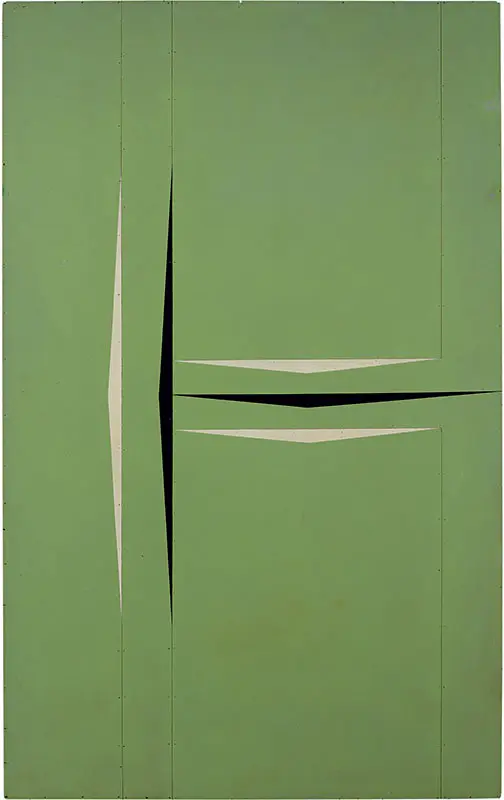
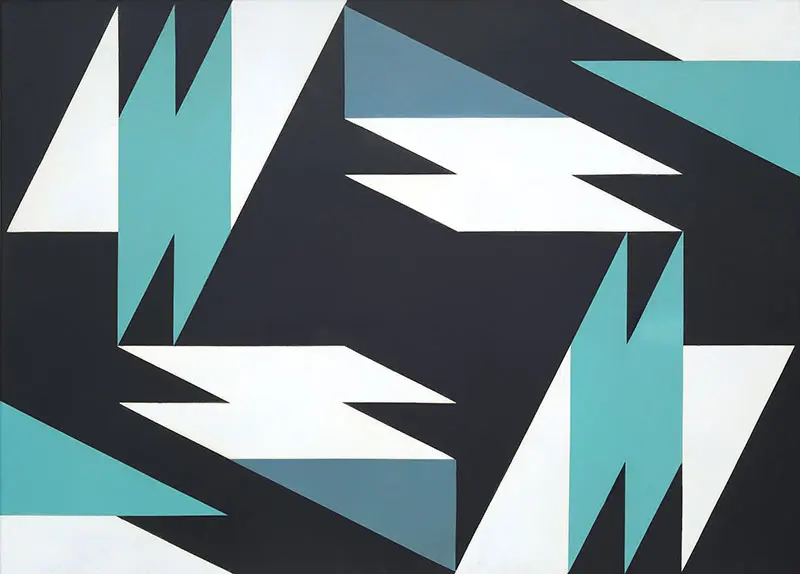
Closing the second section were several of Clark's "modulated surfaces", from 1955, that foreshadowed her characteristic work in subsequent years. Literally invaded by sharp, flat geometric shapes that connect at the corners or the vertices following a frenetic compositional logic, these paintings are intense, forceful, and assertive, clear precedents for the series of "modulated spaces" of 1957 and 1958. Both series revealed an artist in full mastery of her craft and proved that painting was indeed an "experimental field" for her, as she once put it in the title of a lecture, which the curator borrowed for this vastly well-deserved tribute and vindication of Clark's art. The exhibition illustrated Lygia Clark's versatility, the power of her experimental drive, her ability to be many artists at once, and the fecundity of a talent capable of unfolding in various directions, certain as she was of painting being a field for investigation. One that, as such, could be freed from the boundaries of the traditional frame to acquire volume, take over space, and generate or induce multisensorial, haptic experiences.
Lygia Clark. Painting as an experimental Field. 1948-1958. Guggenheim Bilbao. March 6 – October 25 2020.
Geaninne Gutierrez–Guimaraes, adjunct curator at the Guggenheim NYC and the curator of this exhibition, organized the material in three sections: “The Early Years, 1948–1952;” “Geometric Abstraction, 1953–1956;” and “Variation of Form: Modulating Space, 1957–1958.” Presiding over the first section was Retrato da pianista Angélica de Rezende (Portrait of Pianist Angélica de Rezende), a fully figurative pastel-on-cardboard work from the late 1940s. O violoncelista (The Violoncellist), a medium-format oil-on-canvas work from 1951, notably influenced by Picasso and Léger, signals the break: the role of the figure has been reduced to just one more element in the complex architecture of the painting. Composição (Composition) and Escada (Staircase), both from 1951 also, go even farther in the same direction: the figure vanishes entirely, and the pictorial space is stressed to the extreme by an interplay of vertical and diagonal lines that seem to run over the boundaries of the frame.
Clark's 1953 Composição (Composition) provides a sharp contrast. This painting is in the in the second section, a period when Mondrian and Neoplasticism replace Léger and Lyonel Feininger as beacons or polestars. Balance and stability replace belligerence and dynamism, and the composition leans towards placidity. Shortly after painting it, Lygia Clark joined Grupo Frente, an artists' collective connected to the Rio de Janeiro scene that advocated geometric abstraction. The group included Aluísio Carvão, Willys de Castro, Hélio Oiticica, Lygia Pape, and Iván Serpa, and had its first exhibition in Rio in 1954. Tension reappears with greater sophistication in other canvases of the same period. In Descoberta da linha orgânica (Discovery of the Organic Line), from 1954, it results from a single diagonal line bursting into a well-balanced interplay of squares and rectangles in flat colors. In Composição 1 and Sem título (Untitled), both from 1954, tension is achieved through compositional asymmetry and a subtle superposition of color planes. Two Maquetes para interior (Maquettes for Interior) on exhibit in the same room, both from 1955, attested to Lygia Clark's interest in projecting painting beyond the parameters of the easel genre.
Closing the second section were several of Clark's "modulated surfaces", from 1955, that foreshadowed her characteristic work in subsequent years. Literally invaded by sharp, flat geometric shapes that connect at the corners or the vertices following a frenetic compositional logic, these paintings are intense, forceful, and assertive, clear precedents for the series of "modulated spaces" of 1957 and 1958. Both series revealed an artist in full mastery of her craft and proved that painting was indeed an "experimental field" for her, as she once put it in the title of a lecture, which the curator borrowed for this vastly well-deserved tribute and vindication of Clark's art. The exhibition illustrated Lygia Clark's versatility, the power of her experimental drive, her ability to be many artists at once, and the fecundity of a talent capable of unfolding in various directions, certain as she was of painting being a field for investigation. One that, as such, could be freed from the boundaries of the traditional frame to acquire volume, take over space, and generate or induce multisensorial, haptic experiences.
Lygia Clark. Painting as an experimental Field. 1948-1958. Guggenheim Bilbao. March 6 – October 25 2020.
Gallery