ObituaryNovember 25, 2015
Luisa Richter
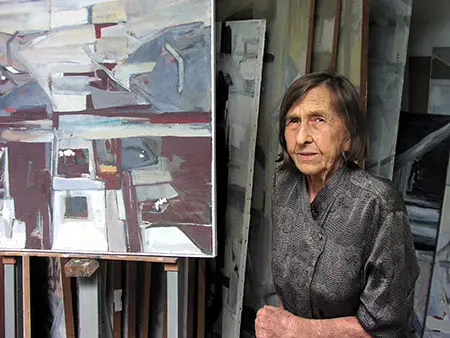
Luisa Richter died in Caracas on October 29th, and there can be no doubt that a masterful presence in Venezuelan art has been lost. Yet she leaves behind a complex body of work and a deep mark on her students, friends, and all who have conversed with her art. What is, then, that deep mark, Luisa Richter's incalculable contribution? Beyond the numerous exhibitions in which she participated and the many honors she received since 1958, when she began showing her art in Venezuela—barely three years after arriving in the country from her native Germany—Luisa was always there, present in her works. Transcending fashions, styles, and movements, her presence—her present—infused those works with a joint breath of art and life. Hers was a being there that meant belonging to the moment, to the times, in a personal, absolute, frank, open way, in sustained dialog and face to face with an artist's commitment to her craft, with the creative process, with thinking about art and the artist. It was a constant, passionate being there that colored every one of her intentions, writings, paintings, drawings, and collages, as well as her nearly 20-year career teaching of Composition, Analytical Design, and Painting at the Neumann Institute. Education, the permanent exchange with her students, was for Luisa Richter an essential component of her contribution to the society—Venezuela's—that nurtured and fostered her art, and which her art nourished in turn. Lucid: from light, brightness, radiance. From a body iridescent with reflected light, the clarity of her interrogations of art, presented in interviews and writings, both her own and by others. But also the clarity and luminosity of the atmosphere that constructed spaces in her paintings. Painting, her craft, a necessity that accompanied Richter throughout her life. Richter discovered the freedom of the brushstroke and the felicity of matter under the guidance of several teachers, particularly Willi Baumeister at the Advanced State Art School in Stuttgart, and with them she discovered also the possibility of abstraction. Once in Venezuela, she was seduced by the warm luminosity of nature and incorporated it into her paintings. In one of her texts—where she intervened old engineering plans by her husband, Hans Joachim Richter—the artist wrote that "What is visible are not images of objects, nor forms announced by the touch of light on things, but the very condition of luminosity, produced by light itself, which makes it possible for components or substances to remain. Radiance. Reflection. Glimpses." A few years back, in conversation with Richter as we prepared a show, the light that bathed the walls of her house in Caracas revealed for me a panting that, while always in front of my eyes, I hadn't noticed during my many visits. Startled, I asked her about what seemed to me more like an apparition. Luisa smiled, pleased: that is how images in her paintings were intended to be revealed, as light insufflated by means of contrasts between cold and warm colors, or of horizontal and vertical structures that in presence of the Sun—the background for her works—appeared as "a scale of dazzling whites," in Richter's words. Richter's work was, thus, in constant transformation, not only in its intrinsic condition as art and in its interaction with the viewer and the very timing of perception, but also because she understood her paintings, collages, and drawings as a body of works in progress, about which she reflected and continued to intervene over the years. Some of her drawings could be the basis for new collages, which in turn could be transformed by the stroke, by words, by pictorial splotches, experiments enhanced by her abundant readings of poetry ...