ExhibitionFebruary 12, 2020
Art Luchita Hurtado: I Live I Die I Will Reborn
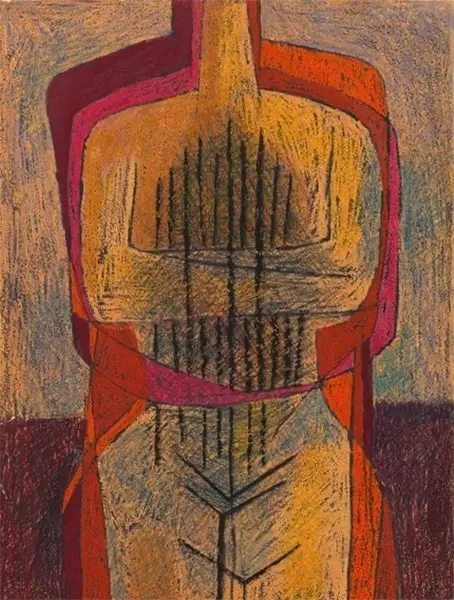
The first exhibition in the United States to showcase the eight-decade career of 99-year-old artist Luchita Hurtado (Venezuela, b. 1920). Prior to 2016, the breadth of Hurtado’s artistic practice was largely unknown, as her works were kept in storage and out of public view for most of her life. The exhibition, from February 16 to May 3, 2020, traces Hurtado’s forays into abstraction, experiments with language, engagements with nature and ecology, and, most significantly, her persistent recourse to self-portraiture and the human figure.
The exhibition, curated by Jennifer King, Associate Curator of Contemporary Projects was originated at the Serpentine Galleries (London), where it was curated by Hans Ulrich Obrist, Artistic Director, and Rebecca Lewin, Curator, Exhibitions and Design. Of note in the exhibition is Luchita Hurtado’s Untitled (c. 1951), a work in LACMA’s collection recently acquired during the 2019 Collectors Committee Weekend, a gift of LACMA trustee Janet Dreisen Rappaport.
Hurtado’s work is characterized by an original view of the world that is both grounded and transcendental, and her subject matter makes use of unexpected perspectives—looking straight down or across her own body, or straight up to a glimpse of sky—using cosmic motifs and geometric abstractions. To the artist, the human body is part of the world, not separate from nature. For Hurtado, the interconnectivity between human beings and the cosmos was heightened by seeing the first photographs of Earth from space in 1946, and her work since has continued to propose all life forms as part of a single, living entity.
Luchita Hurtado was born in Maiquetía, Venezuela, in 1920; she moved to New York in 1928. During her time in New York, Hurtado freelanced as a fashion illustrator for Condé Nast in New York, before relocating to Mexico City, where she joined a group of renowned artists and writers who had emigrated from Europe in the wake of the Spanish Civil War and the Second World War and who were working under the banners of Surrealism and Magical Realism. By the late 1940s, Hurtado had moved to Mill Valley, California, where she was closely associated with the Dynaton Group. In 1951 she moved to Los Angeles, where she resides to this day.
The exhibition is accompanied by the first monograph on Luchita Hurtado, edited by the Serpentine Galleries curators, Rebecca Lewin and Hans Ulrich Obrist, in collaboration with Ryan Good.
The exhibition, curated by Jennifer King, Associate Curator of Contemporary Projects was originated at the Serpentine Galleries (London), where it was curated by Hans Ulrich Obrist, Artistic Director, and Rebecca Lewin, Curator, Exhibitions and Design. Of note in the exhibition is Luchita Hurtado’s Untitled (c. 1951), a work in LACMA’s collection recently acquired during the 2019 Collectors Committee Weekend, a gift of LACMA trustee Janet Dreisen Rappaport.
Hurtado’s work is characterized by an original view of the world that is both grounded and transcendental, and her subject matter makes use of unexpected perspectives—looking straight down or across her own body, or straight up to a glimpse of sky—using cosmic motifs and geometric abstractions. To the artist, the human body is part of the world, not separate from nature. For Hurtado, the interconnectivity between human beings and the cosmos was heightened by seeing the first photographs of Earth from space in 1946, and her work since has continued to propose all life forms as part of a single, living entity.
Luchita Hurtado was born in Maiquetía, Venezuela, in 1920; she moved to New York in 1928. During her time in New York, Hurtado freelanced as a fashion illustrator for Condé Nast in New York, before relocating to Mexico City, where she joined a group of renowned artists and writers who had emigrated from Europe in the wake of the Spanish Civil War and the Second World War and who were working under the banners of Surrealism and Magical Realism. By the late 1940s, Hurtado had moved to Mill Valley, California, where she was closely associated with the Dynaton Group. In 1951 she moved to Los Angeles, where she resides to this day.
The exhibition is accompanied by the first monograph on Luchita Hurtado, edited by the Serpentine Galleries curators, Rebecca Lewin and Hans Ulrich Obrist, in collaboration with Ryan Good.