Book ReviewsMarch 10, 2023· By Ana Isabel Pérez Gavilán
Los Juanes antagonistas del cuerpo en diferencia en la ciudad de Monterrey década de los ochenta y noventa.
Discourses and discontinuities of the body/archive
Rocío Cárdenas Pacheco’s Los Juanes antagonistas del cuerpo en diferencia en la ciudad de Monterrey década de los ochenta y noventa (Los Juanes Antagonists of the Body in Difference in the City of Monterrey Decade of the Eighties and Nineties, 2021), published in Monterrey by Conarte NL and the independent house Tres Nubes, is the result of twelve years of labor, thought, approaches and discoveries of the kind that only a long-term process makes possible. It is situated, critical art history that resists the centralist tradition that has Neo-Mexicanist art as the protagonist of the 1980s, contrasts Monterrey’s business scene to Mexico City’s, and connects the beginnings of the performance art and other marginal practices by three homosexual artists living in northern Mexico to the work of other Latin American individuals and collectives.
Placed outside 1980s heteronormativity by their sexual preference in a conservative, dichotomous city like Monterrey, a city rife with frustration, indignation, repression, inadequacy and, at times, even silent complacency, those men ultimately expressed their isolation through a pained homoerotic creativity (“My body never came back and this is an absence I have no way of explaining,” says Juan José González in the book’s prologue), partially attested in the documents that Cárdenas—who holds a PhD in Social Sciences and Humanities—incorporated into a discontinuous archive of the three Juanes: Juan Alberto Pérez Ponce (1960-1994), Juan Caballero (1959-1998) and Juan José González (n. 1964). With the image of a typed sheet of paper (“This is a true story, so true that it bears no title”) and a video manuscript by González, the materiality of the archive acquires centrality in the book. The book design by Tres Nubes gives unity to those discontinuities, while providing a dutiful selection of images that accurately account for the phenomenon in question.
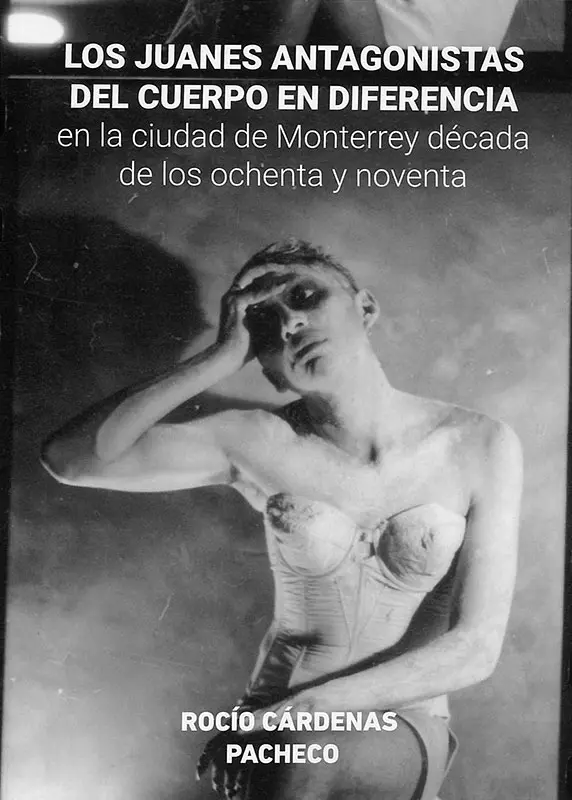
Cárdenas sets up a counterpoint between business policies in Monterrey—illustrated by the figure of the domesticated laborer—and the Juanes’ practices, first as students and later as instructors in the Visual Arts School at Universidad Autónoma de Nuevo León (UANL). The author problematizes the politics of representing the body and the historical dynamics that traverse it, especially the neo-capitalism that dominates Mexico’s “industrial capital” and the development of large-scale cultural projects (Macro Plaza, FEMSA Biennial, MARCO) between 1984 and 1994, the decade covered in her study. Painting, the axis of a thriving international market in Mexican art, pushed aside non-objectual practices; photographs, performances, and actions expressing any sexuality outside the heteronormative were censored and rendered invisible in University spaces as much as in the city as a whole. Many friends died in isolation, cast aside by society’s fear and repudiation in the context of the AIDS epidemic. “Juanjo”, as the author calls González, accompanied the research process, which explains his larger presence in the book, from the cover to the recovery of the memory of the other two, now absent Juanes (they were friends; Pérez Ponce was their teacher) in a city unencumbered “with exercises of remembrance” (p. 174).
Cárdenas announces her lines of inquiry: the policies that produce the archive, including censorship, invisibilization and discontinuity; the politics of body-gender-resistance (Foucault, Diéguez-Caballero); and the politics of art-historical discourse (Didi-Huberman). She provides detailed descriptions of some actions by the Juanes and runs them through the sieve of art criticism—still found in print media—to reveal how the writing of art is traversed by regulatory logics that normalize certain bodies and subjectivities.
As students and teachers at the UANL’s School of Visual Arts, the Juanes triggered a break with the previous generation. Their homosexual identity, however, prompted a historical silencing “produced by art’s legitimizing narrative frames” (p.24) in Monterrey, and their actions were censored and impeded by a public university.
The text appropriates the era’s slang, terms such as la loca, el torcido and el maricón, as a way of giving visibility to figures made marginal by the multiple exclusions of their sexuality, gender, race, and poverty. While distinguishing their practice from the Neo-Mexicanist mainstream, Cárdenas notes that their explorations were not altogether unrelated to its concern with identity and the open presentation of homosexuality. Ultimately, she situates those bodies in difference at a remove from queer theory, which is of more recent vintage and has gained narrative hegemony; it is a pertinent writing move in this context of resistance to the imposition of ways of being homosexual from positions of privilege (as in the case of Julio Galán).
By this route, their devices of resistance to the hegemonic discourses of the market, art history, and art criticism—in a context of normalized repression not only in Monterrey, but across Mexico and Latin America—bring Cárdenas to connect the work of the Juanes with South American experiences, and she finds coincidences with Peruvian artist Giuseppe Campuzano and the Chilean collective Las Yeguas del Apocalipsis.
In conclusion, this is a rigorous and demanding art history document, one that requires pause and patience from its readers as it unravels its knots. It is, without a doubt, required reading for any researcher in performance, art discourses, and gender perspectives in Latin America.
Ana Isabel Pérez-Gavilán Ávila, PhD
PhD in Art History by Binghampton University, New York. She coordinates the Master’s Program in Cultural Promotion and Development at the Center of Interdisciplinary Studies and Research, Universidad Autónoma de Coahuila, Saltillo, where she has taught since 2011. She has conducted research, documentation, and curatorial projects in Mexico City’s most important museums, and has published on colonial-era art in New Spain as well as modern and contemporary art in Mexico.
Rocío Cárdenas Pacheco’s Los Juanes antagonistas del cuerpo en diferencia en la ciudad de Monterrey década de los ochenta y noventa (Los Juanes Antagonists of the Body in Difference in the City of Monterrey Decade of the Eighties and Nineties, 2021), published in Monterrey by Conarte NL and the independent house Tres Nubes, is the result of twelve years of labor, thought, approaches and discoveries of the kind that only a long-term process makes possible. It is situated, critical art history that resists the centralist tradition that has Neo-Mexicanist art as the protagonist of the 1980s, contrasts Monterrey’s business scene to Mexico City’s, and connects the beginnings of the performance art and other marginal practices by three homosexual artists living in northern Mexico to the work of other Latin American individuals and collectives.
Placed outside 1980s heteronormativity by their sexual preference in a conservative, dichotomous city like Monterrey, a city rife with frustration, indignation, repression, inadequacy and, at times, even silent complacency, those men ultimately expressed their isolation through a pained homoerotic creativity (“My body never came back and this is an absence I have no way of explaining,” says Juan José González in the book’s prologue), partially attested in the documents that Cárdenas—who holds a PhD in Social Sciences and Humanities—incorporated into a discontinuous archive of the three Juanes: Juan Alberto Pérez Ponce (1960-1994), Juan Caballero (1959-1998) and Juan José González (n. 1964). With the image of a typed sheet of paper (“This is a true story, so true that it bears no title”) and a video manuscript by González, the materiality of the archive acquires centrality in the book. The book design by Tres Nubes gives unity to those discontinuities, while providing a dutiful selection of images that accurately account for the phenomenon in question.
Cárdenas sets up a counterpoint between business policies in Monterrey—illustrated by the figure of the domesticated laborer—and the Juanes’ practices, first as students and later as instructors in the Visual Arts School at Universidad Autónoma de Nuevo León (UANL). The author problematizes the politics of representing the body and the historical dynamics that traverse it, especially the neo-capitalism that dominates Mexico’s “industrial capital” and the development of large-scale cultural projects (Macro Plaza, FEMSA Biennial, MARCO) between 1984 and 1994, the decade covered in her study. Painting, the axis of a thriving international market in Mexican art, pushed aside non-objectual practices; photographs, performances, and actions expressing any sexuality outside the heteronormative were censored and rendered invisible in University spaces as much as in the city as a whole. Many friends died in isolation, cast aside by society’s fear and repudiation in the context of the AIDS epidemic. “Juanjo”, as the author calls González, accompanied the research process, which explains his larger presence in the book, from the cover to the recovery of the memory of the other two, now absent Juanes (they were friends; Pérez Ponce was their teacher) in a city unencumbered “with exercises of remembrance” (p. 174).
Cárdenas announces her lines of inquiry: the policies that produce the archive, including censorship, invisibilization and discontinuity; the politics of body-gender-resistance (Foucault, Diéguez-Caballero); and the politics of art-historical discourse (Didi-Huberman). She provides detailed descriptions of some actions by the Juanes and runs them through the sieve of art criticism—still found in print media—to reveal how the writing of art is traversed by regulatory logics that normalize certain bodies and subjectivities.
As students and teachers at the UANL’s School of Visual Arts, the Juanes triggered a break with the previous generation. Their homosexual identity, however, prompted a historical silencing “produced by art’s legitimizing narrative frames” (p.24) in Monterrey, and their actions were censored and impeded by a public university.
The text appropriates the era’s slang, terms such as la loca, el torcido and el maricón, as a way of giving visibility to figures made marginal by the multiple exclusions of their sexuality, gender, race, and poverty. While distinguishing their practice from the Neo-Mexicanist mainstream, Cárdenas notes that their explorations were not altogether unrelated to its concern with identity and the open presentation of homosexuality. Ultimately, she situates those bodies in difference at a remove from queer theory, which is of more recent vintage and has gained narrative hegemony; it is a pertinent writing move in this context of resistance to the imposition of ways of being homosexual from positions of privilege (as in the case of Julio Galán).
By this route, their devices of resistance to the hegemonic discourses of the market, art history, and art criticism—in a context of normalized repression not only in Monterrey, but across Mexico and Latin America—bring Cárdenas to connect the work of the Juanes with South American experiences, and she finds coincidences with Peruvian artist Giuseppe Campuzano and the Chilean collective Las Yeguas del Apocalipsis.
In conclusion, this is a rigorous and demanding art history document, one that requires pause and patience from its readers as it unravels its knots. It is, without a doubt, required reading for any researcher in performance, art discourses, and gender perspectives in Latin America.
Ana Isabel Pérez-Gavilán Ávila, PhD
PhD in Art History by Binghampton University, New York. She coordinates the Master’s Program in Cultural Promotion and Development at the Center of Interdisciplinary Studies and Research, Universidad Autónoma de Coahuila, Saltillo, where she has taught since 2011. She has conducted research, documentation, and curatorial projects in Mexico City’s most important museums, and has published on colonial-era art in New Spain as well as modern and contemporary art in Mexico.