Art NotesFebruary 27, 2015
Artist Books
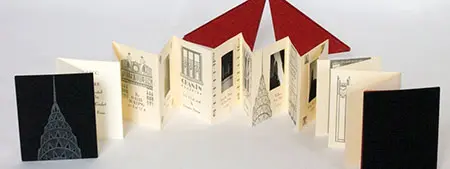
Artist books are experiencing expansion and renewal. With precedents that escape the requirements of this space, the genre became established with conceptual art. In it, "Artist Books" were those that didn't go through a regular printing shop and were hand made. Today, the term has expanded to encompass, beyond unique originals, numbered originals that can be created manually as well as through mechanical or digital means. An artist's book can have different percentage of each ingredient: they can be books and they can be works of art. The marriage between these to aspects is a free expression that uses paper and/or any other material as its support. Formats go beyond what is commonly understood as a book. In synthesis, artist books are whatever the book-artist decides. A growing new population has evolved around this activity. Binders, engravers, printers, lovers of paper, or people in all kinds of crafts, have discovered the artist book, its process, its wide berth. Today, the artist book is in the news due to the renewed energy it has gained through those and other expansions. Before, they makers only showed them in private, but now they are presented in galleries, fairs, and websites (the Internet changes everything). The genre has had outgrowths: zines or fanzines (self-publications of original material or for the appropriation of texts and images; generally their circulation doesn't reach 100 copies, occasionally they can be around 1,000); there are magazines devoted to the topic and a well-populated sub-genre of photography books, which are still in a formal stage. At the same time, there are a growing number of important collectors. At first artist books were exhibited in informal locations, until their exponential growth began during the last decade. An example of their history, survival, and expansion is the Center for Book Arts (CBA), which is celebrating four decades since its foundation by Richard Minsky. Minsky continues to contribute artist books, each more original than the prior one. The CBA functions with a varied range of activities, with Alexander Campos as its Executive Director and curator. They offer seminars, workshops, and international exhibitions. In terms of fairs, the New York Art Book Fair, currently celebrating its 10th year and presenting Printed Matter at PS1/Museum of Modern Art, is an intense and varied event. And just in New York City we can find several smaller fairs: E/AB Fair, New York Print Week, and Central Booking. Meanwhile, CODEX is held in San Francisco thanks to Peter Koch and his wife, editor Susan Filter, who created the Codex Foundation and its international locations. In Latin America, the largest expansion of artist books is happening in Mexico, with Lia in Guadalajara (parallel to the FIL) and with the Alumnos47 foundation, an original proposal with a social intent. This is an established genre since the great artist who first launched it. This momentum offers variety and quality in a great portion of its results. And there are many novice practitioners, about whom only time will tell.