ExhibitionJanuary 20, 2023
Lenora de Barros: My Language
Lenora de Barros: My Language has a conceptual outline that focuses on works that discuss the relationship between body and language with works from the beginning of her career to a commission produced especially for the occasion.
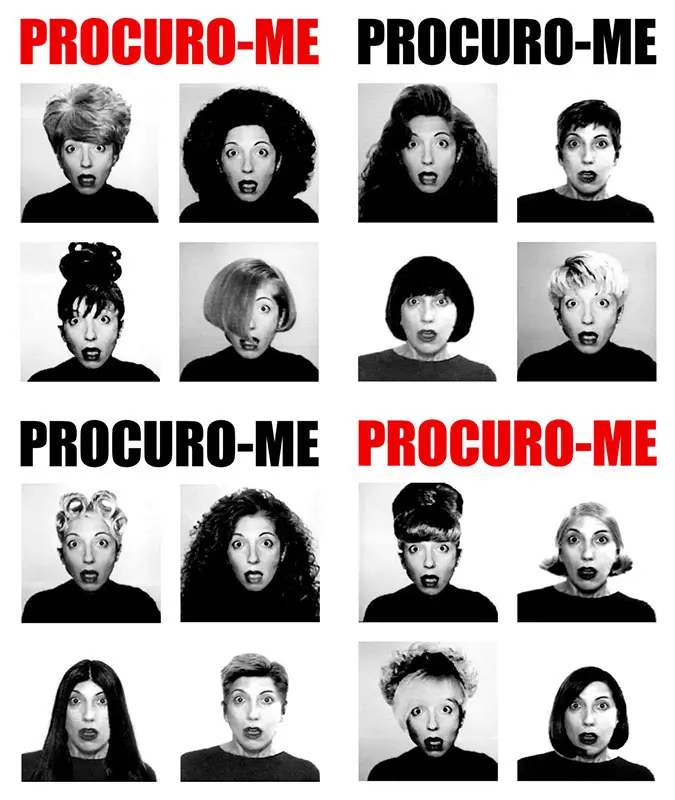
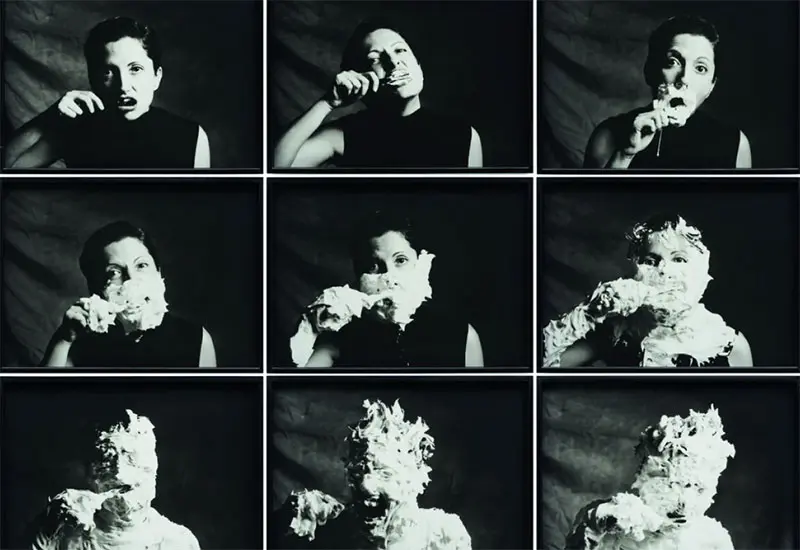
The exhibition, curated by Pollyana Quintella, brings together around 40 works by the visual artist from São Paulo, who uses photography, video, installation, and performance as media. Including iconic productions such as “Poema” (1979), the series “Procuro-me” (2003), and “Homenagem a George Segal” (1975-2014). The latest an emblematic work of her production was the result of a school work that criticized the consumer society, taking as inspiration the expressions of the works of the eponymous sculptor.
An unpublished work commissioned especially for the show entitled “A cara. The tongue. The womb” (2022), a video made up of three acts in which Lenora explores different situations with clay in dialogue with her own body.
Lenora de Barros (1953, São Paulo, where she lives and works) is supported by photography, video, installation, and performance. She held individual and group exhibitions in renowned institutions such as the Maria Antonia University Center (São Paulo), the Imperial Paço (Rio de Janeiro), the Museum of Modern Art of Rio de Janeiro, Casa Daros (Rio de Janeiro), the Cultural Center Banco do Nordeste (Fortaleza), Fundação Proa (Buenos Aires), the 2012 Poly/Graphic Triennale of San Juan, the 2011 Lyon Biennale, the 29th, 24th, and 17th Biennials of São Paulo, the 7th and 5th Biennials of Mercosur (Porto Alegre), the Museum of the City of Lisbon. Her works are part of the Museu d’Art Contemporani de Barcelona collections by Daros Latinoamerica, the São Paulo Museum of Modern Art, and the São Paulo Cultural Center. She graduated in linguistics from the Faculty of Philosophy, Letters, and Human Sciences of the University of São Paulo (FFLCH/USP) in the 1970s. Lenora initially explored the word in the form of text. She worked in important communication vehicles, such as Jornal da Tarde, where, between 1993 and 1996, she wrote a weekly experimental column.
The exhibition, curated by Pollyana Quintella, brings together around 40 works by the visual artist from São Paulo, who uses photography, video, installation, and performance as media. Including iconic productions such as “Poema” (1979), the series “Procuro-me” (2003), and “Homenagem a George Segal” (1975-2014). The latest an emblematic work of her production was the result of a school work that criticized the consumer society, taking as inspiration the expressions of the works of the eponymous sculptor.
An unpublished work commissioned especially for the show entitled “A cara. The tongue. The womb” (2022), a video made up of three acts in which Lenora explores different situations with clay in dialogue with her own body.
Lenora de Barros (1953, São Paulo, where she lives and works) is supported by photography, video, installation, and performance. She held individual and group exhibitions in renowned institutions such as the Maria Antonia University Center (São Paulo), the Imperial Paço (Rio de Janeiro), the Museum of Modern Art of Rio de Janeiro, Casa Daros (Rio de Janeiro), the Cultural Center Banco do Nordeste (Fortaleza), Fundação Proa (Buenos Aires), the 2012 Poly/Graphic Triennale of San Juan, the 2011 Lyon Biennale, the 29th, 24th, and 17th Biennials of São Paulo, the 7th and 5th Biennials of Mercosur (Porto Alegre), the Museum of the City of Lisbon. Her works are part of the Museu d’Art Contemporani de Barcelona collections by Daros Latinoamerica, the São Paulo Museum of Modern Art, and the São Paulo Cultural Center. She graduated in linguistics from the Faculty of Philosophy, Letters, and Human Sciences of the University of São Paulo (FFLCH/USP) in the 1970s. Lenora initially explored the word in the form of text. She worked in important communication vehicles, such as Jornal da Tarde, where, between 1993 and 1996, she wrote a weekly experimental column.
Gallery