ExhibitionSeptember 25, 2023
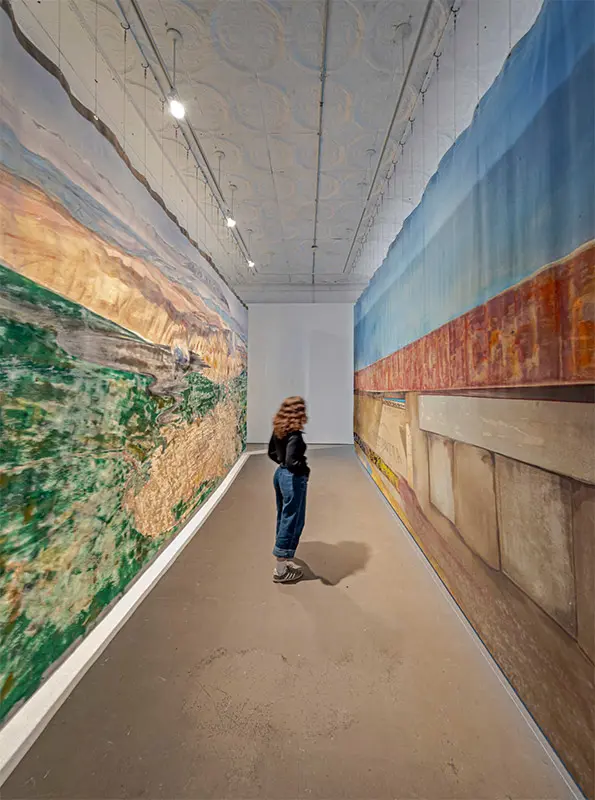
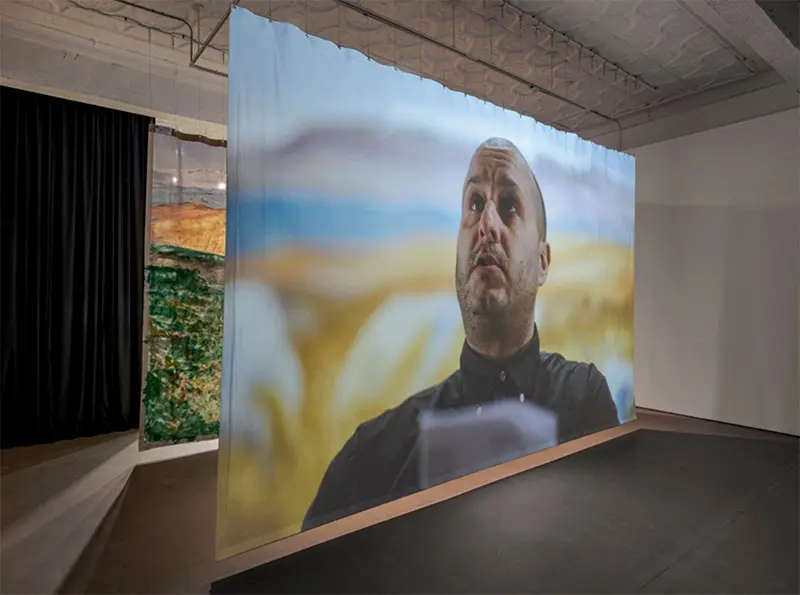
Lawrence Abu Hamdan: Cross-Border Crimes. Museo Universitario Arte Contemporáneo (MUAC)
The MUAC presents “Lawrence Abu Hamdan: Cross-Border Crimes” until March 17, 2024. Lawrence Abu Hamdan’s production is characterized by investigating the intersection between sound, space, and politics. His works question the political dimension of voice and listening to capture what exists beyond sound. Abu Hamdan has defined himself as a private ear, and his projects present sound as testimony and political evidence.
The artist stated in an interview with Ana Janevski, May Makki, and Erica Papernik-Shimizu for MoMA that “the propagation of sound is the most appropriate way to consider all forms of border crossing, whether they are material, interpersonal, architectural, legal, disciplinary, biological, sensory or conceptual.”
Abu Hamdan has called his research a “political ecology of noise”: analyzing and understanding the interacting elements that makeup sound. As he proposes, sound exists in relation to a system and requires listening to it in its relational condition. It requires hearing beyond sound. In that space of political listening, sound reveals us and becomes a pivotal witness to confront and resist. “Attentive listening is a conceptual and political tool to counter the violent ignorance of isolationism and compartmentalization,” Hamdan explained in 2023 in the interview.
In the catalog, Hamad explained: “I think sound is an inherently dirty kind of evidence. Any time we bring a sound into a normal frame of analysis—trying to individuate it, isolate it into individual units of expression—it’s always a problem. To pursue the archaeological metaphor, the sound is always already dirty—dirtied by the room and, if it’s a voice, by the person you’re speaking to. In the beginning, I think I was trying to isolate sound. Eventually, sound taught me to attune myself to leakage in every place it emerges. This is how I eventually ended up being able to listen to the testimony of reincarnated subjects in Lebanon because I saw it as another kind of leakage, continuous with how I would analyze a sound: through its relational quality, through its leaking. Through its ability to penetrate and move through the accumulated boundary as it does so.”
Find the catalog: https://muac.unam.mx/assets/docs/p281lfolio_muac_laurence_abu_hamdanweb.pdf
The artist stated in an interview with Ana Janevski, May Makki, and Erica Papernik-Shimizu for MoMA that “the propagation of sound is the most appropriate way to consider all forms of border crossing, whether they are material, interpersonal, architectural, legal, disciplinary, biological, sensory or conceptual.”
Abu Hamdan has called his research a “political ecology of noise”: analyzing and understanding the interacting elements that makeup sound. As he proposes, sound exists in relation to a system and requires listening to it in its relational condition. It requires hearing beyond sound. In that space of political listening, sound reveals us and becomes a pivotal witness to confront and resist. “Attentive listening is a conceptual and political tool to counter the violent ignorance of isolationism and compartmentalization,” Hamdan explained in 2023 in the interview.
In the catalog, Hamad explained: “I think sound is an inherently dirty kind of evidence. Any time we bring a sound into a normal frame of analysis—trying to individuate it, isolate it into individual units of expression—it’s always a problem. To pursue the archaeological metaphor, the sound is always already dirty—dirtied by the room and, if it’s a voice, by the person you’re speaking to. In the beginning, I think I was trying to isolate sound. Eventually, sound taught me to attune myself to leakage in every place it emerges. This is how I eventually ended up being able to listen to the testimony of reincarnated subjects in Lebanon because I saw it as another kind of leakage, continuous with how I would analyze a sound: through its relational quality, through its leaking. Through its ability to penetrate and move through the accumulated boundary as it does so.”
Find the catalog: https://muac.unam.mx/assets/docs/p281lfolio_muac_laurence_abu_hamdanweb.pdf
Gallery