Art NotesOctober 14, 2010
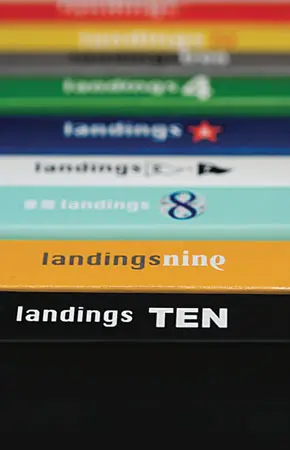
landings TEN (the black book)
Produced by five-o-one art projects, the book landings TEN brings the publishing cycle begun by the landings project in 2004 to a close. This platform for Central -American, Caribbean, and Southwestern Mexican contemporary artists marks the end of the project with the publication of this, its tenth and last intervention. Belize has been the driving force, the place where the first spark ignited the proposal for these ten encounters, these ten "landings" from the periphery of global centers. The edition of the various landings volumes has followed a chromatic narrative that ends with a black number TEN, as if it were the black box of a dangerous artifact, the encrypted record of a global trip. This edition-very much like the earlier publications-is not just a simple catalog that accompanies an exhibition. It represents one more piece of the project with content that explores the possibilities that the format demands, as the edition is converted into another expressive element of landings. The book communicates the spirit of search and provocation developed by the project. The fact that landings originates and is projected from an unusual periphery confers on the project a multitude of nuances and elements that render it as something valuable and surprising. From this condition of outsider, it is able to build an original discourse containing some proposals that could not possibly emerge from the so-called centers of power, from the influential spaces. Hybridization, multiculturalism, globalization, miscegenation, and transculturalism are ever-changing liquid concepts that are constantly being redefined, often by frivolous excuses stemming from this magma that attempts to envision the society that surrounds us through the artistic act and the quest for references and languages that work toward developing a distinctive style. The person responsible for landings, its instigator and the editor of this TEN edition, Joan Duran, prefers art to explain itself with none of the rhetorical verbiage often used to create a conceptual smokescreen. In the works, we also will not find the crotches of a ¿spoon¿ title that help us digest the silly soup of established conventions, because landings invites us to search for answers more than requiring us to look for self-definitions in discourses that seek justifications and approval. In landings TEN, we meet the creative discomfort and aesthetic iconography of its artists, the flashing of images, of concepts that aim at constructing the challenge proposed by these artists. The landings project is a challenge, a model for creation that the artists have transformed into a communicative space from the geographical nation on which they chose to build their own free will, motivated by cultural affinity. The adventurous landings exhibition has carried its message¿through the works of the more than seventy participating artists¿to exhibition venues such as the Art Museum of the Americas in Washington, D.C., the Casa de las Américas in Havana, or the Taipei Fine Arts Museum in Taiwan, and also brought it to Mexico, the Dominican Republic, Costa Rica, and Belize. In this last phase of the long voyage of landings, the TEN edition was originally slated to anchor in Badajoz (Spain) and end its cycle of exhibitions in Europe. Nevertheless, a sinister force sullied this box¿also black, and containing the last clues of a creative voyage¿with excuses and inefficiencies. Yasser Musa explains this vividly in the book. "Badajoz? The shipping containers were already postmarked; passports in hand, we were ready to present our work in the walled city of Extremadura, the birthplace of so many conquistadors. Our artistic crossing bore a historic irony." ¿But everything was to take a turn on October 22, 2008. Like a dagger plunged into the heart, an email arrived from Museo Extremeño e Iberoamericano de Arte Contemporáneo (MEIAC) Director Antonio Franco, stating that due to the `galloping economic crisis,¿ ...