ExhibitionDecember 2, 2015
The recovery of Lina Bo Bardi’s glass easels at MASP
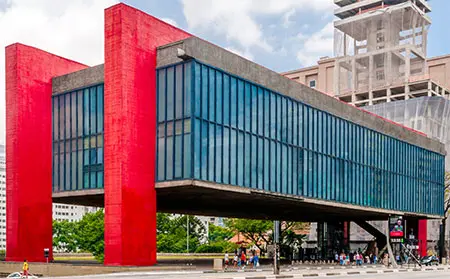
The MASP—Museu de Arte de São Paulo Assis Chateaubriand—will present, starting on December 10th, the iconic glass easels, the exhibition design that Lina Bo Bardi (1914-1992) originally planned in 1968 for the museum's Avenida Paulista site. The show will feature 117 works from the museum collection (from the Fourth Century B.C.E. to the 2000s), arranged in the free area of the second floor. After taking over as Artistic Director for MASP last December, Adriano Pedrosa proposed 2015 as a year for the critical review of the Museum's original guiding principles, intended to reevaluate its collection and its history, and to recover the essence of Bo Bardi's architectural proposal for the building. Lina Bo Bardi subverted traditional museographic notions, refusing to accept a progressive, linear, and unidirectional narrative for the organization of the collection. Bo Bardi's practical solution was to remove the art from the walls and place them on transparent glass supports set on a concrete base, and arranged freely in the monumental gallery space. Information and technical cards were behind the easels, and the works appeared as though suspended in the air, floating and inviting visitors to engage them in a frank and direct manner. Without a predetermined itinerary, visitors were granted autonomy to decide their own path and to design their own history in the museum's collection. According to Adriano Pedrosa, "the radical nature of this project resides, then, in its decolonizing potency, which breaks with traditional, Eurocentric, hierarchical narratives, but also in the art system as a totality, and it proposes a new narrative, non-linear and non-hierarchical. What is needed, above all, is to understand and emphasize the political dimension of such proposals. Behind them lies a definite understanding that the space has been created to be seen from a complete, clear and unique vantage by each visitor, who in that way can dominate it with his or her gaze and cognition, rather than being subjected to it by a division into different galleries or by a pre-determined itinerary that would guide, in an authoritarian way, their visit. Thus, by tearing down the panels that carved the larger spaces into minor galleries and covered the museum's glass windows, the architecture was rendered vast, open, transparent, fluid, permeable, with many possibilities for access and reading, assuming a more human and democratic character and, in consequence, a political dimension. For the re-edition of the original exhibition design, METRO Associated Architects, the firm responsible for the MASP's exhibition project, reconstructed the more than one hundred easels designed by Bo Bardi. Based on historical research and the recovery of remaining elements from the first montage, the new design retains all the original principles and materials: concrete cube, wood wedge, rubber cover, and perforated tempered glass. Some details of the system were perfected, such as the standardization of the method for attaching the art to the glass and the incorporation of a system that will level the works and mute damaging vibrations. In four sizes according to Bo Bardi's original design (in fact, one of them had never been built before), all the glass easels are perforated at standard heights, and metal bars are used to adjust the works to them; a more flexible arrangement than in the original, where each work had its own easel with its own perforations. In the new configuration, the art will be organized chronologically, from the most ancient to the most recent. The oldest work in the exhibition is a statue of the goddess Hygieia, and the most recent is Marcelo Cidade's Tempo suspenso de um estado provisório ("Suspended Time of a Provisional State", 2011). Betwee...