ExhibitionJune 20, 2025
“The Pilgrim's Promise” by Juliana Ríos Martínez
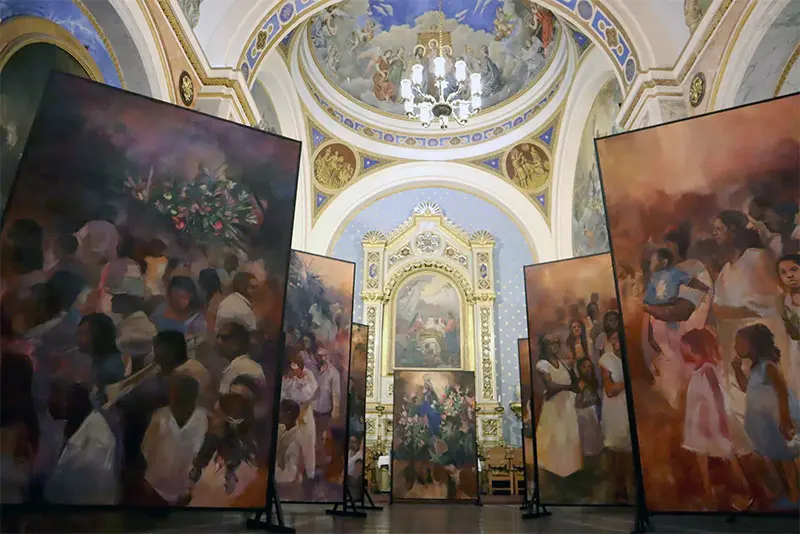
In the San José Chapel, where nineteenth and twentieth century sacred art is shown, a compelling dialogue unfolds between the paintings of Juliana Ríos Martínez and the celebrated works by Priest Santiago Páramo. S.J. Ríos' works reflect the spirituality and cultural nuances of her context in Villanueva, La Guajira. This region is steeped in the heritage of the Wayuu people and bears the scars of colonialism, European migration, enslavement, extractivism, and drug trafficking. Nevertheless, La Guajira is also a testament to ethnic and spiritual resilience, with vibrant syncretisms that continue to thrive today. A notable example is the devotion to the miraculous figure of the Virgen de los Remedios, whose cult originated in the 17th century when she is believed to have halted the sea's advance on Riohacha in 1683.
"La promesa peregrina" features a series of paintings that portray the annual celebration of the Virgen de los Remedios, which takes place every February 2 in Riohacha. These artworks capture the daily lives and traditions of the Guajiro people, deeply rooted in the environment that shaped Ríos. Consequently, the Chapel of San José becomes a significant crossroads where two distinct historical moments converge: the monumental legacy of Priest Páramo, S.J., and the contemporary expressions of Ríos.
"The Pilgrim Promise" by Juliana Ríos Martínez, organized by the Colonial Museum, will be on view through June 29 at the San José Chapel in the San Ignacio Church (Cl. 10 #6-27, Bogotá D. C.).
"La promesa peregrina" features a series of paintings that portray the annual celebration of the Virgen de los Remedios, which takes place every February 2 in Riohacha. These artworks capture the daily lives and traditions of the Guajiro people, deeply rooted in the environment that shaped Ríos. Consequently, the Chapel of San José becomes a significant crossroads where two distinct historical moments converge: the monumental legacy of Priest Páramo, S.J., and the contemporary expressions of Ríos.
"The Pilgrim Promise" by Juliana Ríos Martínez, organized by the Colonial Museum, will be on view through June 29 at the San José Chapel in the San Ignacio Church (Cl. 10 #6-27, Bogotá D. C.).