Photography and war
If one were to consider the great themes of art—the divine, nature, power, love, and others—war would have to be featured prominently in the list. From Homer's Iliad to Tolstoy's War and Peace, Tchaikovsky's 1812 Overture and Spielberg's Saving Private Ryan, the theme of war has engaged artists to celebrate, denounce, or lament the results of combat. The exhibit War/Photography: Images of Armed Conflict and Its Aftermath depicts wars in the modern medium of photography. From its infancy, photography has been involved with war and although nowadays we are much more skeptical about the medium's veracity, the assumptions made about photographic images changed the way armed conflicts were experienced. Bringing these facts to the forefront makes this exhibit as much a historical account of modern wars as it is a reflection about the medium of photography.
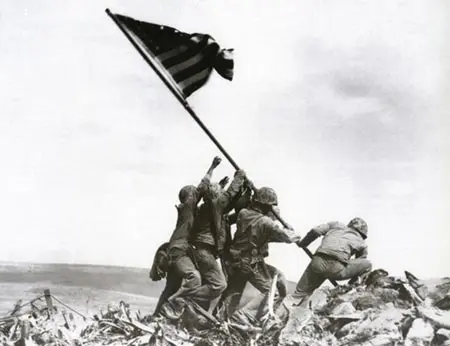
War/Photography was ten years in the making. According to Anne Tucker, curator of photography of the Museum of Fine Arts Houston, she was part of a curatorial team that included Will Michels and Natalie Zelt. In fact, she credits Michels for planting the seed of the exhibit following the museum's acquisition of Joe Rosenthal's Old Glory goes up on Mount Suribachi, Iwo Jima (1945) [shown above]. After looking at over a million images from 152 sources, the team agreed on 486 photographic images and objects dating from 1846 to 2012.
The exhibit is not organized chronologically, but thematically (recruitment, the fight, refugees, etc.). Even so, there is certainly a historical reflection about each one of the themes that addresses not only how that aspect of warfare evolved, but also how the medium changed. Nineteenth-century photographers like Roger Fenton, Felice Beato, Mathew Brady, and Alexander Gardner carried on their craft in a radically different way than do contemporary photojournalists. Right after the official invention of photography (1839), photographic equipment was heavy, cumbersome, and slow; but the public's enthusiasm for the medium was great. The popularity of stereo photographs that showed combat scenes of the American Civil War in three dimensions is clear evidence of that zest.
One of the earliest photographs of combatants is an 1847 daguerreotype by an unknown photographer showing General John E. Wool and his staff on horseback in a captured town in northern Mexico. That campaign was part of the Mexican American War (1846-48) that ended with the ignominious Treaty of Guadalupe Hidalgo. Daguerreotypes required long exposures. So when the daguerreotype was shot riders and horses had to remain perfectly still for a few seconds.
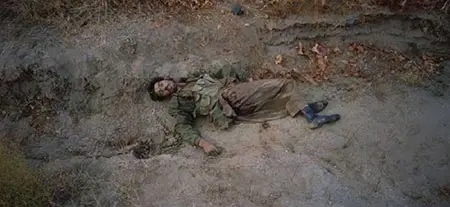
In this exhibit there are iconic images of war by celebrated photographers that will always steal the show; and there are others on their way to reaching that exalted status. One would guess that among the latter are Nina Berman's Marine wedding, Ohio (2006) in which the groom, Tyler Ziegel, whose face was disfigured beyond recognition by a suicide bombing in the Iraq War is marrying his pretty high school sweetheart; or, James Nachtwey's Mourning a brother killed by a Taliban rocket, Afghanistan (1996) where a woman totally draped in a burka prays before a tombstone; or, Luc Delahaye's Taliban (2001) [shown above] —in which the dead combatant's shoes have been stolen and his wallet pilfered. A few of the former we can name are: Robert Capa's Death of a loyalist militiaman, Spain (1936), Alfred Eisenstaedt's V-J Day (1945), Times Square, New York (1945), Freddy Alborta's Bolivian army shows the body of Che Guevara to the press, Bolivia (1967), Eddie Adam's Police Commander Nguyen Ngoc Loan...
Gallery