ExhibitionMay 16, 2022
The Essence of a Painting. An Olfactory Exhibition
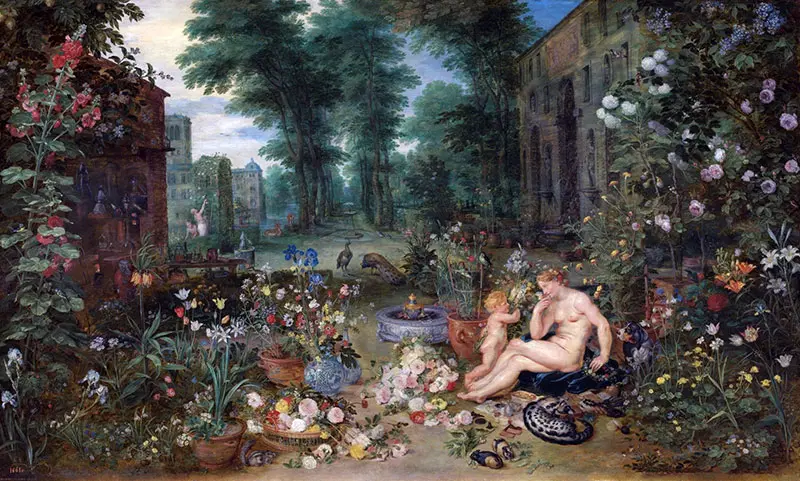
The Sense of Smell, a painting by Jan Brueghel and Rubens, is the focus of The Essence of a Painting. An Olfactory Exhibition, curated by Alejandro Vergara, Chief Curator of Flemish Painting and the Northern Schools at the Museo Nacional del Prado, and Gregorio Sola, Senior Perfumer at Puig and an academician of the Perfume Academy, who has created ten fragrances associated with elements in the painting.
With Samsung’s technological sponsorship and the special collaboration of the Perfume Academy Foundation and the AirParfum olfactory technology developed by Puig, the perfumer Gregorio Sola has created ten fragrances related to elements present in The Sense of Smell, part of the series of The Five Senses that Jan Brueghel painted in 1617 and 1618 and in which the allegorical figures were made by his friend Rubens.
The AirParfum technology, developed by Puig and exclusive in the world of perfumery, allows smelling up to 100 different fragrances without saturating the sense of smell, respecting the identity and nuances of each perfume. Through the four diffusers on the Samsung touch monitors available in the room, visitors will be able to smell the 17th-century elements present in the painting.
Brueghel’s work evokes the garden of rare trees and plants belonging to Isabel Clara Eugenia and her husband in early 17th-century Brussels, depicting more than 80 species of plants and flowers, as well as various animals associated with the sense of smell, such as the scent hound and civet, and a range of objects relating to the world of perfume, including scented gloves, vessels holding fragrant substances, a perfume burner warmed in a sumptuous brazier, and vessels for distilling essences.
The objects seen in these scenes reflect the collecting and taste of the European courts of the time. In 1636 the five paintings were in Madrid, in the collection of King Philip IV. He installed them in a room decorated with two ebony and bronze shelves next to paintings attributed to Dürer, Titian, Patinir, among others.
The ten fragrances available in the exhibition are Allegory, the perfume created by Gregorio Sola, inspired by the bouquet of flowers smelled by the allegorical figure of smell, painted by Rubens. Gloves evoke a glove perfumed with amber according to a formula from 1696, consisting of resins, balsams, woods, and flower essences, accompanied by the chord of fine leather. In the Modern Age, they used perfumed gloves to mask the bad smell of tanning and have a pleasant scent nearby. The fig tree interprets the vegetal, moist, green, and refreshing smell of the shade of a fig tree on a summer day. Jasmine smells different in the morning than at night when it is more opulent. Like other plants seen in the painting, it is an import from warmer areas. The rose is the most recognizable of all the flowers. They say it takes three hundred thousand flowers, picked by hand at dawn, to have a kilo of its essence. Jan Brueghel painted eight varieties of roses, among them the Centifolia and the Damascena, the most used in perfumery. Iris, the most expensive raw material in perfumery, is worth more than twice as much as gold due to its complex and time-consuming production process. The narcissus used in perfumery is grown mainly in the French region of Aubrac and is harvested in late May and early June. In Jan Brueghel’s time, the essence was obtained by distillation. Nowadays, it is acquired by solvent extraction, which makes it possible to produce more essential oil. The civet is an animal that has a pouch between its hind legs from which a resinous substance, civet, formerly used in the perfumery, was extracted. Its odor is strong, animal, almost excremental. The tuberose used at that time was of Indian origin and very expensive; the one used in perfumery when the painting was made came from Mexico. Today its cost can exceed 10,000 €/kg. Due to its strength and intensity, the essence of tuberose in a perfume enhances the character of other floral notes.
With Samsung’s technological sponsorship and the special collaboration of the Perfume Academy Foundation and the AirParfum olfactory technology developed by Puig, the perfumer Gregorio Sola has created ten fragrances related to elements present in The Sense of Smell, part of the series of The Five Senses that Jan Brueghel painted in 1617 and 1618 and in which the allegorical figures were made by his friend Rubens.
The AirParfum technology, developed by Puig and exclusive in the world of perfumery, allows smelling up to 100 different fragrances without saturating the sense of smell, respecting the identity and nuances of each perfume. Through the four diffusers on the Samsung touch monitors available in the room, visitors will be able to smell the 17th-century elements present in the painting.
Brueghel’s work evokes the garden of rare trees and plants belonging to Isabel Clara Eugenia and her husband in early 17th-century Brussels, depicting more than 80 species of plants and flowers, as well as various animals associated with the sense of smell, such as the scent hound and civet, and a range of objects relating to the world of perfume, including scented gloves, vessels holding fragrant substances, a perfume burner warmed in a sumptuous brazier, and vessels for distilling essences.
The objects seen in these scenes reflect the collecting and taste of the European courts of the time. In 1636 the five paintings were in Madrid, in the collection of King Philip IV. He installed them in a room decorated with two ebony and bronze shelves next to paintings attributed to Dürer, Titian, Patinir, among others.
The ten fragrances available in the exhibition are Allegory, the perfume created by Gregorio Sola, inspired by the bouquet of flowers smelled by the allegorical figure of smell, painted by Rubens. Gloves evoke a glove perfumed with amber according to a formula from 1696, consisting of resins, balsams, woods, and flower essences, accompanied by the chord of fine leather. In the Modern Age, they used perfumed gloves to mask the bad smell of tanning and have a pleasant scent nearby. The fig tree interprets the vegetal, moist, green, and refreshing smell of the shade of a fig tree on a summer day. Jasmine smells different in the morning than at night when it is more opulent. Like other plants seen in the painting, it is an import from warmer areas. The rose is the most recognizable of all the flowers. They say it takes three hundred thousand flowers, picked by hand at dawn, to have a kilo of its essence. Jan Brueghel painted eight varieties of roses, among them the Centifolia and the Damascena, the most used in perfumery. Iris, the most expensive raw material in perfumery, is worth more than twice as much as gold due to its complex and time-consuming production process. The narcissus used in perfumery is grown mainly in the French region of Aubrac and is harvested in late May and early June. In Jan Brueghel’s time, the essence was obtained by distillation. Nowadays, it is acquired by solvent extraction, which makes it possible to produce more essential oil. The civet is an animal that has a pouch between its hind legs from which a resinous substance, civet, formerly used in the perfumery, was extracted. Its odor is strong, animal, almost excremental. The tuberose used at that time was of Indian origin and very expensive; the one used in perfumery when the painting was made came from Mexico. Today its cost can exceed 10,000 €/kg. Due to its strength and intensity, the essence of tuberose in a perfume enhances the character of other floral notes.