La empresa soy yo
In curating an exhibition about work, Pilar Villela was clear from the start on the dangers and ambiguities that lie within the idea of work and its possible extensions. Against the glamorized image of the worker, amplified and on display in posters and stripped of its essential attributes, come questions that arise from the working conditions experienced today, but also those that emerge from the everyday lives of common men and women where any action implies labor, be it financially compensated or otherwise, and presupposes a loss when there is no true exchange. The goal was not to document work, but to reflect about it, its sites, its extensions, its restrictions, its real value, as subjugation but also as subversion.
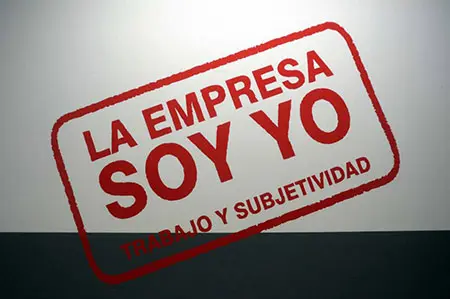
The same paradox is in the title of the exhibition La empresa soy yo (translated both as "The Company is Me" and "I Am the Company"). It is a statement of principle. It is the statement of the self-employed, whether it is because their employment perspectives are exhausted in companies owned by others, or because they have decided to become their own bosses. It is also, of course, a burlesque allusion to the famous declaration by Louis XIV, "L'Etat, c'est Moi." Against the declaration of principles of an absolute monarch, we have the declaration of principles of the absolute worker. The monument to this worker in his or her omnipresence, but also his or her invisibility, is negative.
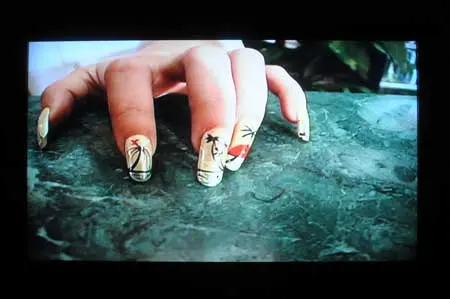
In Awake/Asleep, by Romanian artist Daniel Knorr, we find an electronic device that turns on and off in the gallery a mechanism with text messages sent daily from Berlin. The work is a contract. Knorr plays with the idea of work time: it is there, even if it isn't, and then it goes away. The idea of work time and its indicators is also present in a video by Argentine artist Mikka Rothemberg (exhibiting in Mexico for the first time), titled Time and a Half. It features a waitress who kills time in an empty Chinese restaurant. Her manicured fingernails are an indicator of the product of work time, but also the measure—the drumming of the nails on the table—of time's passage. Strike I and Strike II, by Germany's Hito Steyerel, play with the double meaning of the English word "strike", both a blow and a stoppage of work, with a literal action (a blow by a hammer and chisel) against a video camera that, broken—or better yet, transformed—continues to function.
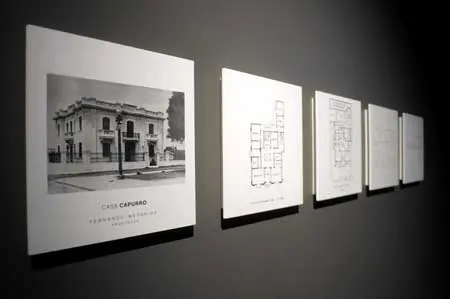
Finland's Pilvi Takala brings to the fore the evidence of the boundaries and extensions of exploitation in her video The True Sleeping Beauty. In Perro/Dios, Pablo Macotela hides in plain sight (with paid inserts in a Mexican newspaper) a training slogan for an elite unit of the Mexican army. Peruvian artist's Daniela Ortiz's polyptychs present, based on house plans, the size of servant's quarters. Amanda Gutiérrez uses the testimony of a worker for a famous US brand of cookies and alternates it with the discontinued product of an American cookie factory whose laid-off Chicano employees buy nostalgically to make an emotional tableau: Breviary of a factory worker.
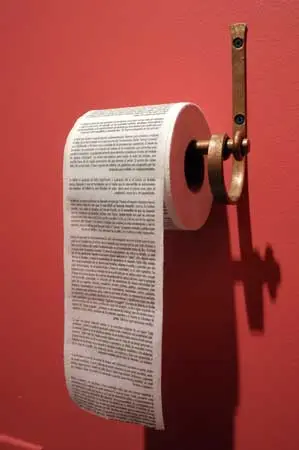
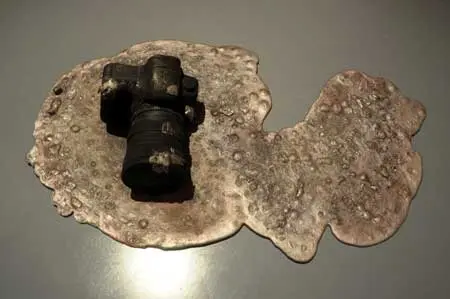
Also featured in the exhibition are works by Ricardo Ali (a burned camera on a puddle of lead), Victor G. Noxpango (an inverted cube that serves as a throne for the museum curator), Gustavo Rodríguez Nava (toilet paper with digital impressions), Vicente Razo (abstract painting based on games of soduku), and Debora Delmar Corporation (an installation with handbags, neckerchiefs, and ice cream).
La empresa soy yo, a group exhibition curated by Pilar Villela, Casa de Lago, September-December, 2013.
Gallery