Book ReviewsSeptember 24, 2020· By Nelly Perazo
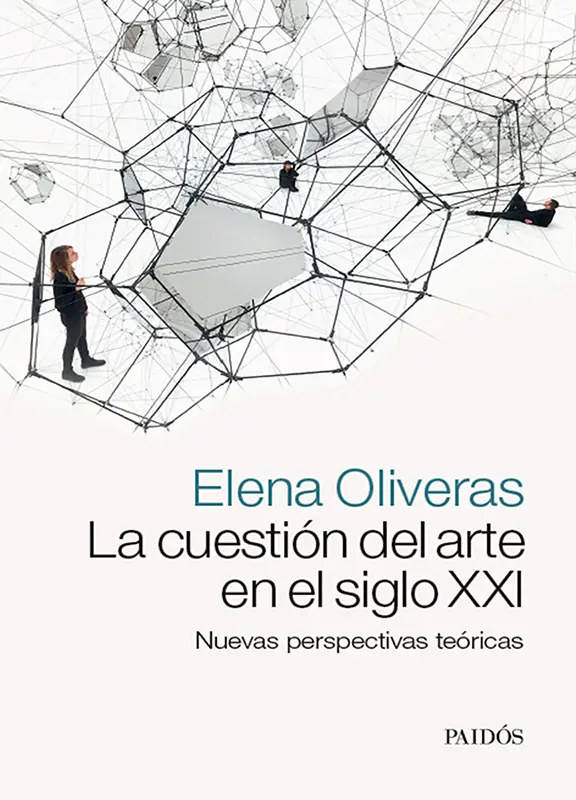
La cuestión del arte en el siglo XXI. Nuevas perspectivas teóricas
Elena Oliveras—a professor at Universidad del Noreste, Ph.D. in aesthetics by Université de Paris, the recipient of several awards—presented her most recent book, La cuestión del arte en el siglo XXI. Nuevas perspectivas teóricas, at the Academia Nacional de Bellas Artes (of which she is a full member), thus adding a new item of great interest to her body of publications on issues of contemporary aesthetics.
The book is organized in seven chapters, each devoted to a thinker who, according to Oliveras, has had an impact on ongoing debates. As the introduction puts it, these are authors who seek to understand how "art today reveals the unstable structure of an ambiguous and even contradictory world that puts in play our basic survival and defense."
These thinkers belong to different generations; some, like Rancière and Jean-Luc Nancy (both born in 1940), were already widely known in the Late Twentieth Century; others, like the Dutch theoreticians Vermeulen and Van den Akker, have only begun to gain recognition in recent years.
Each author's work is analyzed and reflected upon, and connections are established with various aspects of thought on contemporary art.
It is precisely this concept of openness to the reader that gives the book its great communicative power. Elena Oliveras does not limit herself to an explication of the authors’ theories; going further, she links their thought to the work of artists of recent generations: Ai Weiwei, Damian Hirst, Olafur Eliasson, Marta Minujin, Marcel Broodthaers, or to prominent figures of film, literature, and philosophy, such as Goddard, Deleuze, Benjamin, Gehlen, Bataille, Žižek, Foster, Jameson, our own Borges, and others. All to connect, if obliquely, with the possibilities of each reader.
In this way, readers can establish a path between the idea of metamodernism proposed by the Dutch thinkers, which appears as a post-ironic, subjective, and political surmounting of postmodernism, and the concept of alter modernism, which Bourriaud situates in the context of the cultural chaos wrought by the globalization and commercialization of the world.
On his part, Groys analyzes the differences between modernism and postmodernism and notes the features that define the present: the relativism of the point of view and the bottomless process of postproduction. In this line of art in flow, Bourriaud speaks of the hybridization of temporalities, of unsettledness, of the fluidity of bodies and signs, of nomadic thinking, of multiple shifting identities. For Nancy, each object is a fragment of meaning, and meaning is always in process. The fragment in Nancy is the ideal way of expressing the impossibility of totalization in the current moment, forcing viewers to make connections that can be endless, depending on the artist's wink or gesture.
In that regard, he writes that art can sensitize viewers to the world's faults as it exists, activates thought, and counter the passivity of comfort.
Among the various connections that readers can establish is Onfray’s emphasis on the body, affects, and the sensorial. He says that the body links us to the world and favors a hedonism of being, not of having. Rancière, in turn, speaks of allowing new possibilities for life and suspending the habitual or commonplace relationship between appearance and reality.
Another connection that readers can establish is with Bourriaud’s ex-form, at the boundary between what is excluded and what is admitted, between product and residue, and with the arrival of the eschatological and the prosaic that Agamben mentions. The undervalued becomes museum-worthy. Nancy underscores the need for a thought that is open to the vast realm of the extra-artistic.
Rancière necessarily refers to art and politics, and the point can also be traced, in a different way, in the other authors.
In sum, the linkages that readers can establish can multiply endlessly.
While at all times, Elena Oliveras seeks to negotiate obstacles and facilitate access to the theoreticians she presents, her attitude is not that of a teacher seeking to explain the texts. On the contrary, after prompting in her readers the questions that the philosophers raise, they—the readers—begin to build their own answers.
After reading this book, we are left with a strong impression—what Sloterdijk dubbed autopoiesis—that navigating freely through it, without a pre-conditioned axis, our own thought is enhanced, as is our capacity to seek that meaning which, in Nancy’s words, is always being made.
The last section includes a brief anthology of selected texts, information on bibliographical sources, and a valuable referential biography.
The book is organized in seven chapters, each devoted to a thinker who, according to Oliveras, has had an impact on ongoing debates. As the introduction puts it, these are authors who seek to understand how "art today reveals the unstable structure of an ambiguous and even contradictory world that puts in play our basic survival and defense."
These thinkers belong to different generations; some, like Rancière and Jean-Luc Nancy (both born in 1940), were already widely known in the Late Twentieth Century; others, like the Dutch theoreticians Vermeulen and Van den Akker, have only begun to gain recognition in recent years.
Each author's work is analyzed and reflected upon, and connections are established with various aspects of thought on contemporary art.
It is precisely this concept of openness to the reader that gives the book its great communicative power. Elena Oliveras does not limit herself to an explication of the authors’ theories; going further, she links their thought to the work of artists of recent generations: Ai Weiwei, Damian Hirst, Olafur Eliasson, Marta Minujin, Marcel Broodthaers, or to prominent figures of film, literature, and philosophy, such as Goddard, Deleuze, Benjamin, Gehlen, Bataille, Žižek, Foster, Jameson, our own Borges, and others. All to connect, if obliquely, with the possibilities of each reader.
In this way, readers can establish a path between the idea of metamodernism proposed by the Dutch thinkers, which appears as a post-ironic, subjective, and political surmounting of postmodernism, and the concept of alter modernism, which Bourriaud situates in the context of the cultural chaos wrought by the globalization and commercialization of the world.
On his part, Groys analyzes the differences between modernism and postmodernism and notes the features that define the present: the relativism of the point of view and the bottomless process of postproduction. In this line of art in flow, Bourriaud speaks of the hybridization of temporalities, of unsettledness, of the fluidity of bodies and signs, of nomadic thinking, of multiple shifting identities. For Nancy, each object is a fragment of meaning, and meaning is always in process. The fragment in Nancy is the ideal way of expressing the impossibility of totalization in the current moment, forcing viewers to make connections that can be endless, depending on the artist's wink or gesture.
In that regard, he writes that art can sensitize viewers to the world's faults as it exists, activates thought, and counter the passivity of comfort.
Among the various connections that readers can establish is Onfray’s emphasis on the body, affects, and the sensorial. He says that the body links us to the world and favors a hedonism of being, not of having. Rancière, in turn, speaks of allowing new possibilities for life and suspending the habitual or commonplace relationship between appearance and reality.
Another connection that readers can establish is with Bourriaud’s ex-form, at the boundary between what is excluded and what is admitted, between product and residue, and with the arrival of the eschatological and the prosaic that Agamben mentions. The undervalued becomes museum-worthy. Nancy underscores the need for a thought that is open to the vast realm of the extra-artistic.
Rancière necessarily refers to art and politics, and the point can also be traced, in a different way, in the other authors.
In sum, the linkages that readers can establish can multiply endlessly.
While at all times, Elena Oliveras seeks to negotiate obstacles and facilitate access to the theoreticians she presents, her attitude is not that of a teacher seeking to explain the texts. On the contrary, after prompting in her readers the questions that the philosophers raise, they—the readers—begin to build their own answers.
After reading this book, we are left with a strong impression—what Sloterdijk dubbed autopoiesis—that navigating freely through it, without a pre-conditioned axis, our own thought is enhanced, as is our capacity to seek that meaning which, in Nancy’s words, is always being made.
The last section includes a brief anthology of selected texts, information on bibliographical sources, and a valuable referential biography.