Heard on The StreetNovember 12, 2021
The City of Arts
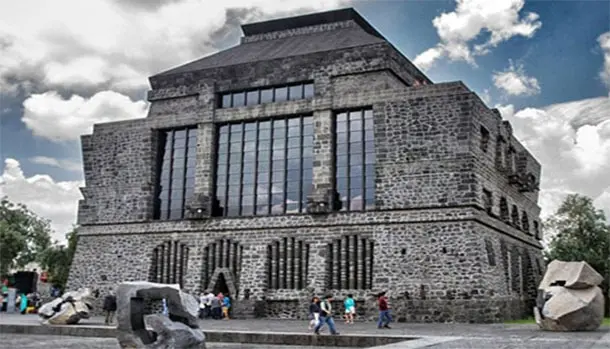
Inspired by Diego Rivera's will and project, after 80 years and four years of remodeling and expansion, the Museo Anahuacalli opened its new spaces of the project "Remodeling, Expansion, and Construction of the Anahuacalli Museum Space." It proposes activities that link the Museum with its community and seeks to insert itself within contemporary art's various disciplines and trends.
The history of the Anahuacalli began in 1941 when Diego Rivera bought the rough land of San Pablo Tepetlapa. After the explosion of the Xitle volcano, lava covered a large part of the southern part of the city, including this area, transforming the landscape and, with it, flora and fauna (in an irregular and rocky terrain). On the 40,000 square meters of land, the Mexican artist built a vast building reminiscent of a Mesoamerican pyramid. This became his atelier and home to his impressive collection of pre-Hispanic pieces. Diego Rivera was not only a muralist but a collector. He managed to collect around 60,000 works from different regions of Mexico. In 1957 Diego Rivera died without finishing his work, but his daughter Ruth Rivera and his friend Juan O'Gorman managed to complete the Museo Anahuacalli in 1964.
The Mexican muralist wanted to create a large project that would support the conservation of Mexican heritage and at the same time serve as a space for collective ideas, as he wrote in his text "Exposición para un proyecto para la Ciudad de las Artes" (1945-1950), in which he argued that the Anahuacalli should combine several buildings and plazas:
-A Museum of Mexican Art in Action, which would consist of nine areas.
-A large permanent exhibition hall.
-An enormous plaza of a thousand meters per side, with a stage in the center, where dance and theater performances and indigenous and civil celebrations would be presented. All the popular festivities of the different parts of the country would be there.
-Around this square, flat-roofed arcades, in the pre-Hispanic style, would house artisan workshops located in the four cardinal points, according to the country's regions.
-Surrounding the plaza, there would be museums of Architecture, Music, and Dance, as well as concert, experimental theater, and cinema forums. In these venues, there would be free workshops for artists.
-The construction would respect the unevenness of the terrain, which would give it "an exceptional character and great beauty. Diego's idea was to take young people out of the schools and link them to popular art so that the Anahuacalli would be an authentic community dedicated to art.
The architects responsible were Mauricio Rocha Iturbide, son of the renowned photographer Graciela Iturbide and the architect Manuel Rocha. Rocha said that what was complicated was to incorporate several discourses in a single construction: "We wanted to create a work that would dialogue with the Museo Anahuacalli. A place that would respect the environment that would be friendly, that each of the components would be integrated as a single piece. The biggest challenge was to create a contemporary work that would be in harmony with Diego Rivera, Juan O'Gorman, and Ruth Rivera.
The project was developed in what used to be the Museum's garden, a 2,300-meter space where 13 new cultural infrastructures were built. These include the Dance and Movement Hall, a Mirador, the Plazuela Ruth, the open-air forums that connect perfectly with the volcanic stone of the site (Piedra y Máquinas). It will also have the spaces Cubo, Creación y Experimentación, the Bodega O'Gorman, the patios Las Piedras, Palo Loco, Helechos and Las Moras.
The new facilities will offer artistic, environmental, and multidisciplinary training workshops as on-site courses in urban photography, watercolor, and landscape, drawing of pre-Hispanic pieces, specialized herbalism, and traditional Mexican medicine. Not to mention Urban Gardens and plant care in the Pedregal, Japanese floral art Kokedamas, vermicomposting, and mushroom cultivation. In addition, the program will include some online education proposals such as workshops on garbage separation and composting and activation of the Badian Codex.
The history of the Anahuacalli began in 1941 when Diego Rivera bought the rough land of San Pablo Tepetlapa. After the explosion of the Xitle volcano, lava covered a large part of the southern part of the city, including this area, transforming the landscape and, with it, flora and fauna (in an irregular and rocky terrain). On the 40,000 square meters of land, the Mexican artist built a vast building reminiscent of a Mesoamerican pyramid. This became his atelier and home to his impressive collection of pre-Hispanic pieces. Diego Rivera was not only a muralist but a collector. He managed to collect around 60,000 works from different regions of Mexico. In 1957 Diego Rivera died without finishing his work, but his daughter Ruth Rivera and his friend Juan O'Gorman managed to complete the Museo Anahuacalli in 1964.
The Mexican muralist wanted to create a large project that would support the conservation of Mexican heritage and at the same time serve as a space for collective ideas, as he wrote in his text "Exposición para un proyecto para la Ciudad de las Artes" (1945-1950), in which he argued that the Anahuacalli should combine several buildings and plazas:
-A Museum of Mexican Art in Action, which would consist of nine areas.
-A large permanent exhibition hall.
-An enormous plaza of a thousand meters per side, with a stage in the center, where dance and theater performances and indigenous and civil celebrations would be presented. All the popular festivities of the different parts of the country would be there.
-Around this square, flat-roofed arcades, in the pre-Hispanic style, would house artisan workshops located in the four cardinal points, according to the country's regions.
-Surrounding the plaza, there would be museums of Architecture, Music, and Dance, as well as concert, experimental theater, and cinema forums. In these venues, there would be free workshops for artists.
-The construction would respect the unevenness of the terrain, which would give it "an exceptional character and great beauty. Diego's idea was to take young people out of the schools and link them to popular art so that the Anahuacalli would be an authentic community dedicated to art.
The architects responsible were Mauricio Rocha Iturbide, son of the renowned photographer Graciela Iturbide and the architect Manuel Rocha. Rocha said that what was complicated was to incorporate several discourses in a single construction: "We wanted to create a work that would dialogue with the Museo Anahuacalli. A place that would respect the environment that would be friendly, that each of the components would be integrated as a single piece. The biggest challenge was to create a contemporary work that would be in harmony with Diego Rivera, Juan O'Gorman, and Ruth Rivera.
The project was developed in what used to be the Museum's garden, a 2,300-meter space where 13 new cultural infrastructures were built. These include the Dance and Movement Hall, a Mirador, the Plazuela Ruth, the open-air forums that connect perfectly with the volcanic stone of the site (Piedra y Máquinas). It will also have the spaces Cubo, Creación y Experimentación, the Bodega O'Gorman, the patios Las Piedras, Palo Loco, Helechos and Las Moras.
The new facilities will offer artistic, environmental, and multidisciplinary training workshops as on-site courses in urban photography, watercolor, and landscape, drawing of pre-Hispanic pieces, specialized herbalism, and traditional Mexican medicine. Not to mention Urban Gardens and plant care in the Pedregal, Japanese floral art Kokedamas, vermicomposting, and mushroom cultivation. In addition, the program will include some online education proposals such as workshops on garbage separation and composting and activation of the Badian Codex.