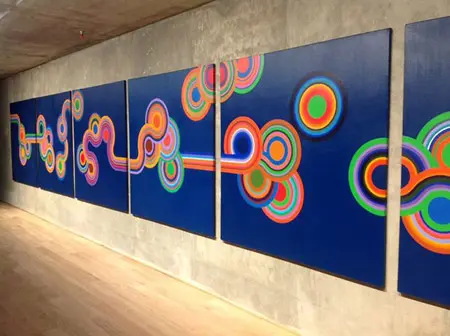
Kazuya Sakai
Until September 29, the Museo de Arte Contemporáneo–Buenos Aires (MACBA) presents the exhibition entitled Kazuya Sakai. Painting Through the Spirit of Music, with a selection of paintings from ten different collections.
Curated by Rodrigo Alonso, the exhibition centers on a singular period in the career of the Argentinean-Japanese artist, a period characterized for his tributes to contemporary and avant-garde musicians. Created during the decade of the 1970s, the works are based on themes and procedures that are closely related to experimental music and jazz in particular.
Kazuya Sakai was born in Buenos Aires in a Japanese family. He began to paint as a self-thought artist during the 1950s while he worked in the promotion of the Japanese culture in Buenos Aires, as a lecturer, teacher and translator. The first artworks by Sakai subscribed to the current of geometric abstraction and he gets together with the local concrete artists. He gradually begins to incorporate calligraphic signs in his works, as he connects them to the education that he received in Japan and to the informalist movement.
During the early half of the 1970s, Sakai settles in Mexico City, where he begins to develop a rigorous geometric aesthetic. Toward 1973, he draws inspiration from the work of Japanese master Ogata Korin (1658-1716). From the study and interpretation of the Seventeenth Century master's imagery, Sakai develops works that include parallel and undulating bands that transit across large planes of saturated and brilliant colors.