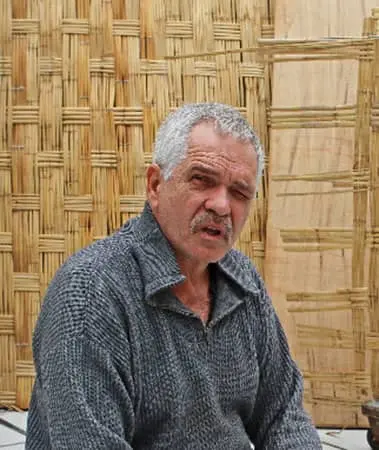
Juan Javier Salazar
Peruvian artist Juan Javier Salazar died at the age of 61. He was a brilliant member of the EPS Huacayo Group (1979-1981) and of the Paréntesis Group (1979).
Salazar studied art at the Sociedade de Belas Artes, in Portugal, (1972) while concurrently studying architecture at the Universidad Ricardo Palma. He then studied art at the Escuela Superior Autónoma de Bellas Artes in Peru (1973-1976). Throughout his 40 years of artistic production, Salazar presented numerous exhibitions in Peru and throughout Latin America (Cuenca Biennial, Chile Triennial, Pinacoteca de São Paulo, among others). He also participated in the 2007 COAST International Artists Workshop in Liverpool. He created some of the most important works of Peruvian conceptual art, including: the intervention—made with nearly 12,000 painted cans of milk—created in collaboration with EPS Huayco at a sandy area during the early 1980s: "Sarita Colonia."
Committed to a new kind of politically-charged popular aesthetic, in 1981 Salazar began a painting project on panels that revised the history of the Peruvian Republic. In Peru, país del mañana (proyecto para hacer un mural cuando tenga el dinero, mañana) [Peru, Country of Tomorrow (Project for a Mural when Money is Available, Tomorrow)] Salazar ironically addressed the failures of the Peruvian state by repeating on vignettes the faces of presidents and dictators consecutively saying "tomorrow." This piece became a referent in his trajectory and he even made several versions of it. The social nature of his work became evident in the action titled Perú Express, in which, on the days of July 28 (the Day of Independence of Peru), Salazar would get on city buses to offer Peru-shaped stuffed toys with tails in exchange for a few coins. He repeated this performance in the expression "to give back citizens the possibility of having their country in their hands." This type of action allowed Salazar the possibility of articulating his work in a space that is parallel to the art system. The precariousness of some of the materials and supports used emphasized the potential of the images drawn in them, like in the series "The last cartridge." This series addressed Peruvian identity through constructions of spheres on wheels. He relied on several disciplines, including engravings, paintings, videos, installations, public interventions and performances, in addition to the continuous productions of contemporary huaco pottery.
Salazar's work perfectly exemplified a type of rational thought that was also magical. In 2001, he performed a well-remembered public intervention in which he covered the equestrian statue Francisco Pizarro, located in downtown Lima, with a fabric stamped with the image of an Incan wall—in a poetic turn of events, the monument was eventually disassembled by the municipal government.
In 2015, at age 60, the importance of his artistic trajectory was recognized with two large exhibitions: "Juan Javier Salazar, Unleashed" at the Centro Cultural de San Marcos, and "60 Great Non-Hits" at the Sala Luis Miroquesada Garland. It was in this great context when he presented his last grand version of the piece Perú, país del mañana, in collaboration with several artists from various generations. His generosity and ingenuity to tell stories made having a conversation with him a way of looking into his work. His passing leaves a great void in the cultural scene of Peru.