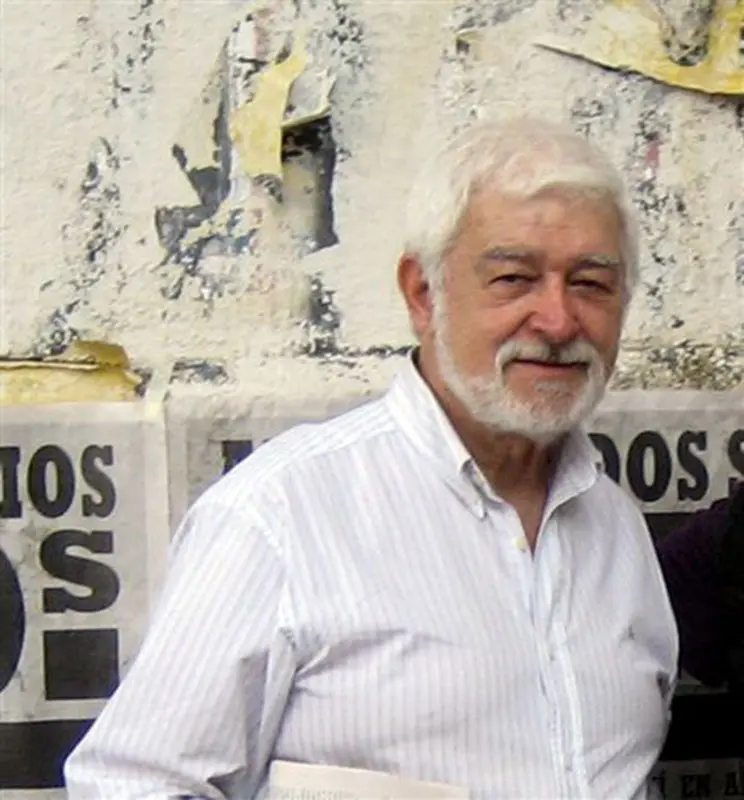
ObituaryOctober 16, 2017
Juan Carlos Romero
Artist Juan Carlos Romero (Argentina, 1931–2017) died on April 22 in Buenos Aires, one month before the inauguration of the exhibition in which he had been working for the last year and a half of his life. He was 86 years old. "Juan Carlos Romero. The Disappearance" opened on May 27 at the Remembrance Park-Monument to the Victims of State Terrorism, during an inaugural event that served as a double tribute to one of the most politically-conscious Argentinean artists who, through his work, was able to confront all forms of power—political, religious, economic—even the one wielded by art institutions in connection to the circulation and reception of works of art. Graphic art, visual poetry, photography, mail art, and installations were part of a vast artistic career that also included performance art, experimentation with engraving and ephemeral works in alternative spaces, teaching at universities and trade union activism. Relying on conceptual art as an instrument of resistance and on the printed word as his palette, Romero eliminated the artistic object and placed it with the abstract world of ideas. His training as a telephone technician instilled in him a profound interest in the different forms of communication. He was a member of the Grupo de los Trece that emerged from the Centro de Arte y Comunicación (CAyC), a group directed by Jorge Glusberg; was part of the team at the visual poetry periodical Diagonal Cero, founded by Eduardo Vigo in La Plata; and of the Grupo Escombros. With a low profile that avoided unnecessary attention, Romero worked with tangible data that informed his struggle against forgetting. As a guest artist in the Ljubljana Biennial of Graphic Arts, Romero presented an installation that consisted almost entirely of periodicals. He selected printed and photocopied words from the print media and used them to try a new form of communication. He took with him an entire month worth of newspaper copies and created new chronicles every day by tearing certain pages out and selecting certain words—like hostages, devastated, less, resist. Once his daily editions were completed, he arranged the elements of each daily news edition across the floor and on the walls. In this renovated context words and signs acquired new significations and a relevance that the original older newspapers had already lost by then. Romero's installation formulated questions about the different ways of reading and the notion of materiality and intellectual property. So simple and profound is his work that it demands reflection, interpretation. He was still able to attend last year's presentation of the reissue of his famous installation Violencia (Violence) at the Museo Reina Sofía in Madrid (2012) and at the Museo Nacional de Bellas Artes in Buenos Aires. He covered the exhibition area from top to bottom with a repeated poster with large characters that formed the word Violencia using newspaper clippings and fragments of texts by other authors. The installation had been originally created in the violent year of 1973 at the CAyC. It is a never ending work whose ever ambiguous but memorable meaning will now be established by a living public in 2017. A few days after his death, several posters designed by Romero began to appear on walls along Calle México, the street where he lived. It was most likely a loving tribute to him and his popular support—inexpensive typographic posters with high communicational value—by his partner María Esther Galera. Created to be displayed on public areas, his art has returned to the streets. Juan Carlos Romero was my friend and my neighbor. He will be missed.