Juan Acha, For a New Artistic Phase
To mark the one hundredth birthday of artist Juan Acha, the Museo de Arte Moderno in Mexico City worked jointly with "Los Yacuzis. Grupo de Estudios Sub-Críticos" (Group of artists, historians, editors, journalists, and curators that emerged from the second generation of the Escuela de Crítica, organized by INBA's Proyecto Siqueiros at La Tallera in Cuernavaca) to curate an exhibition that would revise and update the figure of this Peruvian theoretician and art critic.
There continues to be a connection or bridge between Juan Acha's thorough analysis of the local (and regional) artistic scene and its diverse manifestations and the group's interest of this group to critiquing (sub-critiquing) to open new paths of expression and to leave a record of them. Juan Acha was one of the key figures of the 1970s in the Latin American art scene in general and in the Museo de Arte Moderno in Mexico City in particular.
During Fernando Gamboa's directorship of the museum, Acha was in charge of coordinating exhibition programs, acquisitions, education, and publications. His vision of art (or rather, his take on the different art forms) became central, not only for the development of the Latin American art scene that emerged from the metropolis (regardless of which one), but also for eventually defining the differences between high art, crafts and design; outlining their respective uses and exploitations, catalogs and artistic productions through various public and private institutions.
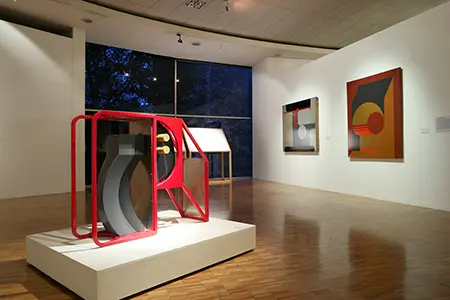
Supported by several cultural institutions, this group of critics based their work on five central themes—new muralism, Mexican geometric abstraction, technological art, iconic-verbal art, and non-objectual art—that are analyzed to examine the museum collection, display emblematic works in the exhibition rooms, as well as to outline and discuss the directions that art has taken—away from the belligerence of the self-proclaimed Third World and towards the, always paradoxical, construction of the global village.
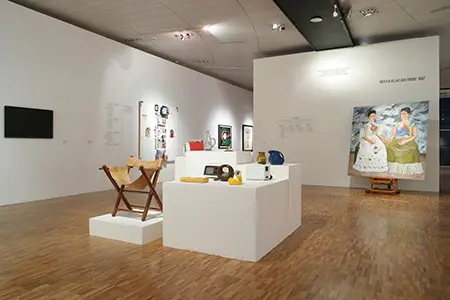
The group figuratively appropriated a collection, an institution and a prominent figure, to lay out a literal camp in the exhibition space. Works by artists like Diego Rivera, David Alfaro Siqueiros, Kati Horna, Arnold Belkin, Gelsen Gas, Juan José Gurrola, Felipe Ehrenberg, the Suma Group, No Grupo, Hersúa, Ómar Rayo, and Víctor Vasarely, among others, interact with those pieces created by the group based on the inquiries developed from the collection, in a map that overlaps and erases the boundaries between historic moments.
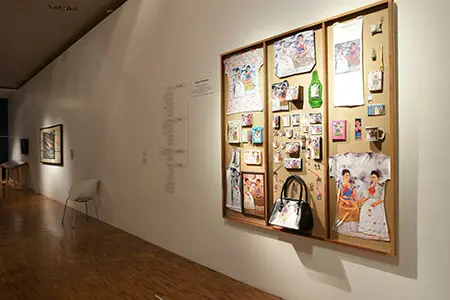
Considering that this art was created in the time of mechanical reproductions—as important to Benjamin as it was to Acha—noteworthy of mention are the mosaics created by Daniel Aguilar. They were assembled with 4,000 Mexican pesos worth of memorabilia of the work Las Dos Fridas (The Two Fridas), bought at the Mercado de Artesanías of Coyoacán (a crafts market) and in the gift shop of the Museo Frida Kahlo. It is a meditation on prices, spaces, affordability and accessibility based on the versions and supports on which the image of this emblematic work of the museum is reproduced (The original work is currently on loan and, for the purposes of this exhibition, was deliberately replaced with a copy created by Héctor Pérez in 1977 (which is also part of the collection).
Also included in the exhibition are works from the collections of: Sala de Arte Público Siqueiros—La Tallera—Museo Archivo Diseño y Arquitectura, and Espacio de Arte Contemporáneo. This exhibition inaugurated the project #JuanAcha100, developed with the collaboration of CENIDIAP, Ex-Teresa Arte Actual, the Centro Cultural Tlatelolco, the Instituto de Investigaciones Estéticas, the MUAC, Biquini Wax E.P.S. and Alumnos 47.
Gallery