ObituarySeptember 14, 2016
José Balmes Parramón
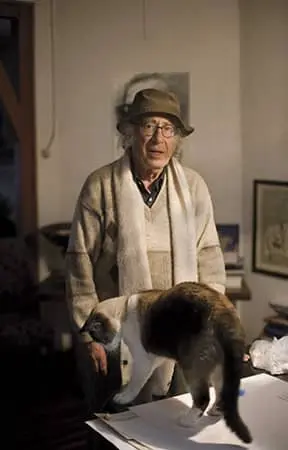
José Balmes-Parramón (1927-2016) migrated to Chile from Spain with his parents. He arrived on the Winnipeg, a boat contracted by the Chilean government to bring to Chile people who had been forced to flee to France following the defeat (in 1939) of the Popular Front in Spain. In his capacity as consul, poet Pablo Neruda was in charge of organizing the journey to Chile of 2,000 Spanish refugees. After several years living in Chile, in 1947 Balmes-Parramón was eventually able to obtain the Chilean citizenship. Speaking about his adoptive country, Balmes-Parramón said, "Even if I spend my entire life trying, I will never be able to do enough to repay the fact of living in this country and becoming one of its citizens. And I have Pablo Neruda to thank for this. Like someone once said 'love debts can never be paid in full,' and I will always be in his debt." Balmes-Parramón was born in 1927 in Montesquiu, a small village in Catalonia. His father, Damia Balmes, became the mayor of that town as a member of the Republican Left of Catalonia (ERC). Because of this affiliation, after the defeat of the Republic, young José was forced to flee to France with his family. In Chile, Balmes-Parramón studied at the Escuela de Bellas Artes of the Universidad de Chile where he was later hired as professor and eventually became its director. He dedicated his life to teaching in various universities. In 1972, he was named Dean of the Faculty of Fine Arts of the Universidad de Chile, a post that he was forced to resign from after the 1973 military coup. Balmes-Parramón leaves Chile and travels to France where he will reside until 1986. In that country he taught art at the Université Paris-I-Panthéon-Sorbonne. After his eventual return to Chile he taught painting the Universidad Católica and at the Universidad Finis Terrae. He married Gracia Barrios—winner of Chile's National Prize of Visual Arts—and had a daughter with her that they named Concepción, also a painter. Balmes-Parramón's teaching influenced several generations of artists, including Eugenio Téllez, Eugenio Dittborn, Eliana Simonetti, Catalina Mena, and Carolina Oltra, among others. In 1947, he founded the Grupo de Estudiantes Plásticos GEP with other important artists. Later on, he organized, and was a member of, the Grupo Signo, a name coined by art critic José María Moreno-Galván. The group's only exhibition was presented in Spain and included the participation of Gracia Barrios, Alberto Pérez, and Martínez-Bonati. The Museo de la Solidaridad was an initiative of left-wing intellectuals who visited Chile during Salvador Allende's government. Its objective was to bring together works of art created by artists from around the world in solidarity with the people of Chile. Eventually, Brazilian art critic Mario Pedrosa would push for this agreement and Balmes-Parramón, along with Miguel Rojas-Mix, would form a National Commission to receive the works arriving from around the world, forming a unique legacy solely owned by the people of Chile. Balmes-Parramón in the art of Chile: Balmes-Parramón must be regarded as the ideal representative of the Informalism Movement in Chile. According to the artist himself, he began his artistic activity at a very young age in Montesquiu, where he entered into contact with the so called late impressionists, including Santiago Rusiñol. At the age of 10, he would go to the town's movie theater to draw in the dark the clothes worn by the screen actresses so his mother, a dressmaker, could pattern her designs after his drawings. In Chile, at the Escuela de Bellas Artes he was taught by P...