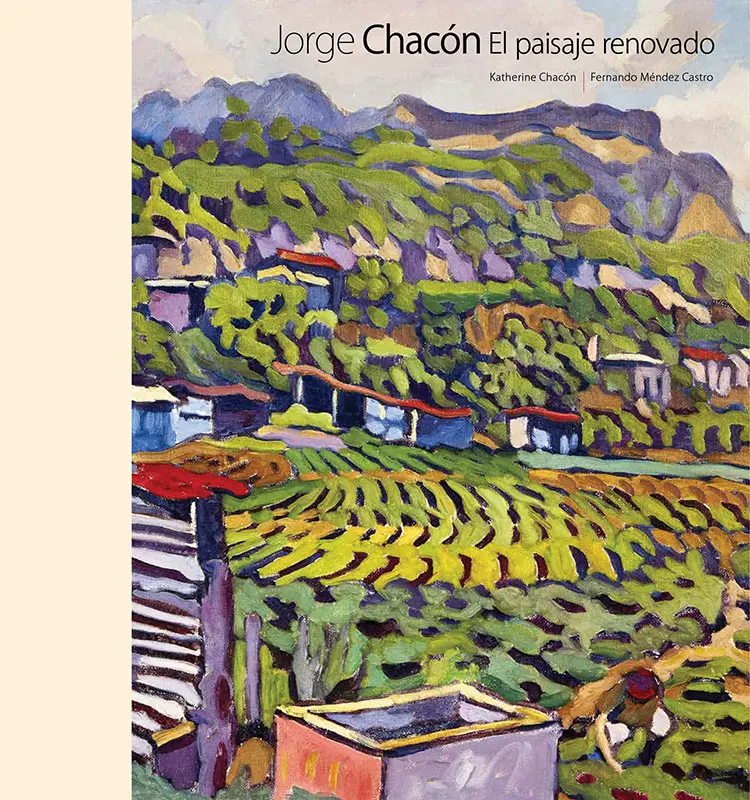
Jorge Chacón. El paisaje renovado (The Renewed Landscape)
Landscape is a recurring motif in modern and contemporary Venezuelan art. One of the main representatives of this current was Jorge Chacón (San Cristóbal, Táchira, 1933–La Victoria, Aragua, 1992), whose legacy has been reappraised by a recent volume published by Rojo Espeso at the request of art collector Fernando Méndez Castro, and edited by curator and art researcher Katherine Chacón.
Titled Jorge Chacón. The Renewed Landscape, the book examines various stages of his creative career through a wide selection of images, analytical texts and various testimonies. The volume highlights significant aspects of Chacón’s life and work, such as his peasant origins, education, artistic sources, and particular style of vernacular landscaping, a genre that he cultivated under the influence of Post-Impressionism and Fauvism, but from a singular perspective rooted in his immediate environment.
This volume also highlights his leading role as a member of the Sabaneta Group, active in the rural town of Sabaneta, in the state of Aragua, where Jorge Chacón lived and worked since the early 1980s. Another commendable aspect of the book lies in the pertinent incorporation of quotes by the artist when addressing the foundations of his artistic credo. Here is one example: “Nature has always set the tone, and inspires me” (p. 11).
Motivated by the intensity of light and color in his local landscape, he preferred to work “in bright sunlight... because if I stayed in the workshop I would fall into a kind of formula painting.... If you are observing your surroundings, then you are not copying, but making your own work” (p. 15). Based on this premise, his production, with all its tonal impetuosity and compositional efficiency, emerged and developed in direct contact with his immediate environment.
The fertile repercussions of his pictorial conceptions are well explained by Katherine Chacón, who analyzes different facets of a work whose themes include landscapes, patios and plots of land, flowers and foliage, as well as country and city life. “Jorge Chacón’s painting,” the author points out, “achieved something remarkable: a style that made it instantly recognizable. He was different, bold, personal” (p. 9).
Fernando Méndez Castro offers a personal and heartfelt approach marked by respect and admiration for the artist. His essay recognizes the irreducible strength of Chacon’s talent and his ability to manifest it even in the most unfavorable conditions.
Researcher Félix Hernández and artist J. J. Moros also commemorate the work of Jorge Chacón in their essays. Gladys Yunes and Anny Bello, in charge of the archival research and the bibliography respectively, provide meaningful and consistent information about his biography, exhibitions, recognitions and collections.
The flawless design by Pedro Mancilla, the careful photographic register of the works by Moris Moreno and the portraits by Carlos Germán Rojas enhance the graphic display of the contents and images that make up this 192-page trilingual edition (Spanish, English and French.
At a time when national artists’ archives, documents and legacies are endangered by institutional precariousness and indolence, this publication evidences the importance of art collecting and research for the rescue and enhancement of artistic memory. With these attributes, Jorge Chacón. The Renewed Landscape constitutes an invaluable contribution to the study and dissemination of the work by this renowned artist and its outstanding significance for the twentieth-century Venezuelan visual arts.