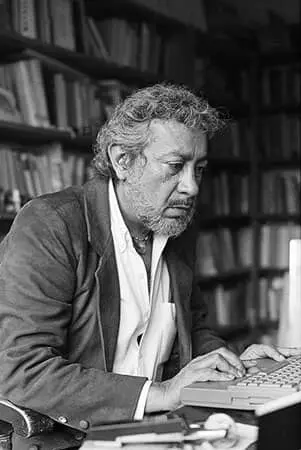
ObituaryNovember 23, 2016
Jorge Alberto Manrique-Castañeda
"Knowing how to listen is perhaps the best way to enrich one's life: knowing how to express and defend one's point of view is perhaps the best way to enrich the lives of others." Jorge Alberto Manrique Mexican art critic Jorge Alberto Manrique died in early November. A central figure in the advancement of modern art and its distribution in the most important museums of Mexico, his innovative vision was cast across a vast and diverse cultural landscape as he proposed new models of exploration from the field of art criticism. Jorge Alberto Manrique held the directorship of the Instituto Nacional de Bellas Artes (INBA) from 1974 to 1980. During his tenure, he incorporated new areas of research in the fields of dance, popular culture, and music. A member of the Academia Mexicana de Historia, the Academia de las Artes, and of the International Council of Museums, he also directed the Instituto de Investigaciones Estéticas of the Universidad Nacional Autónoma de México-UNAM (1974-1980), founded the INBA's Museo Nacional de Arte (1982-1983), directed the Museo de Arte Moderno (1987-1998), and was a member of the Sistema Nacional de Investigadores, Nivel 3 (SNI III) since 2005. A teacher, writer, and historian closely associated with the Mexican artists of his generation, he developed important relationships and alliances on the subject of freedom of expression. Professor Jorge Alberto Manrique was one of the most prominent teachers at the Department of Philosophy and the Arts and a prominent researcher at the UNAM's Instituto de Investigaciones Estéticas. He authored nine books and collaborated in the edition, co-authorship or publication of articles in more than one hundred and forty books. His most important works centered on history and art history and were published in Colombia, France, Italy, Mexico, Poland, Spain, Germany, the United States, Brazil, and Argentina. He published more than two hundred articles as contributor for the periodicals Plural, Universidad de México, La Palabra y el Hombre, Diálogos and for the Mexican newspaper La Jornada. He was a student of Professor Edmundo O'Gorman, who in 1973 gave the response to his dissertation on the Historical Ambiguity of Mexican Art. He became a member of the International Association of Art Critics (AICA). He maintained a close relationship until the last days of his life with art critic Teresa del Conde, with whom—at the end of the 1980s and beginning of the 1990s—he co-authored a book of "absurd letters" titled Una Mujer en el Arte Mexicano. Memorias de Inés Amor (A Woman in Mexican Art. Memories of Inés Amor). This collaboration stemmed from their shared predilection for the diaries, memories, and stories from letters or traveling journals. During this same period, Manrique became the central figure of an important moment (as director of the Museo de Arte Moderno) on behalf of artistic freedom in Mexico, when, on January 23 of 1988, the Pro Vida group successfully demanded (despite a well-established defense) the dismantling of an installation by Rolando de la Rosa that consisted of a Virgin of Guadalupe with the breasts of Marilyn Monroe, a Jesus Christ that resembled Mexican film star Pedro Infante, and a Mexican flag stepped on by cowboy boots. Under this context of protests by far-right catholic groups, Manrique was forced to resign. His closest colleagues included Carlos Blas-Galindo and Aurelio de los Reyes, among many others. A warm and incisive teacher open to dialogue about differences, Manrique's lucid mind unsettled the conservative canons of Mexican society within the visual arts realm. His legacy will live on not only through the work that he left behind, but also through the coherent influence that he e...