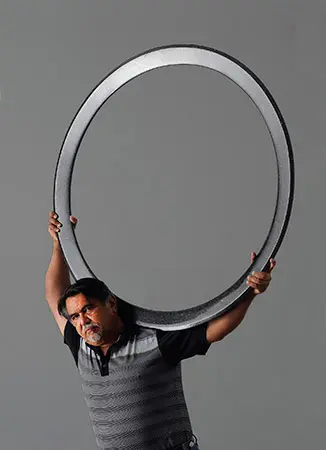
ObituaryJune 26, 2015
Jesús Moroles
Jesus Moroles once remembered the first time he engaged granite: "I was holding a hammer with both hands, I had on earplugs, goggles, a dust mask, a scarf around my neck and a hardhat. The overalls I had over my own clothes were covered with a cake of dust. I couldn't hear, or see anything (...). When I stopped, I realized there were about thirty people around me watching what I was doing. The stone took over. It was so hard it barely showed what I had done to it. I had not even scratched it! But it controlled me. I fell in love with it." When Moroles was thirty years old, he undertook a pilgrimage to Pietrasanta, Italy. As he was climbing the worn-out marble steps leading to the legendary quarries of Carrara, he understood that he wished to produce work that could be placed in the world so that people could touch and interact with it. Thus, his sculpture was not to be made from the marble with which Michelangelo carved his Moses, but rather from the granite of the great Egyptian pyramids and the walls of Tenochtitlan. He spoke about marble with some disdain: "It's so soft you can cut it with a nail file", whereas granite was a fundamental element to him, "the living stone" and "the core of the universe." That is why Moroles worked almost exclusively with granite, a material whose hardness and unpredictability frightens away many sculptors. Moroles was a shaman of stones. He thought every stone had a soul and that his mission was to liberate it while leaving its heart intact. "I've got to be able to listen to each stone while it's being worked on. Each piece resonates differently and reacts differently, so I pay attention to what the stone tells me it wants to do." These statements may appear somewhat incongruous given that Moroles' stereotomy—his art of cutting stone—is a craft of mathematical and technical precision involving powerful diamond saws and pinpoint accuracy. Nevertheless, even his most geometric and rectilinear sculptures manifest their forms with the naturalness of quartz crystals. The intimacy that Moroles developed with stone was such that he could predict exactly what its behavior and even its "voice" was going to be. In 1993 the Houston Chronicle's art critic, Patricia Johnson, reviewed his show "Tearing Granite: Thunder in the Stone" at Davis/McClain Gallery, describing an evening of sculpture, music and dance. The musician David Schrader and a dance group from Moroles' alma mater, North Texas State University, were part of the performance. Moroles carved keys on stone sculptures like Black Musical Stele (1999) so that they could be played as musical instruments. Schrader accompanied a sound recording that had been prepared previously playing the steles as if they were xylophones (with sticks, stones and wire brushes), using Molcajete (grinding stone) as a drum. The recording was Larry Austin's composition Rompido (sic), rendered with the deafening sounds of hammering, high-powered saws, grinders and other machines used for cutting and moving large granite sculptures. The dancers, choreographed by Sandra Combest, climbed onto mobile sculptures like Moonscape Ring (1993)— an enormous oval piece of granite weighing 3,480 pounds. Notwithstanding its tremendous weight, Moonscape Ring could roll like a bicycle wheel, making its own sound along the way. The highlight of the performance occurred when one of the steles was struck with enough force to play a certain note: one that caused the stone to break in half. In 1987 Moroles completed Lapstrake, a 64 ton, 22 foot tall sculpture for the E.F. Hutton, CBS Plaza located across the street from the Museum of Modern Art in New York City. Over 2,000 works by Moroles are scattered around the world; in China, Egypt, France, Italy, Japan, Switzerland and the ...