ExhibitionJune 3, 2015
Jean-Baptiste Debret
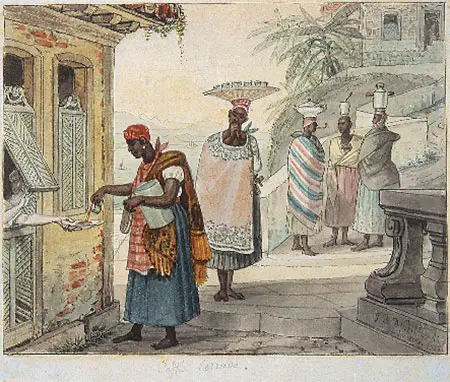
Rio de Janeiro was once again visited by French artist Jean-Baptiste Debret. His first stay in tropical lands occurred when he was sent to Brazil at the beginning of the nineteenth century as a member of the French Mission, whose goal was to establish the first school of fine arts in the then provisional headquarters of the Portuguese Crown. Debret ended up becoming one of the greatest chroniclers of the Brazilian everyday life of that century. Trained as a neoclassical painter, Debret found in Brazil both an expanded color palette and a wide array of characters that he incorporated in his painstaking and refined compositions. Social relations, the role of African slaves in the economy, the customs of women in society and a transformed architecture—to accommodate the needs of an emerging urban center—were the themes that the French artist portrayed and left as historical documents for future generations. After returning to his homeland, he published a three volume didactic book for the European public titled Voyage Pittoresque et Historique au Brésil, ou Séjour d'un Artiste Français au Brésil (A Picturesque and Historic Voyage to Brazil, or the Sojourn of a French Artist in Brazil), which contained engravings accompanied by descriptive texts. The exhibition "Debret's Rio de Janeiro" presents 120 watercolors and drawings produced during the fifteen years period—from 1816 to 1831—in which the artist lived in Brazil. The works belong to the Coleção Brasiliana of the Museus Castro Maya. They are images created during his spare time when he was free from any Court related duties not solely associated with his documentary painting, but also having to do with the decoration of official events and the creation of costumes for stage plays, among other responsibilities. In his travels through this new land of people, colors and exotic smells, Debret filled his sketchbooks with quick strokes, sketches that he later worked in watercolor. The degree of detail in these drawings is impressive considering the peculiarities and limitations of a technique usually adopted for scenes with less detail. The work titled Boutique de Barbiers (Barber Shop, 1821), for example, shows a small section of society. It depicts a white lady by a window sheltered from the sun as a black female street vendor offers her goods, while an adjacent barber shop is tended by black slaves who are expected to give any money they receive to their master. Many of Debret's creations from this period are part of the repertoire of images of the Brazilian population. They were used to illustrate history books and they came to establish a link with popular culture. Some of his images of slavery were used in the opening of the 1970s Brazilian soap opera titled Escrava Isaura (Slave Isaura), a TV production was broadcast in nearly 80 countries worldwide and across five continents. Taking place at a time when the city of Rio de Janeiro celebrates its 450 years of existence, the exhibition may very well be a gift to mark the momentous occasion. According to the curator of the exhibition, Anna Paola Baptista, Debret can be regarded as "an eyewitness to history, who accompanied and portrayed political events that changed the history of Brazil," from the acclamation of Dom Juan VI of Portugal, to the arrival of Maria Leopoldina of Austria, the first Brazilian empress, and the coronation of Emperor Dom Pedro II, the child emperor.