ExhibitionMay 24, 2023
Iole de Freitas at IMS Paulista
The exhibition "Iole de Freitas, 1970s / Image as Presence" opened at the Instituto Moreira Salles on May 6, with a talk between the artist and the curator of the exhibition, Sônia Salzstein, professor of art history and theory and director of the Institute of Brazilian Studies at USP, mediated by João Fernandes, artistic director of IMS. The exhibition brings together photographs and films from the period when the artist lived in Milan, London, and New York. Little known to the Brazilian public, the works also address themes such as movement and the passage of time.
In the 1970s, Iole de Freitas lived in Milan in an environment of political and cultural effervescence; the city's galleries and museums exhibited works of arte povera, body art, and conceptual art; women artists began to gain prominence in the art circuit.
The curator comments about the period covered by the exhibition: "The radical nature of the debate on European politics at the time coincided with the first experiments in conceptual art and body art, with manifestations in which the affections and vulnerabilities of the artist's body were crucial issues. The 1970s witnessed the vibrant presence of Iole and, in general, women artists on the more daring art circuit of the time. Not coincidentally, she attended exhibitions alongside other artists pioneering the exploration of the filmic image in their work."
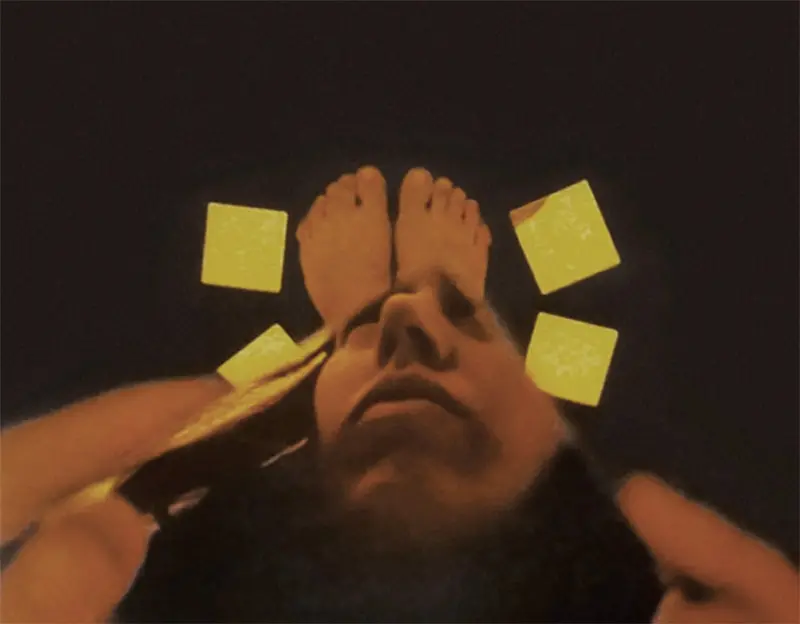
Among the works are the photographic series Spectro (1972), composed of images of the artist taken by herself in domestic settings, such as the interior of her home or studio.
The exhibition also presents the films Elements (1972), Light Work (1972), and Exit (1973), recorded on super-8. The poetics of the body is also at the center of these works, as Salzstein points out: "The versatile super-8 devices, later acclaimed by artists for their lightness and mobility, were experienced by Iole as extensions of her body, and marked the emergence of a series of audiovisual recordings in which her body emerged potentiated and involved, in multiple fragments, through a language of light and presence. Along with the exploration of the moving image, which allowed her to enter into dense and complex spaces crossed by shadows and reflections, Iole launched, throughout those years, into the photographic recording of her own body, always questioning one beyond, in stripped, silent performances without an audience, in which it is often possible to capture the act of the artist pulling the trigger of the photographic device".
Three installations were reconstructed for the exhibition: Glass Pieces, Life Slices, presented initially at the Giancarlo Bocchi Gallery (Milan) in 1976; EXIT, made for the solo exhibition at the Marconi Gallery (Milan), in 1977; and, finally, Cacos de vidro, rebanadas de vida, which explores the projections of slides from the Glass Pieces, Life Slices series on sheets of glass, in reference to the work dedicated to the 16th São Paulo Biennial, 1981.
The exhibition proposes a central approach to the artist's career, in which she begins to explore themes such as movement and transparency, which would mark all of her later work.
For more information, visit: https://ims.com.br/unidade/sao-paulo/
In the 1970s, Iole de Freitas lived in Milan in an environment of political and cultural effervescence; the city's galleries and museums exhibited works of arte povera, body art, and conceptual art; women artists began to gain prominence in the art circuit.
The curator comments about the period covered by the exhibition: "The radical nature of the debate on European politics at the time coincided with the first experiments in conceptual art and body art, with manifestations in which the affections and vulnerabilities of the artist's body were crucial issues. The 1970s witnessed the vibrant presence of Iole and, in general, women artists on the more daring art circuit of the time. Not coincidentally, she attended exhibitions alongside other artists pioneering the exploration of the filmic image in their work."
Among the works are the photographic series Spectro (1972), composed of images of the artist taken by herself in domestic settings, such as the interior of her home or studio.
The exhibition also presents the films Elements (1972), Light Work (1972), and Exit (1973), recorded on super-8. The poetics of the body is also at the center of these works, as Salzstein points out: "The versatile super-8 devices, later acclaimed by artists for their lightness and mobility, were experienced by Iole as extensions of her body, and marked the emergence of a series of audiovisual recordings in which her body emerged potentiated and involved, in multiple fragments, through a language of light and presence. Along with the exploration of the moving image, which allowed her to enter into dense and complex spaces crossed by shadows and reflections, Iole launched, throughout those years, into the photographic recording of her own body, always questioning one beyond, in stripped, silent performances without an audience, in which it is often possible to capture the act of the artist pulling the trigger of the photographic device".
Three installations were reconstructed for the exhibition: Glass Pieces, Life Slices, presented initially at the Giancarlo Bocchi Gallery (Milan) in 1976; EXIT, made for the solo exhibition at the Marconi Gallery (Milan), in 1977; and, finally, Cacos de vidro, rebanadas de vida, which explores the projections of slides from the Glass Pieces, Life Slices series on sheets of glass, in reference to the work dedicated to the 16th São Paulo Biennial, 1981.
The exhibition proposes a central approach to the artist's career, in which she begins to explore themes such as movement and transparency, which would mark all of her later work.
For more information, visit: https://ims.com.br/unidade/sao-paulo/