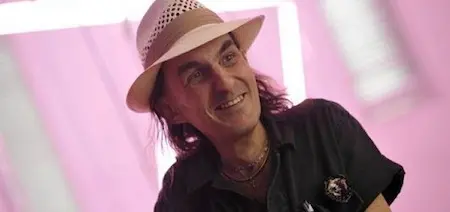
Hudinilson Jr., or, The Artist Who Did Not Listen to the Siren’s Song
It has never been easy to resist the Siren's song, and even less not to fall prey to their spell. Especially when it promises benefits, lucre, and advantages… In the case of Hudinilson Urbano Junior (São Paulo, 1957-2913), it was clear from very early on that there were other, more poetic songs that the artist was following, and that he would not be mesmerized by the standardized melodies of success or prestige when wielding the truth of a biography rendered into a living poetics, wherein life and work were to interconnect their tense threads, their plot like a drift (a flux that is in part Fluxus-like). In fact, and as one of the most marginal artists in Brazil's aesthetic history (without forgetting the semi-forgotten place occupied by Oiticica for many years), he carried out an artistic practice at the extreme of experiences and supports, at the limit of their pre-conceived nature (and in consequence within the conceptual and media polyvalence of the 1970s and 80s); and, in sum, that boundary line where forms and concepts are configured and interact with friction with their context (not just political, but also cultural and institutional). Thus, when dictatorship was the gray-colored background of life in Brazil, transgression responded to the officially legitimized normalization of violence—manu military. With the democratic and post-democratic era—lived by Hudinilson through the absolute de-mystification of his idealistic political pedigree—violence was victimized and considered the exclusive domain of the State, which is to say, prohibited to any kind of concurrence. Detecting this resulted in a certain critical clarity, but also in certain contractual risks, run in an intense itinerary filled with important contrasts. This is the case of the four years of existence of the 3NÓS3 (1979-1982), formed with Mário Ramiro and Rafael França, oriented towards a more non-conformist urban intervention. Their 11 resounding public actions retain the mark "of transgression, of illegality, and of the expression of thoughts and practices marginal to the official process," as the annals of art have recorded, and were worked with attention to social communication.
Beyond this public terrain, where another highlight is his use of stencil-based graffiti (in the 1980s, some times in the company of Alex Vallauri, from whom he received guidance), Hudinilson Jr. experimented with many artistic expressions: drawing, painting, mail art, Xerox art (of which he was a pioneer in Brazil). And, as is the case with Alair Gomes or Victor Arruda, it is possible to recognize in the São Paulo artist a—militantly homoerotic—imagetic introspection of the male body, which fueled emblematic works like a "Xerox performance" of his own body in Exercicios de me ver (starting in 1982), but also hundreds of agendas as sui generis artist's books where he mixed iconography resulting from a variety of universes (mass media, film, art) resembled the transversal visual spirit of Aby Warburg's Atlas Mnemosyne.
Like an unruly, contrarian, rebellious Narcissus, ravaged by alcoholism and marginalized in the context of the São Paulo art world—a sign of the marketplace in the country—Hudinilson was only recently "recovered" and presented two solo exhibitions at Jaqueline Martins gallery, and his historic oeuvre was presented at ARCO 2013 with great international response. Previously, he participated in the 1st Havana Biennial and the exhibition Arte Xerox Brasil at the Pinacoteca do Estado de São Paulo, of which he was a curator (both in 1984). Hudinilson exhibited his work at the 18th São Paulo Biennial (1985) and the 3rd Mercosur Visual Arts Biennial (2002). A panoramic exhibition...