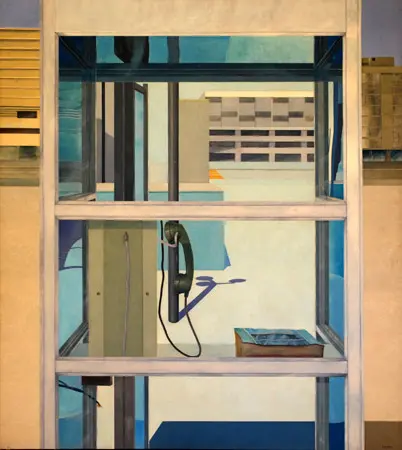
Hernán Miranda 1979 – 2013
One of the year's highlights at Chile's Museo de Bellas Artes is the first retrospective of Hernán Miranda's work, which remained open to the public through July 16th. The show featured more than 40 works, grouped under different concepts, such as "Urban Landscape."
Miranda uses oils and acrylics to represent political, military, and social scenes that are commonly associated with recent Chilean reality. Inspired by photographs taken from the media and in history books, Miranda engages in a re-reading through a sustained chromatic pattern and a coherent realistic technique. In Cuerpo de Chile, his most recent series, unseen until now, copper is used as support: this material is of great significance in Chile, one of the world's leading exporters of the metal. Alongside Miranda's paintings, the exhibition included his series Biombos and Imagen latente, which bring together pictorial and installative elements following an aesthetic that is based on the natural world (birds and grids formed by tree branches). Miranda, born in Valdivia in 1949 and the Director of the city's Museo de Arte Contemporáneo, recreates everyday and historical events in an allegorical and personalized manner. This anthology show, in one of the Chilean capital's most important museums, brings to today's audience the product of a long career, including works created more than 30 years ago, from his combinations of works and artists of historical import, such as Dürer, to contemporary images of helicopters and tanks, a phone booth, or political leaders or worldwide renown. The dialog between the classical and the postmodern is repeated in several of Miranda's paintings, updating genres forgotten by contemporary art, such as equestrian portraiture, royal portraiture, and military scenes, always with a realistic technique and the use of bright colors (often including a contrast of complementaries).