ExhibitionMarch 10, 2017
Hélio Oiticica To Organize Delirium at The Art Institute of Chicago
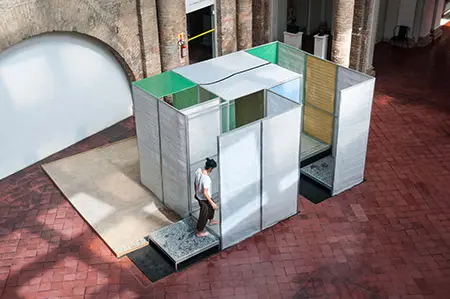
The exhibition Hélio Oiticica: To Organize Delirium at the Art Institute of Chicago has recently been inaugurated as the most comprehensive retrospective of the Brazilian artist in the United States. One of the most influential artists of the twentieth century, Oiticica was a pivotal member of the Neo-Concrete group, a movement of Brazilian artists that formed in 1959 seeking to impart the geometric investigations of Concretism with emotion, sensuality, and subjectivity. Early in his career, Oiticica pioneered the concept of participatory works, which reimagined the traditional boundaries between art and life. To Organize Delirium is the first retrospective to emphasize the significance of Oiticica's later works, created during his time in New York after receiving a Guggenheim Fellowship (1971-78) and during his return to Brazil (1978-80). To Organize Delirium presents a multifaceted look at Oiticica's vast body of work, from his geometric, abstract Metaesquemas to the translation of ideas into the third dimension. James Rondeau, President and Eloise W. Martin Director of the Art Institute of Chicago, writes, "His beautiful and brilliant craziness presaged some of the most durable art of the last fifty years. Hélio Oiticica could never have predicted the vastness of his influence – It is a legacy that the majority of his inheritors, historians and artists alike, have yet to fully metabolize." Oiticica's inquiries into the potential of architectural space include Penetrables and Tropicália (1967), colorful structures inspired by the favelas of Rio de Janeiro. Tropicália, a large-scale installation featuring sand, gravel, exotic birds, and plants, rebelled against Brazil's oppressive military dictatorship and rightwing conservatism by embracing a purely Brazilian art. Viewers will also have the opportunity to participate in Oiticica's interactive works by wearing his Parangolés, works in fabric that reveal political or poetic messages when in motion. These works highlight how Oiticica insisted upon the power and potential of human autonomy and social interaction. The exhibition premiered at the Carnegie Museum of Art, Pittsburgh, and after showing at the Art Institute of Chicago by May 7th, will make its final stop at the Whitney Museum of American Art, New York. It is organized by Lynn Zelevansky, The Henry J. Heinz II Director, Carnegie Museum of Art; Elisabeth Sussman, Sondra Gilman Curator of Photography, Whitney Museum of American Art; James Rondeau, President and Eloise W. Martin Director, Art Institute of Chicago; and Donna De Salvo, Deputy Director for International Initiatives and Senior Curator, Whitney Museum of American Art; with Anna Katherine Brodbeck, Associate Curator, Carnegie Museum of Art. For more information visit: http://www.artic.edu/exhibition/h-lio-oiticica-organize-delirium