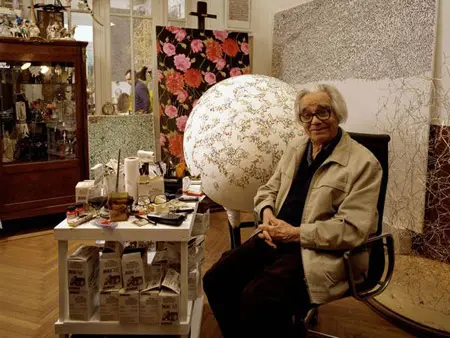
Farewell to our León
León Ferrari, one of the Twentieth Century's most significant artists, a tireless thinker and activist, a great friend and unmatched collaborator, has departed. I had the tremendous privilege of working alongside León on several occasions, and visited his home and his various studios every time I traveled to Argentina. In those fascinating spaces, filled with impossible objects and transgressive images, I witnessed his indefatigable efforts and shared conversations peppered with humor and irony. An intelligent and jovial León, always at the avant-garde of ideas and historical events, reigned that magical world populated by plastic floras and faunas, magnificent calligraphies, and santería sculptures. Those conversations inevitably moved towards the topics of injustice, suffering, oppression, and the violence that is implicit in all dogmas.
In 2004 León wrote an essay in response to Susan Sontag's well-researched Regarding the pain of others, which explores the indifference of intellectuals confronted with the horrific images that populate the history of art. León debated the position adopted by the American writer, who condoned suffering in connection to sacrifice, an intrinsically Christian alliance that, for her, contrasts with a modern sensibility.
That same year, León's retrospective exhibition at Centro Cultural Recoleta was condemned by Archbishop Bergoglio, today Pope Francis I, who saw it as "an affront to a Christian people and to people of good will whose taxes support the Centro." Bergoglio's censure had important repercussions, causing the temporary closing of the show, later reopened by judicial decree. But the most important effect of the confrontation was to incite a substantive debate about the role of art, censorship, and freedom of expression in Argentina.
Especially significant in León's prolific production are his many iconoclastic works, used as missiles against suffering, and his exaltation of religious painting. León created an unequaled, fiery poetics and accompanied it throughout his life with permanent positive civic actions. His life punctuated by tragedy transformed him into a champion of human rights and a tireless participant in the struggle to restore memory to a country and a continent where amnesia so often prevails. In that realm, and as an artistic contribution to the report of the National Commission on the Forcible Disappearance of Persons (CONADEP in its Spanish acronym), Ferrari produced the hair-raising series of images titled Nunca más ("Never Again"), published by the newspaper Página 12 in the form of widely circulating weekly inserts that a government decree made mandatory school reading in 1995.
There have been many international exhibitions of León Ferrari's work, but perhaps the most memorable was his participation in the 52nd Venice Biennale, where he won the Golden Lion, a first for an Argentinean artist. As was his habit, and even at that moment of great international achievement, his humility was genuine and his greatest pride was the opportunity to have his message presented to the world, particularly from Italy, so close to Vatican City. I ran into him and his steadfast companion, Alicia, on the bridge of the Arsenale, and after a few minutes of conversation he expressed his surprise at having been given accommodations at the famous Lido hotel. "I am going to ask for a more regular place," he said. "The room is too big and luxurious for us."
León Ferrari's works using Braille writing, some of which can be seen in London as part of the exhibition Visual Poetry: The Experimental Path of Intermedia Traditions in Latin America, were the motivation for the last exhibition of his life in ...