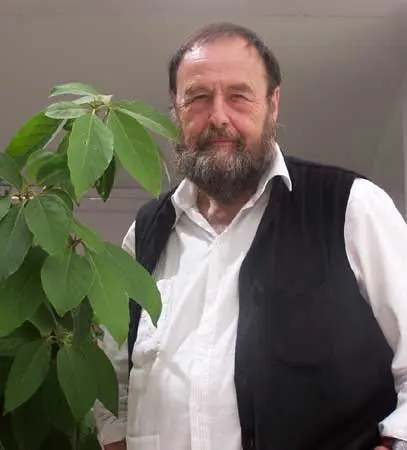
ObituaryMarch 18, 2005
Harald Szeemann
Harald has left us. I don¿t know why or to where life decided to abandon him, because I am sure that he would never have gone alone. He loved life too much and his aura enveloped us in a magic way. Harald Szeeman, one of the most celebrated curators in the world and one of the most generous people we have known, has passed away. The world of art will never be the same, and we will never be the same after having known him. I remember my visit to Tegna in Ticino, at the end of winter 2000: I arrived in Zurich one Saturday morning and went to Bahnhof to take the train to Locarno. Finally I arrived at my destination and saw Harald, like any other person, waiting in the sidewalk, with his old car parked outside, to drive me to his studio half an hour out of the city. Inside I was thinking, had this been any famous Latin American, he would have sent a chauffeur from the Museum¿ but no, this was how he was, walking history acting like a friend. We talked all afternoon, and I left with the promise that he would come to see what the Central American artists were doing. And he more than fulfilled his promise. Harry, as many North American artists and colleagues called him, who was always Harald for us, was big in all senses of the word. In November 2000, he visited us. On this occasion, he spent three days looking as catalogues, videos, reading, giving talks and meeting artists, in a marathon that he later confessed to me had been an ¿overdose¿, an orgy of documentation. None the less, in the midst of some instants of sleepiness between one artist and another, between a cigarette and a coffee, he had seen and retained everything. The long conversations over a few glasses of wine were evidence of an impressive register, the establishment of ties between the works, the respect not to show works that were not in the best condition, and an overflowing passion to see, see and see more. The result of the visit was the invitation of Jaime Tischler, Priscilla Monge, Federico Herrero, Luis González Palma, Aníbal López and Regina Galindo al Arsenal, to be part of his project Platform of Humanity of the Venice Biennial 2001. I had the honor of being part of the international jury that year, with another four curators, and unanimously, two of the prizes to young artists went to Federico Herrero and Aníbal López. Harald was special for all the participants, and when finalizing the Biennial, he hand-wrote cards to all the artists. He hated email and hand-wrote faxes, with a closed calligraphy, regular and safe. He responded to everything and his mind was like an archive. When I entered his studio in Tegna, as big as a factory, I had to repress my emotions when I saw an aside in the library marked ¿Costa Rica¿, where the publications, invitations and catalogues that we had sent were placed. It seemed indicative that Jaime had given him a photo titled ¿fear of death¿, in which some lights illuminated another life. Szeeman was a visionary, who marked forever a way of doing exhibitions, to assume conceptual responsibility but also responsibility for the mediation between the artist and the institution; he was a perfect speaker who knew how to use his intuition as a tool. Emblematic exhibitions such as ¿When attitudes become ways¿, and above all ¿Document V¿, in 1972, one of the most commented on exhibitions in history, presented a series of relatively young and little known artists, who now form part of the history of art of the 20th century. In 2004, he still continued discovering and showing young artists. His vitality and desire to share were stronger than he was, and his unequalled human relations were always unconventional ¿ the night of the inauguration and prize awarding of the 2001 Biennial, he escaped at the end with his wife Ingeborg, and his friend Richard Serra, and with all the electricians and picture-mounters of the biennial to have dinner in a simple trattoria in an island close to Venice, instead of going to the elegant Venice d...