ObituaryJune 10, 2016
Gyula Kosice
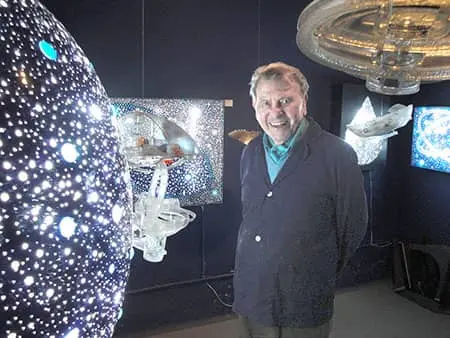
Sculptor Gyula Kosice (1924-2016) was also a poet, theoretician, polemicist and author of several published books. Born Ferdinand Fallik into a Hungarian Jewish family in the country then known as Czechoslovakia (today Slovakia), Kosice was an important figure in the local vanguard. He and his parents arrived to Argentina in 1928 where he lived until his death on May 25 of this year. Kosice initially gained prominence during the 1944 debate of ideas organized by the foundation of the Asociación Arte Concreto Invención. In that same year, he cofounded the Arturo periodical, a creative proposal that—according to essayist Jorge B. Rivera—encapsulated the idea and technological development of kinetic art, the research and incorporation of new materials, the systematic integration of the art-science-technique continuum, and the consistent and sustained revitalization of the autonomous creation concept. Kosice eventually split from the Concreto Invención group and in 1947, alongside other artists, he wrote the Madí Manifesto, which postulated invention and creation and recognized the demarcated fields of painting and sculpture. A creator of water, light and movement, he produced his first articulated and mobile sculpture titled Röyi ("It is an invented word") in 1944. In 1946, he created "luminescent structures" by pioneering the use of neon gas. Water as the central element in his work began to occupy a privileged place in 1949. Kosice created the Ciudad Hidroespacial (Hydrospatial City), an architectural and urbanistic project for the space. He began to explore the use of different materials, creating the first mockups and photomontages of that city by the end of the 1950s—although the project came to fruition in a text written in 1971. Kosice conceived a utopic metropolis suspended in the space, through the creation of mockups and luminescent pieces in which humanity was to be established in a future far removed from the prevailing crowded and contaminated environment of the time, in order to establish an intimate contact with the stars. On the occasion of the exhibition titled "Argentinean Abstract Art" presented in May-July of 2003 at the Fundación Proa, the work Conversaciones con Artistas (Conversations with Artists) was published with Kosice's opinions and stimulating dialogues between him, Tomás Maldonado, Enio Iommi, Raúl Lozza, Martín Blaszko and the public. With the same passion that always characterized him, Kosice affirms that "we are made of time," makes some points and resumes past discussions. With all of his dreams intact, Kosice details his visit to NASA, where he brought a mockup of the Hydrospatial City. "I asked if it was possible to erect it. There, I was told that it was indeed possible—but not profitable—to make the prototype of the hydrospatial habitat mockup on Río de la Plata by using cold fusion. When they told me that economic unfeasibility was the only impediment, I suggested that stopping armament production for 24 hours would save enough money to develop the first prototype. This inspired me to continue my effort. I am hopeful that a habitat of the Hydrospatial City descends and lands on a white sand breach looking at the ocean. In the 1944 piece titled Arturo, I affirm that 'mankind shall not be bound to Earth forever.' Men must reach beyond they know and will eventually go so. We may not be alive to witness it, but I am convinced that it will occur." Kosice recalled that the first exhibition of the Asociación de Arte Concreto Invención occurred at the home of Doctor Enrique Pichon-Rivière in 1945. The second one, also in that year, was presented at the home of Grete Stern—author of the formidable Photomo...