Art NotesJuly 8, 2014
War and Peace by Cándido Portinari
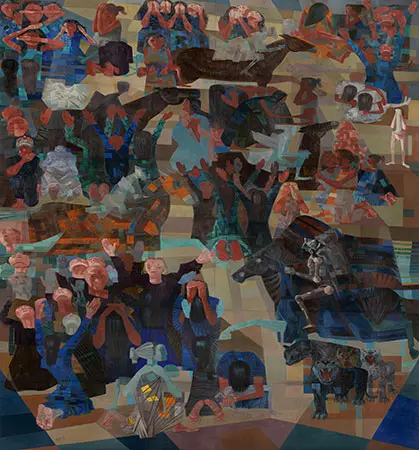
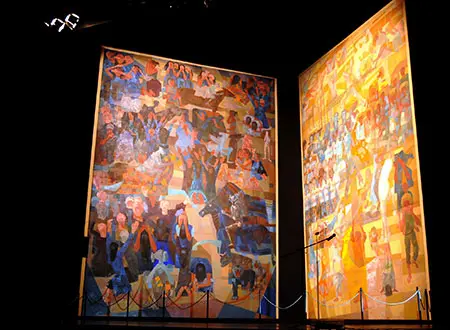
The United Nations building, in New York City, is where we habitually find this major work by the artist renowned as the greatest Brazilian painter in the first half of the Twentieth Century, Cándido Portinari (1903-1962). The disassemblage of the diptych, due to renovations in the building, allowed for the (free of charge) presentation in Paris of the two large panels that comprise War and Peace (14 x 10 meters each), accompanied by a set of 37 seven preparatory studies, drawings and paintings, as well as other works on loan from public and private collections. This outsize epic, both political and artistic, was created in the mid-1950s with the help of two assistants, Enrico Bianco and Rosalina Leao, after a commission by the Brazilian government to the artist for a donation to the UN. It came close to never being presented in Brazil before its shipping to the United States, because the height of the hangar in which Portinari worked didn't allow for both panels to be displayed together. But in the midst of the McCarthy era, Portinari, a communist, was not allowed to travel for the inauguration scheduled at the UN in 1957. So, under pressure by Brazilian artists and intellectuals, War and Peace was shown, before traveling to its final location, at the Municipal Theater in Rio de Janeiro, in an exhibition inaugurated on February 27th, 1956, by Brazilian president Juscelino Kubitschek. An emblematic work, the zenith of Portinari's art and a manifest expression of his ethical, political, and formal dreams, its aesthetics variously influenced by Mexican muralism, Picasso, and the abstraction of the Paris school, among others, War and Peace impresses viewers with its monumentality and the multiplicity of its themes, their interconnectedness and correspondences, as well as its refined handling of polychromy, all with the intent of reaching the largest number of people talking about themselves. "If you want to speak of the universal, speak about your village", Tolstoy wrote, and his dictum summarizes in a majestic way Portinari's art in general, and very especially the message of War and Peace. In its presentation at the Grand Palais, designed as a light and sound spectacle, the work's dramatic force is somewhat lost in the grandiloquence of the light and sound effects. The positive note: a mechanism that makes it possible, thanks to a video system, to enlarge on the wall the details highlighted by the projector, which guides viewer in a segmented discovery of this enormous composition. The inconvenience: that same mechanism, which breaks down the global view of the work and forces viewers to wait for the end of the "show" to appreciate the diptych at leisure. Portinari's relationship with Paris is long, but the artist was forgotten after his two exhibitions in the French capital: 1946, Charpentier gallery, and 1957, Maison de la Pensée Française. In 1961 Portinari requested a visa to enter France but it was denied due to his communist affiliation. This diptych, whose presentation in Paris was organized by Brazil's Projeto Portinari, may, perhaps, help remedy the situation and make up for lost time.
Gallery