ReopeningNovember 14, 2018
Glenstone Museum reopens in Maryland
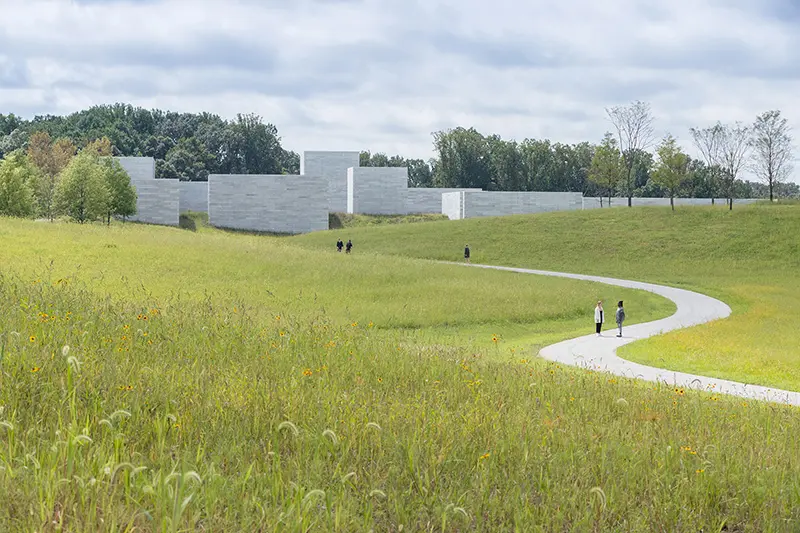
On October 4, Glenstone Museum reopened its doors to the public, revealing the results of a five-year expansion. Established as a not-for-profit, Glenstone Foundation, by Emily Wei Rales and Mitchell P. Rales, is a museum of modern and contemporary art opened in 2006. It is integrated into more than 230 acres of gently rolling pasture and unspoiled woodland in Montgomery County, Maryland, less than 15 miles from the heart of Washington, DC. Works selected for the inaugural installation of the Pavilions represent key moments in the development of art since World War II, a period when our understanding of the nature of art has been continually challenged and redefined. At the time of the opening, nine rooms of the Pavilions house single-artist installations of major works or bodies of work. The single-artist installations, many realized with the collaboration of the artists, are: • two large-scale sculptures by Martin Puryear: Big Phrygian, 2010-2014, and The Load, 2012, (Room 1) • the Moon Landing triptych by On Kawara, 1969, three large-scale canvases commemorating the Apollo 11 lunar landing mission of July 1969, (Room 3) • Untitled, 1992, by Robert Gober, (Room 4) • Collapse, 1967/2016, by Michael Heizer, (Room 5), with Heizer's 1968/2016 Compression Line • Ever is Over All, 1997, by Pipilotti Rist, (Room 6) • four sculptures by Charles Ray—Table, 1990, Fall '91, 1992, The New Beetle, 2005, and Baled Truck, 2014 (Room 8) • Livro do Tempo I, 1961, by Lygia Pape, an assemblage of 365 unique wooden geometric reliefs, each representing one day of the year (Room 9) • Moss Sutra with the Seasons, 2010-2015, by Brice Marden, (Room 10) • and five sculptures, 1951-1991, by Cy Twombly, (Room 11) The largest room in the Pavilions (Room 2), with 9,000 square feet of column-free space, houses an inaugural installation of 65 artworks by 52 artists, dating from 1943 to 1989. Showing the depth of Glenstone's collection, these iconic examples of movements including Abstract Expressionism, Gutai, Brazilian modernism, Arte Povera, Minimalism, and post-Minimalism like Arman, Jean-Michel Basquiat, Joseph Beuys, Alighiero e Boetti, Alexander Calder, Sergio Camargo, Lygia Clark, Willem de Kooning, Marcel Duchamp, Dan Flavin, Alberto Giacometti, Arshile Gorky, Keith Haring, Eva Hesse, Jasper Johns, Donald Judd, Yves Klein, Sol LeWitt, Agnes Martin, Marisa Merz, Bruce Nauman, Hélio Oiticica, Sigmar Polke, Jackson Pollock, Robert Rauschenberg, Mark Rothko, Mira Schendel, Richard Serra, Frank Stella, Jean Tinguely, Andy Warhol, and Toshio Yoshida, among others. Outdoor sculptures integrated into the landscape at Glenstone include works by Janet Cardiff and George Bures Miller, FOREST (for a thousand years…), 2012; Robert Gober, Two Partially Buried Sinks, 1986-1987; Andy Goldsworthy, Clay Houses (Boulder-Room-Holes), 2007; Felix Gonzalez-Torres, Untitled, 1992-1995, realized posthumously by Glenstone in 2007; Ellsworth Kelly, Untitled, 2005; Jeff Koons, Split-Rocker, 2000, among others. For more information visit the museum website at: www.glenstone.org