Art NotesNovember 25, 2015
Frida Kahlo Conexões entre mulheres surrealistas no México
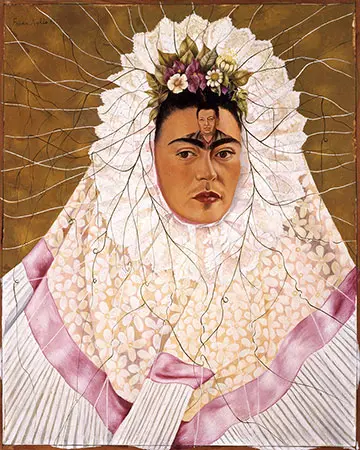
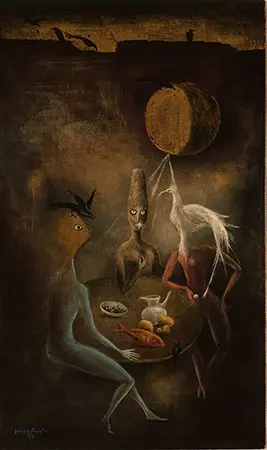
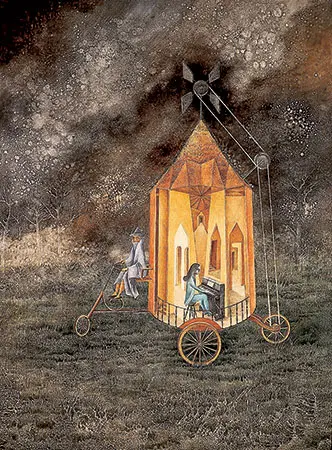
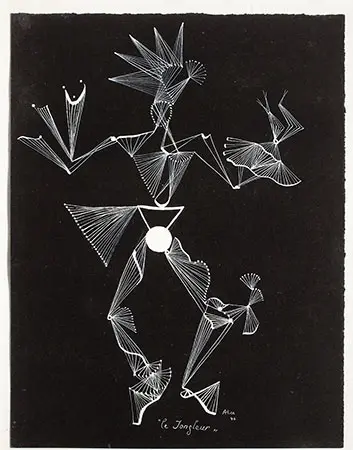
Twentieth Century Latin American art is deeply indebted to women artists, but as the revisionism of avant-garde in Paris comes to an end, what is to be left on the other side of the Atlantic, or to female figures, always displaced. The idea that these figures always produced a minor kind of art gradually dissipated in Mexico. After Artaud's visit (1936), María Izquierdo's painting was "discovered" as a "resurrection of the primitive"; Breton and Paalen came out in support of this notion. Today, these discoveries are multiplied and made tangible through Teresa Arcq's curatorship, in Frida Kahlo Conexões entre mulheres surrealistas no México ("Frida Kahlo Connections between Surrealist Women in Mexico"), an exhibition at the Tomie Ohtake Institute from September 27, 2015 through January 10, 2016. The first exhibition node, [Self-Portrait], opens with iconic works. A paean to inward-looking Freudian treatises is what we find in Mujer saliendo del psicoanalista ("Woman Leaving the Psychoanalyst"), where Remedios Varo portrays herself wearing several masks and balancing a man's head (her father) in her hand. Equally foundational is Frida Kahlo's Diego en mi pensamiento ("Diego in My Thoughts"), where her face is veiled by a cape that represents, more than a generic exoticism, the matriarchal tehuano culture with which she sought a utopian connection. Other nodes follow: [Female Body]; [Symbolic Still Life]; [Romance, Maternity, Family]. In [Female Body], sexuality and nudity are anchored on what Rosalind Krauss has deemed Surrealism's photographic condition. Rosana Rolanda's Fotograma con vaso y cara ("Still Photograph with Glass and Face") is a disjointed representation applying the famous technique of the "radiogram", expanded by the artist after she learned it from Man Ray. Kati Horna's optic games with glass in Paraísos artificiales ("Artificial Paradises") allude also to the same condition. The [Symbolic Still Life] node, based in a colonial-era genre, underscores the semantic leap from a fruit cut open to the construction of phrases like La novia que se espanta de ver la vida abierta ("The Bride Frightened at Seeing Life Opened"). This painting by Kahlo, taken as an example, winks at Jacqueline Lamba, Breton's wife, with whom the French artist used to practice the objet trouvé in different markets. In [Romance, Maternity, Family] we encounter obsessions with maternity and abortion that, according to Arcq, bring the idea that art is separate from biography to a crisis point. Naturalistic representations resembling exvotos, small votive offerings, alongside canvases loaded with the myth of identity, such as Diego, yo y el señor Xólotl ("Diego, Myself, and Señor Xólotl"), put tension on these classifications. Like phrases undergirding these nodes, [Territories of Creation] and [Magical Realms] engage spheres that often touch each other, mainly in the work of Leonora Carrington and Varo, two foreign painters resettled in Mexico who, alongside Marx Ernst and Benjamin Péret—their partners, respectively—adhered definitely to Surrealism. Carrington's Tres mujeres con cuervo ("Three Women with Crow") and Varo's Carricoche ("The Wagon") bring to the fore a magical context in need of safeguarding, but are more indebted to alchemical rituals than to Mexican folklore. The final propositions establish hitherto mostly unexplored connections, as in [Staged Life], with examples of theater costumes like Alice Rahon's creations for Ballet Cósmico ("Cosmic Ballet"). There is a section devoted to [Surrealism and the Unconscious], with examples of automat...
Gallery