ObituarySeptember 21, 2018
Felipe Herrera
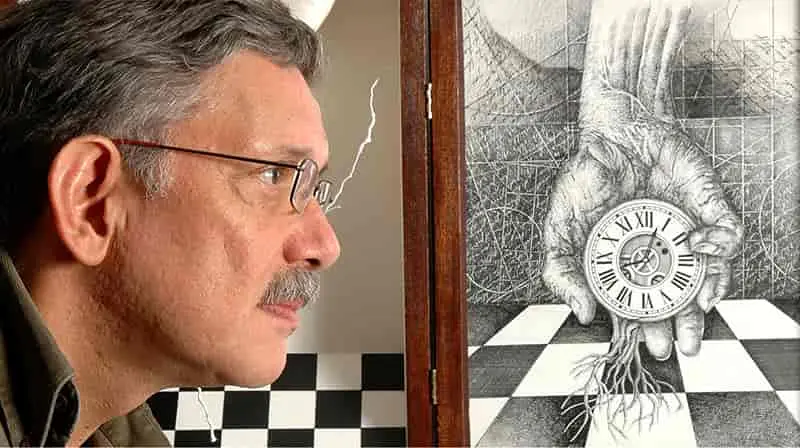
A creator whose career recurrently expressed the emotional depths of the human experience through unmistakable figurations within the visual landscape of Venezuela of the second half of the 20th century, Felipe Herrera died on August 23 in the city of Caracas. He was born in 1947 in Valencia, the capital of the State of Carabobo, Venezuela. From 1962 to 1967 he studied True Art at the Escuela Cristóbal Rojas in Caracas. During this period, he adopted sculpture as the expressive medium that through modeling would never entirely abandon him. He was an avid reader who developed meaningful relationships with cultural and literary groups, poets, and intellectuals. Fantasy literature, poetry—particularly the poetry of French poet Jacques Prévert and Venezuelan poet Eugenio Montejo—and the intense observation of nature and its surrounding reality, stimulated his innate susceptibility to the lyric dimension of existence. Although for a short period Herrera took a break from his artistic practice to focus on teaching and political activism, by the end of the 1970s, and coinciding with the so called boom of Venezuelan drawing, he began to explore this modality and eventually develop a depurated technique and highly intimate iconography. Through the years, his contributions to drawing would become so decisive that they consolidated him as a master of this artistic discipline in the continent. The quality and complexity of Felipe Herrera's drawings became widely recognized by critics and the public beginning in the 1980s, when he received his first awards from the New Nature Salon (Museo de Barquisimeto, 1981), the First Fundarte Drawing Biennial (Galería de Arte Nacional, Caracas, 1982), and the Ninth Art Salon of Aragua (Museo de Arte de Maracay, 1984). During this period, he also won acquisition prizes granted by the 1981 Salon of Young Artists and the Third National Visual Arts Biennial, both presented at the Museo de Arte Contemporáneo de Caracas. In the 1990s, Herrera began creating assemblies that integrated his love for the three-dimensional figure, his interest in the creation of complex spaces, and his partiality towards the juxtaposition of symbols in the style of the surrealists. Like in his drawings, these assemblies updated a vocabulary of recurring signs that suggests the oneiric atmospheres created by Max Ernst and Salvador Dalí, Etcher's contradictory spaces, and the compassionate aesthetics by Anselm Kiefer, an artist whose influence reaffirmed Herrera's search for the humanist meaning of art. In recent years, Herrera's trajectory was recognized with the First Award of the Arturo Michelena Biennial (Valencia, 2010), the Armando Reverón Award, granted by the Asociación Venezolana de Artistas Plásticos (2012), and the Special Award by the Venezuelan Chapter of the International Association of Art Critics (2017). Along with the exhibition titled "Inexorables," organized in 2016 by the Ateneo de Caracas, these distinctions compensated to a certain extent for the lack of a critical and retrospective revision of the independent, solitary, and profoundly poetic work by Felipe Herrera.