ExhibitionMay 28, 2021
Felipe Ehrenberg: Testamento (1968-2017),
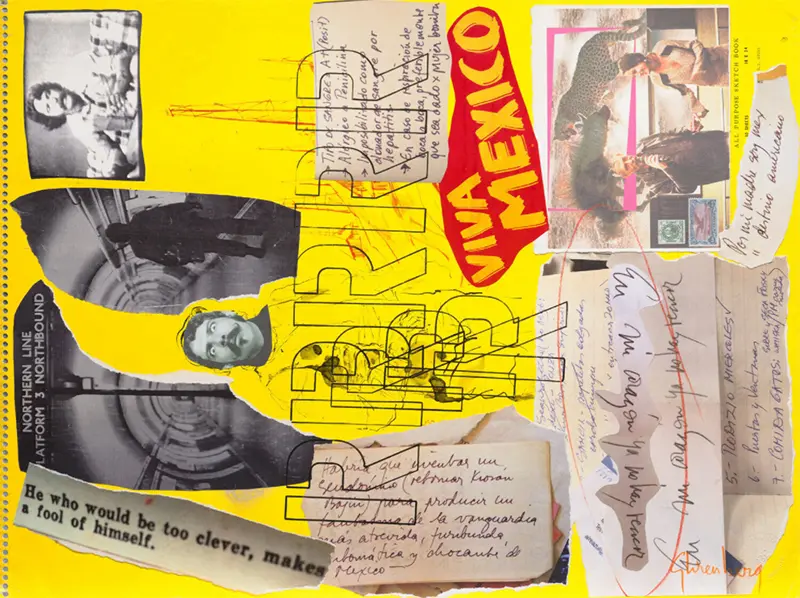
For the first time, the exhibition displays the thirty-four collages in Felipe Ehrenberg’s Testamento (Will) (1968–2017), a retrospective and reflective assemblage of documents, photographs, writings, and drawings compiled at the very end of the artist’s decades-long career. A coda to Ehrenberg’s monumental practice, Testamento is also the fourth and final show in ISLAA’s inaugural series of exhibitions devoted to mail art and conceptual practices in Latin America.
Felipe Ehrenberg’s (1943-1917) creative activity was propelled by a tireless drive for experimentation and an unyielding commitment to the expansive possibilities of art. Preferring the self-defined descriptor of “neologist”—one who explores new ideas—to “artist,” he developed a diverse and influential body of work encompassing performance, mail art, artists’ books, and paintings that probed art’s role to society. Ehrenberg became closely aligned with the Fluxus movement in the 1960s and ’70s, cofounding the Beau Geste Press, a publishing haven for visual poets, neo-Dadaists, and Fluxus artists that privileged books as artistic media. In 1976, he formed the Grupo Proceso Pentágono, a pivotal collective of Mexico’s Grupos movement, whose installations and actions incisively critiqued national politics and state repression under the stronghold of the PRI party. Ehrenberg independently produced paintings and sculptures rooted in pop art style and conceptual performances that reconfigured the dynamics between artist, spectator, and environment in subsequent years.
Completed during the final months of his life, Testamento—or “will” in English—is a deeply personal survey of Ehrenberg’s career and boundless artistic vision, piecing together fragments of previous works, recent sketches, ephemera, handwritten texts, snapshots, and photographic portraits of over nearly fifty years.
Felipe Ehrenberg: Testamento is curated by Olivia Casa and will be on view until August 7, 2021. It is accompanied by an original bilingual publication featuring an essay by Néstor García Canclini in Spanish and English, available for free at ISLAA. For more information, visit: https://www.islaa.org/
Felipe Ehrenberg’s (1943-1917) creative activity was propelled by a tireless drive for experimentation and an unyielding commitment to the expansive possibilities of art. Preferring the self-defined descriptor of “neologist”—one who explores new ideas—to “artist,” he developed a diverse and influential body of work encompassing performance, mail art, artists’ books, and paintings that probed art’s role to society. Ehrenberg became closely aligned with the Fluxus movement in the 1960s and ’70s, cofounding the Beau Geste Press, a publishing haven for visual poets, neo-Dadaists, and Fluxus artists that privileged books as artistic media. In 1976, he formed the Grupo Proceso Pentágono, a pivotal collective of Mexico’s Grupos movement, whose installations and actions incisively critiqued national politics and state repression under the stronghold of the PRI party. Ehrenberg independently produced paintings and sculptures rooted in pop art style and conceptual performances that reconfigured the dynamics between artist, spectator, and environment in subsequent years.
Completed during the final months of his life, Testamento—or “will” in English—is a deeply personal survey of Ehrenberg’s career and boundless artistic vision, piecing together fragments of previous works, recent sketches, ephemera, handwritten texts, snapshots, and photographic portraits of over nearly fifty years.
Felipe Ehrenberg: Testamento is curated by Olivia Casa and will be on view until August 7, 2021. It is accompanied by an original bilingual publication featuring an essay by Néstor García Canclini in Spanish and English, available for free at ISLAA. For more information, visit: https://www.islaa.org/