RetrospectiveOctober 18, 2019
Retrospective exhibition dedicated to Mario Merz at Palacio de Velázquez
Organized for the Museo Reina Sofía in collaboration with Fondazione Merz and curated by Manuel Borja-Villel, the exhibition Mario Merz, Time is Mute, will take place at the Palacio Velázquez until March 29, 2020.
The retrospective on the work of Mario Merz (Milan, Italy, 1925 – Milan, Italy, 2003) surveys the provenance of a body of work suspended in a kind of pre-historic time, at odds with the discourse of modern-era history. This anachronistic perspective, apparent in the choice of materials and iconography, stems from the ideological and committed stance of an artist and his relation to the political and intellectual climate in Italy in the 1960s and 1970s, in addition to his rejection of pervasive capitalism and the American way of life after the Second World War.
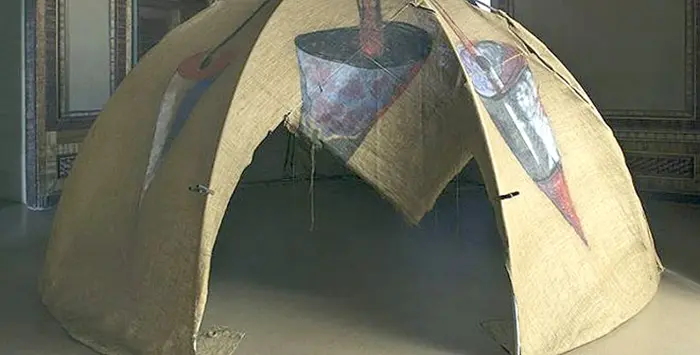
Merz’s practice, linked to Arte Povera, incorporates different key characteristics that the coetaneous art critic Germano Celant identified with this movement: in addition to its opposition to the post-industrial society of consumerism, we find a conscious use of organic materials such as clay, branches, wax and coal. From the application of these materials stem some of the recurring associations in the pre-modern imagery of the artist, for instance fire, lightning bolts and arrows; figures with mythical and geological meanings – the igloo, the table, the spiral, the river; or ancestral animals like the rhinoceros and the crocodile. These motifs, coupled with the idea of the nomad, run through the breadth of the artist’s poetics, vindicating lifestyles in consonance with nature that resist the predatory schemes of capitalist modernity. Thus, the search for mythology distinguished Merz’s work from his kindred contemporaries, for his archaism bore no relation to a melancholic yearning for the past, but instead was related to a razor-sharp critique of industrial and consumerist modernity.
The retrospective on the work of Mario Merz (Milan, Italy, 1925 – Milan, Italy, 2003) surveys the provenance of a body of work suspended in a kind of pre-historic time, at odds with the discourse of modern-era history. This anachronistic perspective, apparent in the choice of materials and iconography, stems from the ideological and committed stance of an artist and his relation to the political and intellectual climate in Italy in the 1960s and 1970s, in addition to his rejection of pervasive capitalism and the American way of life after the Second World War.
Merz’s practice, linked to Arte Povera, incorporates different key characteristics that the coetaneous art critic Germano Celant identified with this movement: in addition to its opposition to the post-industrial society of consumerism, we find a conscious use of organic materials such as clay, branches, wax and coal. From the application of these materials stem some of the recurring associations in the pre-modern imagery of the artist, for instance fire, lightning bolts and arrows; figures with mythical and geological meanings – the igloo, the table, the spiral, the river; or ancestral animals like the rhinoceros and the crocodile. These motifs, coupled with the idea of the nomad, run through the breadth of the artist’s poetics, vindicating lifestyles in consonance with nature that resist the predatory schemes of capitalist modernity. Thus, the search for mythology distinguished Merz’s work from his kindred contemporaries, for his archaism bore no relation to a melancholic yearning for the past, but instead was related to a razor-sharp critique of industrial and consumerist modernity.