ExhibitionJune 11, 2015
Experiences of Light: Photography Without a Camera
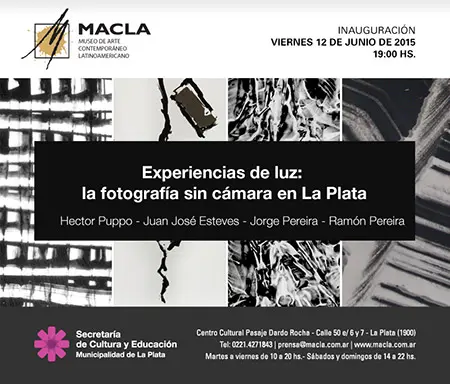
The show Experiencias de luz: la fotografía sin cámara opens on June 12th, featuring works by Héctor Puppo, Juan José Esteves, Jorge Pereira and Ramón Pereira on exhibit in rooms 4 and 5 of the MACLA Museo de Arte Contemporáneo Latinoamericano de La Plata. The show can be visited through July 12th and admission is free. In the 1960s, following postulates that had already been put in play in Europe in the early Twentieth Century, a group of La Plata artists began to explore the creative potential of photography in the laboratory. Héctor Puppo, brothers Jorge and Ramón Pereira, and Juan José Esteves developed a technique whose forefathers were the Dadaists and several of the artists who accompanied the progress of the Bauhaus school. For these artists, the most important component of the photographic process is not the camera, but the "sensible layer", as established by Laszlo Moholy-Nagy. Their photographs are not created using a camera and a shot, but in the development lab. Héctor Puppo, Jorge Pereira, and Ramón Pereira used glass plates that could be from radiography, which they painted using tempera or ink and subjected to scratching. When light was projected through these plates onto photographic paper, via an enlarger, textures, rhythms, and abstract forms emerged and connected randomly. They also placed on the plate leaves, stalks, threads, nets, and other elements that produced new images. Juan José Esteves first produced in his laboratory series where the figurative image disappears, leaving blank spaces. Later he moved entirely away from the idea of a shot, and began to create his photographs entirely in the lab, with an enlarger, development emulsions, and photographic paper. He followed the path of full abstraction, canceling any search for representation. All of them were active participants in the mobilization of the art scene in that period. Puppo and Jorge Pereira were present, along with other members of Visión Integral (VIIN), in photography exhibitions in different locales. In 1967, Jorge Pereira participated with several works in the Cinquieme Biennale de Paris at the Musée d´Art Moderne. In 1968, Puppo presented a solo show of his still frames, at the Engineering Students' Center in La Plata. In that decade, Esteves contacted the Diagonal Cero group and later exhibited Señores, pasen y vean ("Gentlemen, come and see") in Experiencias 69, a show at the Di Tella Institute. It was a collaborative work with Pazos, de Luján Gutiérrez, Otero Manzini, Fernández, and Etchart. In 1970, alongside Ramón Pereira and others, Jorge Pereira formed the CEV (Center for Visual Experimentation), which would exhibit at the Lirolay Gallery in Buenos Aires, Odin Gallery in La Plata, and the Museum of the City of Buenos Aires. In 1972, Jorge Pereira, Ramón Pereira, Esteves, and Luis Pazos participated in the exhibition Fotografía tridimensional at the CAYC (Art and Communication Center), helmed in Buenos Aires by Jorge Glusberg. Esteves continued to work until his death in 2007, and exhibited in different spaces in Argentina and France. Héctor Puppo formed Grupo Escombros in the mid-1980s, and moved towards conceptual art. Jorge Pereira carried his exploration of light into painting and kinetic art, but he didn't abandon photography; neither did Ramón Pereira, who gave the genre continuity in digital imaging. The show includes a printed triptych and a digital catalog with texts and images, available for free download at www.macla.com.ar