Art NotesMarch 12, 2014
Ética-Estética-Política. GBG ArtsSeptember-November 2013
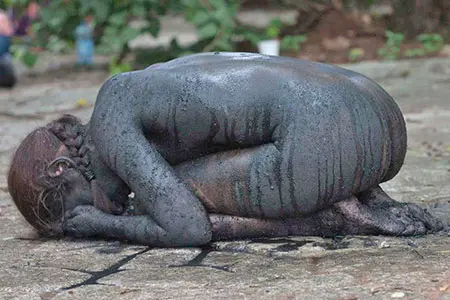
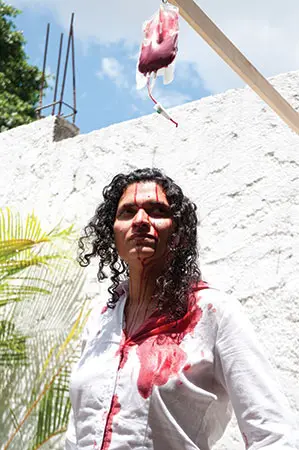
The exhibition Ética-Estética-Política, curated by María Elena Ramos, was presented at GBG Arts Gallery in Caracas. A look at the works of the nineteen Latin American artists featured in the exhibition confirms what its title announces: the strong interconnection and the ever more inextricable commitment of today's artistic expression in the region with the task of questioning and critiquing the relationship between individuals and power, or society. Videos, installations, performances, paintings, photographs, media as heterogeneous as the proposals on exhibit, and as the contemporary era itself, are the chosen vehicles to establish a dialog with the viewer and have them confront the suffering, the surprise, the irony of physical and social bodies—traces of words and memories—that reveal the violence, the decay, the impotence, and the fury of survival and oblivion. The journey begins in a small room devoted to three works by Guatemalan artist Regina José Galindo, Paisaje, Piedra, and Alud, video documents of actions in which her body—nude, vulnerable, subjected to punishment and torture—is the means to bring forth a denunciation of gender inequality and violence in her country, perhaps those of any Latin American society. Human anatomy is a concern in the work of Sandro Pequeno: an altered anatomy, halfway between man and machine, assembled from parts of children's toys, which raises questions about the limits of artificial biological modification. Bodily fluids are part of a suffering body in Érika Ordosgoitti's performance: a sustained recitation of urban experiences while her own blood slowly spills on her head, soaking her face and clothes. In the work of Armando Ruiz, a young artist born in Barranquilla who lives and works in Maracaibo, blood and body lacerations are extrapolations of visual matters connected to drug addiction. In Tú, yo, ellos, nosotros, a reticule of white papers gradually reveals itself as the support of drawings made in blood, from which columns of cut-out words emerge and repeat: "sentencing," "frustrating," "worsening." In the videos Métete Métete, Como una paleta and Cerebrito cerebrito, qué tiempitos, actions and images allude to the mental decay and alteration of perception that are the result of drug consumption. In the hallway connecting the room with Galindo's videos with the rest of the exhibition space, two proposals share a dividing wall that functions as their support: to one side, Lo inconcebible simplemente existe, by Lihie Talmor; to the other, Puerta de cielo. Doce testimonios, an installation by Rosa Virginia Urdaneta. In Talmor's prints, photographs of sites near the Auschwitz-Birkenau concentration camp generate a kind of displacement of memory: images that, distancing themselves from the immediate visual references associated with the location, achieve a suspension of the horror, which here lays hidden, yet always latent. Violence is also presented as a veiled latency in Urdaneta's work, small pieces of paper paced on the wall, like votive offerings with their subtlety negated by the testimonies of child soldiers with the FARC and the ELN, of which they are the support. The leitmotiv in Bocas de ceniza, a video projection by Colombian artist Juan Manuel Echavarría, are the songs of survivor of massacres in Colombia: close-up shots of their impassive faces confront us with their subjective experiences, threaded through the verses of their songs, a personal memory that becomes collective. Is a constructive violence possible? Can it be linked to creation? These seem to be the questions posed by Armando Rosales when ...
Gallery