OtherMarch 8, 2010
Esteban Lisa in the Land of the Cedars: Tradition and Abstraction
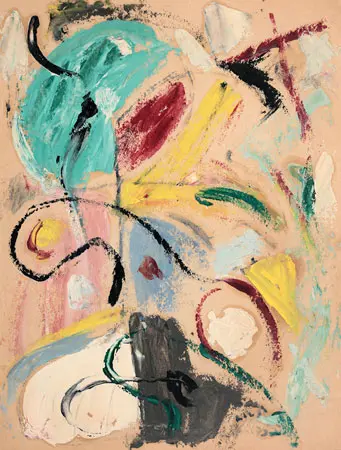
...Thus grew the tale of Wonderland: Beneath the setting sun... Alice! A childish story take, And with a gentle hand Lay it where Childhood's dreams are twined In Memory's mystic band, Like a pilgrim's wither'd wreath of flowers Pluck'd in a far-off land. Alice's Adventures in Wonderland, Lewis Carroll Esteban Lisa's arrival in the Wonderland that is Lebanon takes the form of a spiritual and mystical journey to the land of the cedar trees, to ancient Phoenicia. His emotional connection with that marvellous country derives from his pupil Horacio Boustany El Khoury, who was Lebanese by origin. The abstract forms of Lisa¿s paintings seem like stars in the silence of the firmament. Together with his writings, they introduce us to the great mystery of the universe, and to the wonders of life and creation. In reality, Lisa¿s legacy to us is a humanist message that has been pursued by his pupils and by many others: ¿What is will always be, it can never not exist¿, so said the philosopher. Today, Esteban Lisa, pilgrim and migrant, pays homage to the people of Lebanon through the figure of Horacio Boustany El Khoury, as well as to his homeland, Spain, and his adopted home, Argentina. Lisa makes us the gift of his soul and of his origins through his paintings, created with the subtle and exotic colours of his native and adopted lands and painted in the form of exquisite garlands. Lisa¿s work and thought create a perfect triangle in which the three cultures come together. As early as 1962 Lisa gave a lecture to the Lebanese Society of Gualeguay (Argentina) to commemorate the 19th anniversary of Lebanon¿s independence, entitled ¿Lebanon¿s traditional Culture: contemporary culture and the art of Asef Bichilani¿. Extracts from this text are reproduced in the catalogue of the present exhibition. The tree, symbol of life, the family, strength, solidity and the foundations of life, represents the eternal cycle of birth, growth, death and re-birth. The pillars of the palace of the ancient kings of Lebanon ¿ that same palace inhabited by the goddess Isis, who came to this ancient land in search of her spouse, Osiris ¿ were built with wood from the Cedar of God. On its pillars the immortal character of the Lebanese people was sculpted, with their myths, music and secular traditions. Their sacred values are those of the family, friendship and respect for all beliefs. Esteban Lisa was born in a village near Toledo in Spain. Like Beirut, Toledo was a city in which a variety of cultures and religions co-existed, and liberty, tolerance and fraternity were its keystones. Following that tradition Lisa taught painting to Jewish, Lebanese and Syrian immigrants in a poor quarter of Buenos Aires. After his death his activities were commemorated through the Fundación Esteban Lisa, founded by the leading Lebanese industrialist Horacio Boustany El Khoury, the Jewish furrier and artist Issac Zylberberg, and the writer of European origin Francisco Pelegrín. All three had been devoted pupils of Lisa. Horacio Horacio Boustany El Khoury.¿s memory now returns to the lands of his ancestors thanks to the Audi family, with whom he always maintained a warm friendship. Lisa¿s work and teachings have been the guiding thread that has united these families and made the present exhibition possible. In the manner of a masterpiece written as a personal diary, Lisa¿s small, intimate paintings need to be grouped together in order to be seen as one large painting in which the totality of his life¿s experience reveals itself as image, force and movement. His work offers a faithful reflection of his spiritual and ethical beliefs whose goal is man¿s ongoing development. From this seed a fine, strong tree has grown and one that has resisted the ongoing cycle of time and the changing of the seasons. Its branches form a musical stave in which the leaves are the notes that can be heard when the wind blows. The miracle of ever-returning spring is end...