ExhibitionMay 30, 2022
"Spiral for Shared Dreams" by Carolina Caycedo
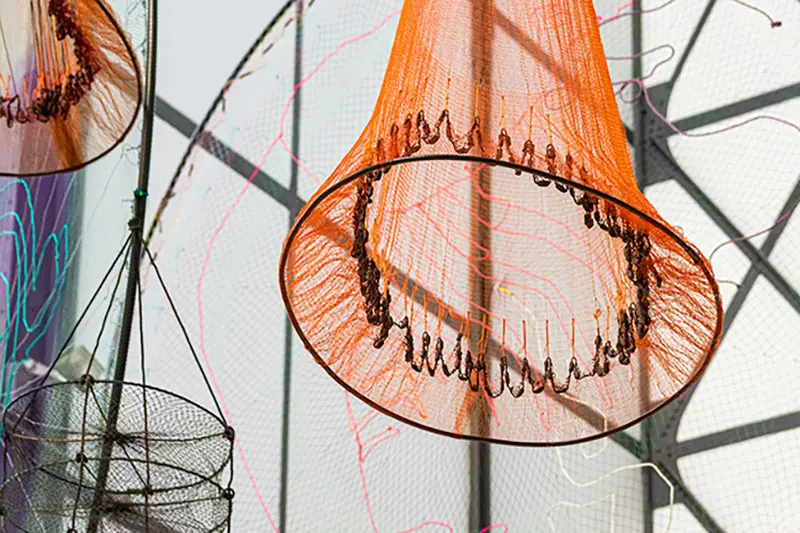
Until June 26, the Museo Universitario del Chopo presents the exhibition "Spiral for shared dreams" by Carolina Caycedo, which is a hanging installation created especially for the institution and belonging to the project "Be Dammed" initiated in 2012 by the construction of the Quimbo hydroelectric dam that divided the Magdalena River (the largest in Colombia), a research project and participation in community activism long breath against the privatization of water. Through different strategies, including video, installations, and performance, she has pointed out the damage caused by large dams on the natural and social landscape. The artist has pointed out the importance of fishing as a sustainable local economy. She incorporates the nets in her work to safeguard the ancestral knowledge of weaving and the link of fishermen with the water and with the history of water itself.
Carolina Caycedo, with her works, insists on the inseparable union between human beings and nature. She blurs its conception as a resource, as a mere object of study and exploitation. Her artistic practice and her connections to resistance movements operate against the excessive exploitation of natural elements, the collapse of ecosystems, the effects on local economies, and the consequent environmental crisis.
One of the components of this installation is the series "Cosmotorrayas," a series of 13 works made with nets hand-woven by river communities affected by extractivist initiatives. Her collaboration with communities includes different geographies, among them Colombia, Brazil, Guatemala, and the Philippines.
"The Cosmotarrayas can be read as the cosmos of the people I have met and their stories of dispossession and resistance; they operate as a connection between my community involvement and my studio practice," commented Carolina Caycedo.
"Spiral for Shared Dreams" was produced with networks of fishing communities from the Mujeres del Manglar collective in Zapotalito, Oaxaca; Comité Salvemos Temacapulín, Acasico and Palmarejo; Cooperativa Norte de Tecuala, Nayarit and the Colectiva Mujeres del Golfo de Baja California Sur.
Carolina Caycedo, with her works, insists on the inseparable union between human beings and nature. She blurs its conception as a resource, as a mere object of study and exploitation. Her artistic practice and her connections to resistance movements operate against the excessive exploitation of natural elements, the collapse of ecosystems, the effects on local economies, and the consequent environmental crisis.
One of the components of this installation is the series "Cosmotorrayas," a series of 13 works made with nets hand-woven by river communities affected by extractivist initiatives. Her collaboration with communities includes different geographies, among them Colombia, Brazil, Guatemala, and the Philippines.
"The Cosmotarrayas can be read as the cosmos of the people I have met and their stories of dispossession and resistance; they operate as a connection between my community involvement and my studio practice," commented Carolina Caycedo.
"Spiral for Shared Dreams" was produced with networks of fishing communities from the Mujeres del Manglar collective in Zapotalito, Oaxaca; Comité Salvemos Temacapulín, Acasico and Palmarejo; Cooperativa Norte de Tecuala, Nayarit and the Colectiva Mujeres del Golfo de Baja California Sur.