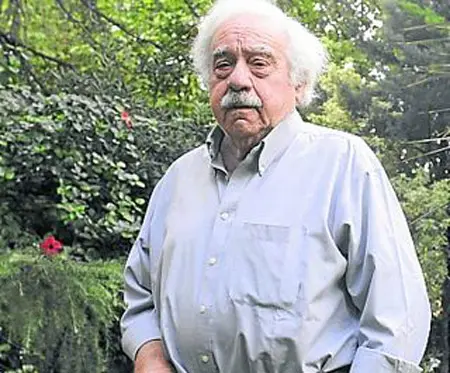
Enio Iommi
"My pleasure would be to burn down my entire oeuvre. My last work, a great bonfire".
Iommi was born in Rosario, Argentina, in 1926 and has his beginning in the arts in his father's workshop, an Italian-born sculptor graduated from the Brera Academy in Milan. Before turning 20, he explored abstract art alongside Tomás Maldonado, Alfredo Hlito, Raúl Lozza, and Lidy Prati, with whom and other young artists he founded the Asociación Arte Concreto Invención, protagonist of one of the most important chapters in the history of the River Plate avant-garde, in 1945.
A year later, the cohort of concrete painters and sculptures presented their first exhibition as a collective at the Peuser Salon. The catalog included the "Inventionist Manifesto", a key document of constructivism in Argentina. Invited by the Italian government, during the 1960s Iommi traveled in Italy, Switzerland, England, the United States, and France. Around this period, his work began to change, and in 1971 the results were in view with Una línea, un espacio at Carmen Waugh's gallery.
Iommi's work can be described in four periods: his sculptures of the 1940s, which signified the beginning of concrete art in Argentina; his geometric period between 1951-1970; the 1970s and 1980s, focused on the violence that characterized that era; and his final period after 1990, with spatial proposals where new materials posited varied relationships with space.
These lines of investigation are evidence of a prolific career, which moved from functionalism to assemblages, to the re-signification of everyday objects (in many instances, found objects). With this last option, he interrogated the organizing principle of rationality, revealing his desire and ability to move within the expressive heterodoxy that always characterized his extensive production, filling it with a skillful analysis of the historical shifts through which he lived. The validity retained by his oeuvre resides there.
As Elena Oliveras accurately pointed out (ArtNexus 29), "In an almost methodical way, Iommi didn't hesitate to contradict himself. He broke through his 'self image', this is to say, the predictable order of a continuity in style, to accommodate his new, authentic concerns. This is why he is, especially for the younger generations, a paradigmatic figure." It is not often that we find artists who are capable of questioning and take down their own achievements, even those that were widely recognized by critics and audiences.