Book ReviewsDecember 20, 2024· By Nelly Perazo
Elena Oliveras. Distopias y microutopías. Prácticas de resistencia en el arte del siglo XXI
Elena Oliveras—author of the recently launched Distopias y microutopías. Prácticas de resistencia en el arte del siglo XXI (Dystopias and Micro-Utopias. Practices of Resistance in the Arts of the 21st Century)—has many followers who have recognized the high relevance of previous works such as Estéticas de lo extremo (Aesthetics of the Extreme), La cuestión del arte en el siglo XXI (The Question of Art in the 21st Century), and La metáfora en el arte (The Metaphor in Art), among others.
In fact, the yearly journal Temas—issued by Argentina’s National Academy of Fine Arts (of which Oliveras is a full member)—dedicated its 2018 edition to the return to utopianism in contemporary art. Oliveras’s piece for this edition made clear that her interest and knowledge on this subject far exceeded the spatial limits of an article.
A PhD in Aesthetics from the University of Paris and a wealth of teaching experience have prepared Oliveras to guide her readers through aesthetic specificities while also immersing us in today’s overwhelming global problems. And she does it with such skill that our attention does not waver, and rather increases as the text advances. She is even able to familiarize unversed readers with myriad topics and authors.
From the start, she describes the historical context in which she has framed her essay as well as the semantic uses and limits of the terms ‘utopia’ and ‘dystopia.’ Further on, she underlines the statements that Nicolas Bourriaud made in Relational Aesthetics (1998) regarding the great social utopias and modernity’s revolutionary hopes, which gave way to “micro-utopias of the everyday,” as a safer bet for the advancement of the transformations that today’s world requires.
This book is grounded in aesthetics and brimming with examples of artworks that reveal dark aspects of contemporary reality. The author and the artists featured here are deeply and actively concerned with unmasking distressing situations. Through artistic manifestations, Oliveras makes us aware of the atrocities, simulations, and violence, disguised or not, which plague our current world and the need to overcome them. As always, the author positions herself under the sign of intensity.
She stresses the relevance of Nietzsche’s ideas, a rare occurrence in the French School since Deleuze. She repeatedly quotes the German philosopher’s analyses on art and clarifies the real reason for his interest in the will to power: not to dominate other human beings, but to work internally on the self in order to set forth on a positive path. Oliveras also bears Nietzsche in mind when underscoring the presence of the body in order to reject useless sacrifices and avoid any nihilistic or pessimistic way out.
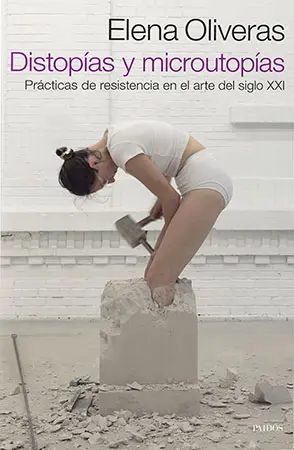
The book’s cover image was a remarkable choice. It features a photo of the performance by Sofia Durrieu titled Cariátide (final de) [Caryatid (End Of)]. Durrieu is zealously trying to free her legs from the cement block that they’re trapped in: an unquestionable metaphor for the rejection of the classical caryatid’s obligation to support, motionless, the tremendous weight placed on their head. This action is one of many examples presented in the chapter called “Tiempo de mujeres” (Women's Time). Oliveras reinforces her theoretical analyses with the living archive that militant artists are constantly renewing in order to address different aspects of sexuality and to search for spaces of friendship and work that may benefit the elderly and others who are still marginalized by society.
Each chapter incites us to examine dystopian practices in either literature, cinema, or the visual arts. With respect to the former, the unavoidable references to Aldous Huxley’s Brave New World and Orwell's 1984, among others, culminate in current inadequacies: the overabundance of data that, in the words of Byung-Chul Han, desensitizes and prevents us from projecting affections and fantasies; the standardization of language; the proliferation of commonplaces; the reiteration of advertising; and the underscoring of the fortuitous and the accidental to the detriment of critical thinking.
By dwelling on the numerous dystopias in cinema, Baudrillard’s reflections in Simulacra and Simulation (1981) and his “welcome to the desert of the real” (taken up by Žižek with a work of the same name) bring us back to the awareness of inhabiting a hybrid culture that navigates between the face-to-face and the virtual. There is no lack of allusions to Borges or Guy Debord and his admonitions concerning the society of the spectacle, but above all, to the weight of the questions we ask ourselves facing today's overwhelming invasion of the digital realm.
In the section dedicated to dystopian practices in the visual arts, the multiplication of the different aspects of the topics dealt with and the artworks cited demonstrate Olivera’s breadth of knowledge on the art of our days, as well as her engaged analytical practice. Not only are works referring to the topology, temporality or political nature of violence analyzed, but also to our bodies given the likelihood of genetic manipulation of life. The devastating results of the ecological imbalance caused by man’s zeal to dominate nature with no regard to the consequences are also discussed here, as well as the serious shortcomings of the consumer society, which have been brilliantly exposed by Argentinian artists of the stature of Líbero Badíi, Alberto Heredia, Enio Iommi, Aldo Paparella, and Horacio Coll.
Many Argentinian artists are brought up in the book to clarify or place different accents to Olivera’s theoretical considerations. In this way, the author highlights the operational methods not only of well-known artists, but also of young creators who are renewing the ways of understanding and dealing with reality, while also allowing us to discover their practice.
Thus, we learn about Teresa Pereda and her moving relationship with the land; Andrea Juan and her multiple struggles against ecological damage; Graciela Taquini and her assessment of the existential possibilities of old age; Mariela Yeregui and her interactive robotic installations. And also, about the work of artist collectives such as Belleza y Felicidad, Estrella de Oriente or La Intermundial Holobiente, among many other examples given throughout the book.
When referring to artivism, the author clarifies from the outset its semantic difficulties due to the possible confusion with political or critical art, and proceeds to detail the specificities of this twenty-first-century’s booming neologism. The concept of artivism is indeed central to this book. Therefore, it is pertinent to resort to her words when explaining that artivism's definition intertwines, among other parameters, “the intentions of the artist who aspires to produce a change in the political, social, and cultural order with a sense of urgency, consciousness-raising actions, and the resignification of the ideal of art’s dissolution in life.” The indispensable active presence of the art recipient goes without saying.
Artivism may or may not have immediately palpable results. It depends on actions that may materialize in specific moments or disseminate over time. No doubt artivism deserves special attention because it is a living testimony of the burning call for urgent actions to overcome existing imbalances.
The problems posed by the expanded concept of art have been present for a long time; a concept that must address the troubling questions that AI and robotics are provoking. These problems are also dealt with in micro-utopian practices of resistance. The 2011 Kassel documenta and its curator, Okwui Enwezor, who proposed the presence of all ethnic groups from all over the world, was a precedent that found strong echoes in documenta 2022. The 60th Venice Biennale, whose curator, Adriano Pedrosa, gave the title of Stranieri Ovunque (Foreigners Everywhere), has marked a new milestone for overcoming marginality.
All of the topics included in this comprehensive and engaging book contextualize the artistic practices of resistance that affirm the possibility of a better and happier world, even within the complex uncertainties in which we live. Unquestionably, the proper historical conditions are needed for new ideas to even be considered.
To guide the reader in this journey, Olivera’s book offers an up-to-date bibliography, a list of images, and an index of names.
In fact, the yearly journal Temas—issued by Argentina’s National Academy of Fine Arts (of which Oliveras is a full member)—dedicated its 2018 edition to the return to utopianism in contemporary art. Oliveras’s piece for this edition made clear that her interest and knowledge on this subject far exceeded the spatial limits of an article.
A PhD in Aesthetics from the University of Paris and a wealth of teaching experience have prepared Oliveras to guide her readers through aesthetic specificities while also immersing us in today’s overwhelming global problems. And she does it with such skill that our attention does not waver, and rather increases as the text advances. She is even able to familiarize unversed readers with myriad topics and authors.
From the start, she describes the historical context in which she has framed her essay as well as the semantic uses and limits of the terms ‘utopia’ and ‘dystopia.’ Further on, she underlines the statements that Nicolas Bourriaud made in Relational Aesthetics (1998) regarding the great social utopias and modernity’s revolutionary hopes, which gave way to “micro-utopias of the everyday,” as a safer bet for the advancement of the transformations that today’s world requires.
This book is grounded in aesthetics and brimming with examples of artworks that reveal dark aspects of contemporary reality. The author and the artists featured here are deeply and actively concerned with unmasking distressing situations. Through artistic manifestations, Oliveras makes us aware of the atrocities, simulations, and violence, disguised or not, which plague our current world and the need to overcome them. As always, the author positions herself under the sign of intensity.
She stresses the relevance of Nietzsche’s ideas, a rare occurrence in the French School since Deleuze. She repeatedly quotes the German philosopher’s analyses on art and clarifies the real reason for his interest in the will to power: not to dominate other human beings, but to work internally on the self in order to set forth on a positive path. Oliveras also bears Nietzsche in mind when underscoring the presence of the body in order to reject useless sacrifices and avoid any nihilistic or pessimistic way out.
The book’s cover image was a remarkable choice. It features a photo of the performance by Sofia Durrieu titled Cariátide (final de) [Caryatid (End Of)]. Durrieu is zealously trying to free her legs from the cement block that they’re trapped in: an unquestionable metaphor for the rejection of the classical caryatid’s obligation to support, motionless, the tremendous weight placed on their head. This action is one of many examples presented in the chapter called “Tiempo de mujeres” (Women's Time). Oliveras reinforces her theoretical analyses with the living archive that militant artists are constantly renewing in order to address different aspects of sexuality and to search for spaces of friendship and work that may benefit the elderly and others who are still marginalized by society.
Each chapter incites us to examine dystopian practices in either literature, cinema, or the visual arts. With respect to the former, the unavoidable references to Aldous Huxley’s Brave New World and Orwell's 1984, among others, culminate in current inadequacies: the overabundance of data that, in the words of Byung-Chul Han, desensitizes and prevents us from projecting affections and fantasies; the standardization of language; the proliferation of commonplaces; the reiteration of advertising; and the underscoring of the fortuitous and the accidental to the detriment of critical thinking.
By dwelling on the numerous dystopias in cinema, Baudrillard’s reflections in Simulacra and Simulation (1981) and his “welcome to the desert of the real” (taken up by Žižek with a work of the same name) bring us back to the awareness of inhabiting a hybrid culture that navigates between the face-to-face and the virtual. There is no lack of allusions to Borges or Guy Debord and his admonitions concerning the society of the spectacle, but above all, to the weight of the questions we ask ourselves facing today's overwhelming invasion of the digital realm.
In the section dedicated to dystopian practices in the visual arts, the multiplication of the different aspects of the topics dealt with and the artworks cited demonstrate Olivera’s breadth of knowledge on the art of our days, as well as her engaged analytical practice. Not only are works referring to the topology, temporality or political nature of violence analyzed, but also to our bodies given the likelihood of genetic manipulation of life. The devastating results of the ecological imbalance caused by man’s zeal to dominate nature with no regard to the consequences are also discussed here, as well as the serious shortcomings of the consumer society, which have been brilliantly exposed by Argentinian artists of the stature of Líbero Badíi, Alberto Heredia, Enio Iommi, Aldo Paparella, and Horacio Coll.
Many Argentinian artists are brought up in the book to clarify or place different accents to Olivera’s theoretical considerations. In this way, the author highlights the operational methods not only of well-known artists, but also of young creators who are renewing the ways of understanding and dealing with reality, while also allowing us to discover their practice.
Thus, we learn about Teresa Pereda and her moving relationship with the land; Andrea Juan and her multiple struggles against ecological damage; Graciela Taquini and her assessment of the existential possibilities of old age; Mariela Yeregui and her interactive robotic installations. And also, about the work of artist collectives such as Belleza y Felicidad, Estrella de Oriente or La Intermundial Holobiente, among many other examples given throughout the book.
When referring to artivism, the author clarifies from the outset its semantic difficulties due to the possible confusion with political or critical art, and proceeds to detail the specificities of this twenty-first-century’s booming neologism. The concept of artivism is indeed central to this book. Therefore, it is pertinent to resort to her words when explaining that artivism's definition intertwines, among other parameters, “the intentions of the artist who aspires to produce a change in the political, social, and cultural order with a sense of urgency, consciousness-raising actions, and the resignification of the ideal of art’s dissolution in life.” The indispensable active presence of the art recipient goes without saying.
Artivism may or may not have immediately palpable results. It depends on actions that may materialize in specific moments or disseminate over time. No doubt artivism deserves special attention because it is a living testimony of the burning call for urgent actions to overcome existing imbalances.
The problems posed by the expanded concept of art have been present for a long time; a concept that must address the troubling questions that AI and robotics are provoking. These problems are also dealt with in micro-utopian practices of resistance. The 2011 Kassel documenta and its curator, Okwui Enwezor, who proposed the presence of all ethnic groups from all over the world, was a precedent that found strong echoes in documenta 2022. The 60th Venice Biennale, whose curator, Adriano Pedrosa, gave the title of Stranieri Ovunque (Foreigners Everywhere), has marked a new milestone for overcoming marginality.
All of the topics included in this comprehensive and engaging book contextualize the artistic practices of resistance that affirm the possibility of a better and happier world, even within the complex uncertainties in which we live. Unquestionably, the proper historical conditions are needed for new ideas to even be considered.
To guide the reader in this journey, Olivera’s book offers an up-to-date bibliography, a list of images, and an index of names.