Art NotesNovember 5, 2014
The Object as Poem / The Poem as Object
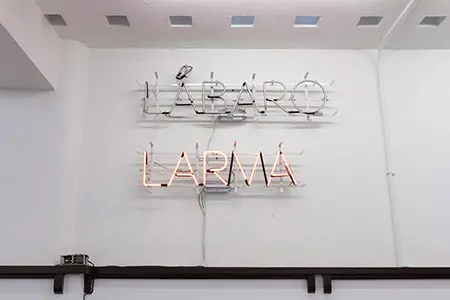
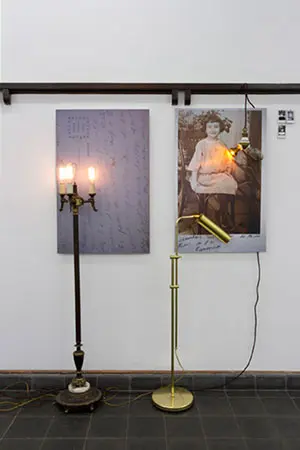
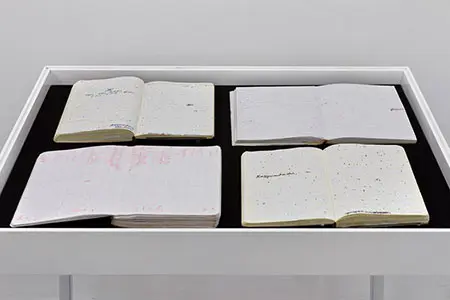
Fernando Mesta invited poet Luis Felipe Fabre to curate an unconventional exhibition for House of GAGA (which on its own right has stood out as an unconventional space in the Mexican art scene). The idea for the exhibition was, of course, Fabre's. He invited a diverse group of poets, including established authors Mónica Nepote, Luigi Amara, Enrique González-Martínez, Sergio Loo and Inti García-Santamaría, along with new luminaries like Daniel Saldaña and Alexander Tarrab. According to Fabre, the exhibition "arises from a series of discussions on systems and economies" according to which "loneliness and the crises of the worlds of art and poetry" reveal the "distance between them and how much, despite appearances, they need each other." Fabre invites all these poets, calls them artists, and explains that they "use words as their primary vehicle of expression" to project their materials onto the object. One of the questions Fabre poses is: to what extent of material density can a poem still be a poem? Mónica Nepote, who has worked in the past with multimedia proposals based on the poem (or poetry), expresses in a literal manner the tensions between incomparable and incompatible markets like the art market and that which she describes as "micromarket of poetry." Stock market indicators are projected on a screen accompanied by the soundtrack of a poem read aloud—that can be listened to with headphones. The piece was created in collaboration with Daniel Loustaunau and is called Efecto viral sobre la economía del lenguaje (Viral Effect on the Economy of Language). Nepote surrenders to the evidence— as she told VICE—that "salable or hit poetry "is not exactly the kind of poetry that one expects to put in crisis (...) the stability of a language (...) kidnapped by techno-mercantile agendas." In concrete terms, between economy, material density and communication channels between art and poetry, poets look to sell (themselves) as artists do and, to that end, emulate the formulas and exploit the channels that artists resort to in order to sell (themselves). Fabre complains about the symbolic value of poetry on paper money, "Sor Juana on the 200-peso bill, Netzahualcoyotl on the 100-peso bill, Octavio Paz on the 20-peso bill or coin: it is not a bad rating if one thinks about it. If it is true that time is money it is because with money one is able to buy time." She extends the premise of this symbolic value as a expense in her work entitled after a poem by Sor Juana: "¡Que dieran los saltimbancos, /a poder, por agarrarme / y llevarme, como Monstruo, /por esos andurriales / de Italia y Francia, que son / amigas de novedades / y que pagaran por ver / la Cabeza del Gigante, /diciendo: Quién ver el Fénix /quisiere, dos cuartos pague... What would the mountebanks not give / to seize me and display me / taking me round like a Monster / through byroads and lonely places / in Italy and France, which are / so fun of novelties / where the people pay to see / the giant head, / and crying: /If the phoenix you would view, / step up and pay two coins…). It is a somewhat obvious reference (but also a metaphor) to the mechanics of consumption: Sor Juana portayed as sphinx offers oracles in exchange for payment in coin. It would be interesting if Fabre took this sculpture/artifact to malls and documented the interaction with an audience outside of the art gallery. The exhibition was titled All Originals Will Be Destroyed (which is a promise but also a threat in the purest spirit of Cabaret Voltaire). It also includes poems by Ismaeil Velázquez-Juárez, Maricela Guerrero Jorge Solis-Arenazas, Rodrigo Flores-Sánchez and Xitlalitl Rodriguez—wo participates with a grotesque caricature of Demian Hirst, in which she underlined the&mdash...
Gallery