MuseumSeptember 20, 2019
Brazil's National Museum to reopen partially in 2022
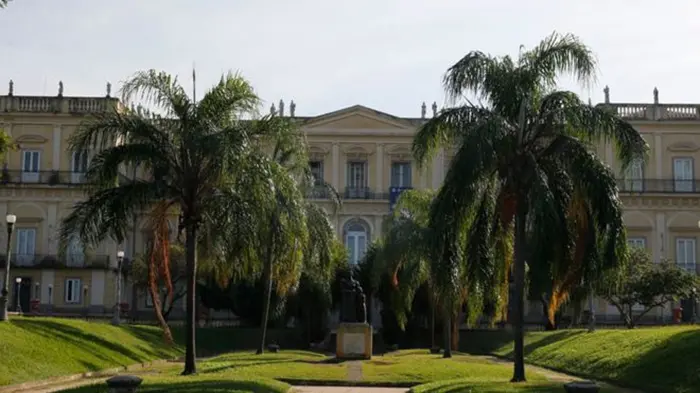
In a press conference held at the Brazilian Academy of Sciences nearly a year after the event, Denise Pires de Carvalho, President of Río de Janeiro’s Federal University, announced that the fire at the National Museum destroyed a significant portion of the collection, and that the institution expects to reopen one of its wings in 2022. The date was chosen to coincide with Brazil’s Bicentennial celebration.
To date, the museum has been able to raise 16,4 million for the reconstruction of this section, with funds coming mainly from the Brazilian government, institutions as Unesco, and the German government. The museum is faced with the added challenge of an $11 million budget cut ordered by the country’s president, Jair Bolsonaro.
After an exhaustive assessment of the loses, it is now known that 17 of the 34 collections were totally or partially destroyed in the fire. More than 2000 items were found in the wreckage, among them Luzia’s skull, the oldest human remains ever excavated in the Americas, dating from 11,500 ago, as well as fragments of a dinosaur skeleton that were among the museum’s most-visited exhibits, as reported by the Smithsonian Institution.
To date, the museum has been able to raise 16,4 million for the reconstruction of this section, with funds coming mainly from the Brazilian government, institutions as Unesco, and the German government. The museum is faced with the added challenge of an $11 million budget cut ordered by the country’s president, Jair Bolsonaro.
After an exhaustive assessment of the loses, it is now known that 17 of the 34 collections were totally or partially destroyed in the fire. More than 2000 items were found in the wreckage, among them Luzia’s skull, the oldest human remains ever excavated in the Americas, dating from 11,500 ago, as well as fragments of a dinosaur skeleton that were among the museum’s most-visited exhibits, as reported by the Smithsonian Institution.