ExhibitionOctober 15, 2023
ICA inaugurates Forecast Form: Art in the Caribbean Diaspora, 1990s-Today
On October 5, the Institute of Contemporary Art/Boston inaugurated the exhibition "Forecast Form: Art in the Caribbean Diaspora, 1990s–Today." The exhibit revisits issues of identity and difference, themes that have come to the forefront since decolonial theories and multiculturalism impacted diverse social identities, challenging the stereotypical perception of the Caribbean as an exotic tropical paradise.
The ICA exhibition brings together works by 28 artists living in the Caribbean or of Caribbean descent. In addition, the curatorial approach focuses on the concept of diaspora, which implies the dispersion of people due to migration, whether forced or voluntary. However, the exhibition problematizes this concept by understanding migration as a way of recognizing identity is constantly changing due to mobility and displacement. This exhibition challenges traditional ideas about the Caribbean, highlighting that its definition is not limited to geographic, linguistic or ethnic factors, but is characterized by constant exchange and movement.
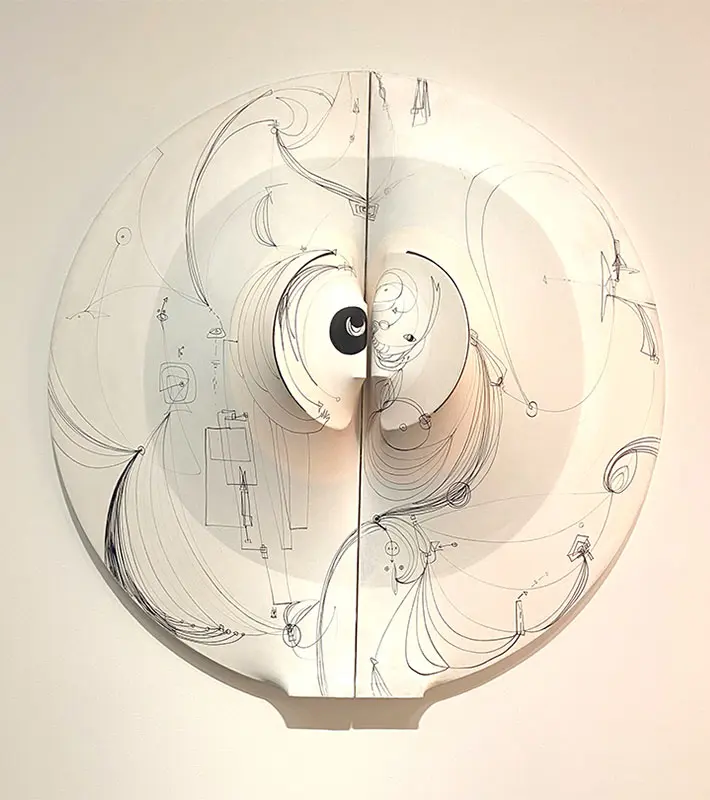
The exhibition is divided into six sections. The first one, "Territories," explores how the body is our first home and the bearer of our personal and collective stories. The artist Zilia Sánchez, whose works are in this room, declares, "I am an island," reevaluating her own body and identity through a sense of place. The second section is "Formal Rhythms," in which all the presented works suggest movement—not only by depicting or capturing bodies in motion but also by emphasizing movement through formal decisions, materials, and techniques. The third section is "Exchange," which delves into how historically, the Caribbean has been a site for cultural exchange and economic exploitation, from colonial-era plantations to today's tourism and petroleum industries that sustain the global economy. The fourth section is "Image-Making," where producing and reinterpreting archived images are significant ways to shape and preserve memory. Both photography and archival video serve this purpose, and artists often use them as starting materials to question dominant historical narratives. The fifth section is "Landscape." When thinking of the Caribbean, there's an imagery of lush, multicolored, and abundant tropical landscapes that often suppress painful and violent histories. Instead of conveying these stories through narrative modes, the artists featured in this section employ various techniques—often depicting the flora of a place, including trees and plants, as well as gardens—to reference the stories of colonialism, migration, and resource extraction. The last section, "Traces," speaks to how people and places evolve over time, leaving both visible and invisible traces. What traces remain of colonial histories, imprinted in the memories of bodies, places, and objects?
Some of the participating artists in "Forecast Form: Art in the Caribbean Diaspora, 1990s–Today" include Teresita Fernández, Álvaro Barrios, Daniel Lind-Ramos, Rubem Valentim, Adán Vallecillo, Ana Mendieta, Donna Conlon y Jonathan Harker, Félix González-Torres, Deborah Jack, Suchitra Mattai, Didier William, and Jeannette Ehlers. The exhibition was curated by Carla Acevedo-Yates, Curator of Marilyn and Larry Fields, with Iris Colburn, Curatorial Assistant, Isabel Casso, former Susman Curatorial Fellow, and Nolan Jimbo, Susman Curatorial Fellow. The exhibition was at the Museum of Contemporary Art Chicago from November 19, 2022, to April 23, 2023, and at the ICA Boston, it will be open to the public until February 25, 2024.
The ICA exhibition brings together works by 28 artists living in the Caribbean or of Caribbean descent. In addition, the curatorial approach focuses on the concept of diaspora, which implies the dispersion of people due to migration, whether forced or voluntary. However, the exhibition problematizes this concept by understanding migration as a way of recognizing identity is constantly changing due to mobility and displacement. This exhibition challenges traditional ideas about the Caribbean, highlighting that its definition is not limited to geographic, linguistic or ethnic factors, but is characterized by constant exchange and movement.
The exhibition is divided into six sections. The first one, "Territories," explores how the body is our first home and the bearer of our personal and collective stories. The artist Zilia Sánchez, whose works are in this room, declares, "I am an island," reevaluating her own body and identity through a sense of place. The second section is "Formal Rhythms," in which all the presented works suggest movement—not only by depicting or capturing bodies in motion but also by emphasizing movement through formal decisions, materials, and techniques. The third section is "Exchange," which delves into how historically, the Caribbean has been a site for cultural exchange and economic exploitation, from colonial-era plantations to today's tourism and petroleum industries that sustain the global economy. The fourth section is "Image-Making," where producing and reinterpreting archived images are significant ways to shape and preserve memory. Both photography and archival video serve this purpose, and artists often use them as starting materials to question dominant historical narratives. The fifth section is "Landscape." When thinking of the Caribbean, there's an imagery of lush, multicolored, and abundant tropical landscapes that often suppress painful and violent histories. Instead of conveying these stories through narrative modes, the artists featured in this section employ various techniques—often depicting the flora of a place, including trees and plants, as well as gardens—to reference the stories of colonialism, migration, and resource extraction. The last section, "Traces," speaks to how people and places evolve over time, leaving both visible and invisible traces. What traces remain of colonial histories, imprinted in the memories of bodies, places, and objects?
Some of the participating artists in "Forecast Form: Art in the Caribbean Diaspora, 1990s–Today" include Teresita Fernández, Álvaro Barrios, Daniel Lind-Ramos, Rubem Valentim, Adán Vallecillo, Ana Mendieta, Donna Conlon y Jonathan Harker, Félix González-Torres, Deborah Jack, Suchitra Mattai, Didier William, and Jeannette Ehlers. The exhibition was curated by Carla Acevedo-Yates, Curator of Marilyn and Larry Fields, with Iris Colburn, Curatorial Assistant, Isabel Casso, former Susman Curatorial Fellow, and Nolan Jimbo, Susman Curatorial Fellow. The exhibition was at the Museum of Contemporary Art Chicago from November 19, 2022, to April 23, 2023, and at the ICA Boston, it will be open to the public until February 25, 2024.